In February 2026, Anshul approached the Shumei Natural Farming team to better understand their philosophy and practices. A series of exchanges led to a visit to AuroOrchard by Kenichi-san and Vishal from the Shumei India team, based in Mumbai. During their visit, they introduced the farm team to Shumei’s philosophy and approach to natural agriculture.
As a step towards exploring this approach more deeply, AuroOrchard offered to host trials of Shumei natural farming. Anshul also met with Shumei practitioners online to learn more about their experiences and how they put the philosophy into practice.
The intention behind these exchanges is to learn from Shumei’s philosophy and methods, explore their relevance to the farm, and see how agriculture in Auroville can continue to develop through dialogue with ideas and practices from across the world.
Shumei is a spiritual organisation founded in Japan in 1970. We have three main practices – Jyorei healing, the appreciation of art and beauty, and natural agriculture – for the creation of a world free from sickness, poverty, and strife. As we share the ideal of Sri Aurobindo, human unity, we strive to hold hands despite our differences, for future generations – aiming to become “World Citizens”.
This farming method was discovered by Mokichi Okada in Japan, who is the founder of Shumei. Realising that pesticides and fertilizers harm the body, he experimented with this farming method – having deep respect and concern for nature. After the success of the experiment, this farming method has been spreading ever since. Now there are many farmers throughout the world, especially in Japan, who practice this method, achieving wonderful results. The quote below by Mokichi Okada is the discoveries of this experiment.
“Used over a period of time, there will not be any need to spend money on fertilizers. Pest damage, such as from insects or parasites, will be reduced to a fraction of what it is now, and damage from wind and water will decrease by more than fifty percent.
Also, especially noteworthy is the delicious flavor of the crops grown by this natural approach. Once you taste the rice, wheat, and vegetables grown in this manner, you will become unwilling to eat anything grown with the aid of fertilizer. Fruit also improves greatly in quality after one stops giving the plant or tree man-made fertilizer. The blooms of flowering plants also grow larger and more beautiful, and if they are used for ikebana (the Japanese art of flower arrangement), they do not wither for a long time—a feature which brings much pleasure.
The Natural Agricultural approach also brings a drastic decrease in the amount of insect damage. Noxious insects increase as a result of an increase in the use of fertilizers, and it is therefore only natural that if we get rid of the fertilizers, the pests will go with them.”
Seen from the discovery above, almost every aspect of crops and even flowers have a drastic improvement when it is practiced through natural agriculture. Next is the reasoning of the decrease of pest damage and the improved roots of natural agriculture plants.
“Damage from wind and water occurs almost every year. If you use the Natural Agricultural methods, you will find that this damage decreases noticeably. This is because when the original crops absorb fertilizers, they become extremely weak from the poisoning caused by the absorption of these fertilizers. I have also discovered that this poison provides an attractive diet for pests. Furthermore, these pests can actually be generated by fertilizers, and then, of course, they eat the crops and multiply. Once they appear in the roots, these pests are sure to devastate the root hairs and leave the plant weak and sickly. This process is the cause of withered leaves, drooping or bent stalks, falling blooms, fruit that does not ripen, and such things as yellow dwarf potatoes.
Many types of pests also establish themselves in places other than root hairs, but a healthy plant has the capacity to overcome them. If, however, the plant has been weakened by absorbing fertilizer, it is too feeble to resist and is destroyed. When a naturally grown plant encounters wind and rain, it is tough enough to resist being beaten down. The reason for the difference is obvious if we examine the roots. The natural plant has root hairs that are longer and thicker than those of the fertilized plant, and as a consequence are more firmly rooted.”
Here is an argument by Mokichi Okada regarding soil and fertilisers.
“One point I must stress concerns the properties of the soil. Soil was made by the Creator in order to produce crops to nourish and sustain humans and animals. Therefore, its essential nature is that of a fertilizer. We could even say that it is no less than a great mass of fertilizer. This fact has been unknown before today, and people have mistakenly assumed that fertilizer provides nourishment to crops, and therefore have used all sorts of fertilizers. As a result, the essential nature of the soil has been almost destroyed.
Consequently, if you want to increase crop yield, you must strengthen the soil itself as much as possible. To do this, you must avoid mixing anything impure into the soil; you must use only natural compost. That is, you must purify the soil as much as possible, and this will be enough to ensure wonderfully good results. This approach is so revolutionary that a mind sucked in the past can never grasp it.”
“The center of the earth is a huge ball of fire that is constantly radiating heat—that is spirit—to the surface. This takes the form of nitrogen, a natural fertilizer given to us by God. It rises up through the surface of the earth and gathers at a certain height in the air, after which it is carried down by rain and soaks into the soil. This natural nitrogen fertilizer falls, as it were, from the sky, and is of course completely adequate in quantity. It is never too much and never too little.”
Like organic farming, plant mulching is also encouraged. But in natural agriculture, we don’t treat it as a nutrient – we use it to keep the soil moist, warm, and compact. Here’s his argument regarding this with an example of rice plants.
“See how the soil is covered in a deep rich blanket of withered grasses and dead leaves as autumn deepens into winter every year. This blanket is there to make the soil fertile, and this is what we should make the natural compost from. You may think that natural compost supplies nutrition to crops, but this is by no means the case. The essential effect of natural compost is to keep the soil moist, to warm it and keep it from becoming compacted. Thus, the soil absorbs heat and water, and does not become hard. In giving natural compost to rice plants, you should cut the rice-straw very fine and knead and mix it thoroughly into the soil—this is the natural way. This type of straw is a product of the rice plant and therefore is effective in warming the plants’ roots. It is clear that the withered grasses and leaves of autumn are the best natural compost for vegetables. As there is always a forest or wood near where vegetables grow, nature obviously intends for its leaves and grasses to be used as compost.”
We also encourage continuous cropping – the practice of continuously farming the same crop on the same field. We believe the soil adapts to what it grows, making the crop quality improve gradually. Spirituality is also practiced as one of the main factors of this method. We believe that the soil is living and has feelings just like humans, so we are encouraged to have a pure heart when practicing. Our thoughts, feelings, and words have a great effect on the soil and crops. We treat our crops as living beings, taking care with love.
The core principle of this method is as below, with an explanation.
“Thus, the principle of Natural Agriculture is an overriding respect and concern for Nature. Nature teaches us everything. All the manifestations of nature are created and formed from the three basic elements: fire, water, and earth, which, respectively, correspond to the spirits of the sun, the moon, and the earth. You will find the truth of this the more you examine the myriad wonders of nature. Crops, of course, are no exception. If they get enough sunlight, if their water supply is adequate, and if the soil they grow in is pure, there will be enough crops to satisfy the needs of humanity, and even a surplus.”
But there is something to keep in mind when starting natural agriculture. Below is a quote regarding this.
“Let me caution you about one thing. Even when you have completely changed over to Natural Agriculture, hidoku (poisonous effects of fertilizers) that are sure to remain to a greater or lesser extent in the soil, as well as the remaining seeds, will continue to have a great influence. If your initial results are very poor, this is because there is still a great amount of man-made fertilizer remaining in the field. To remedy this situation, you should mix this soil with pure soil brought from somewhere else.”
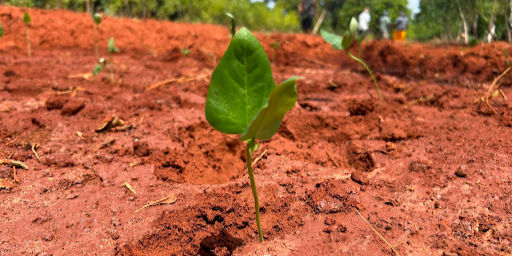
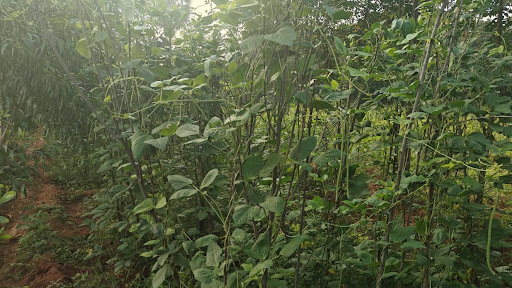
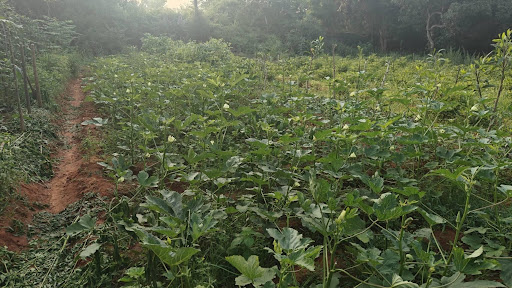
We started this experimental farm at the beginning of July with long beans, ladyfingers, and brinjal using the seeds provided by AuroOrchard. We first sowed the seeds on a seed tray inside a greenhouse. By the end of July, the long beans and ladyfingers were ready to be planted on the experimental farm, which is two fields, each measuring 30 meters by 5 meters. The brinjal took a little more time to grow and was planted around the end of August. We’ve planted long beans on one field, brinjal and lady finger on the other.
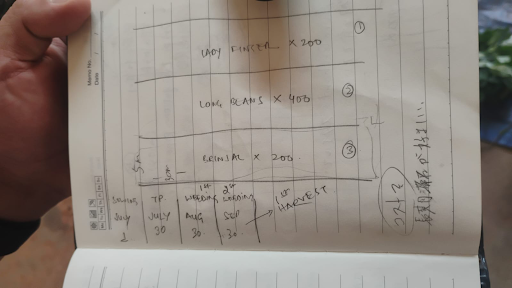
The initial plan for the experiment made in May 2026
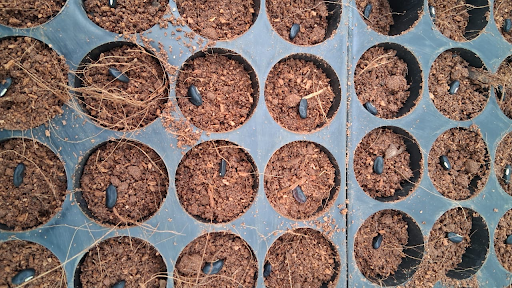
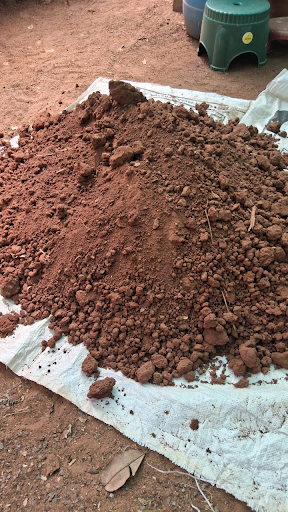
AuroOrchard usually uses a mix of garden soil and compost for its nursery soil. For these experiments, only garden soil was used.
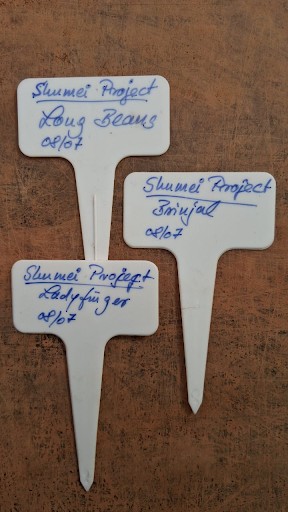
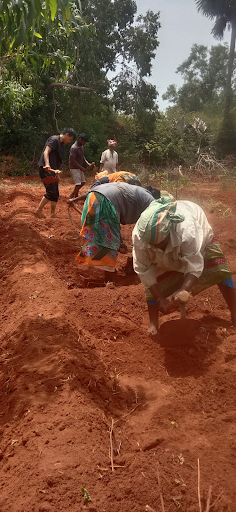
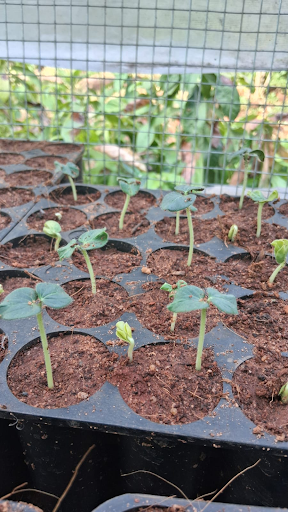
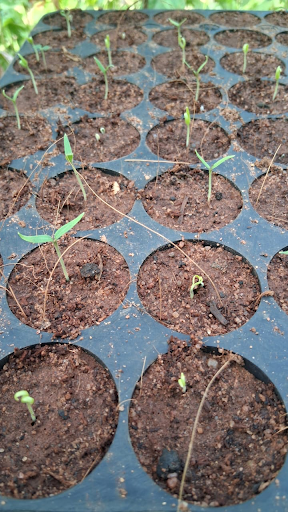
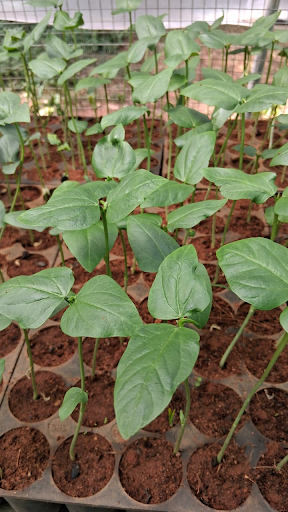
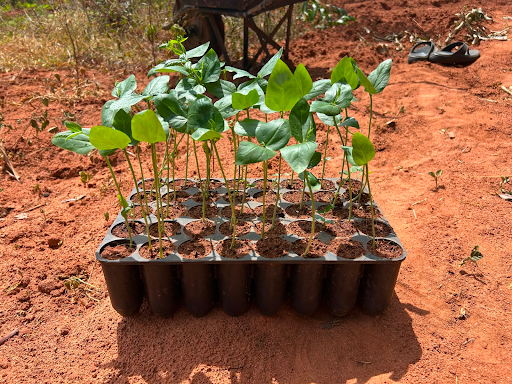
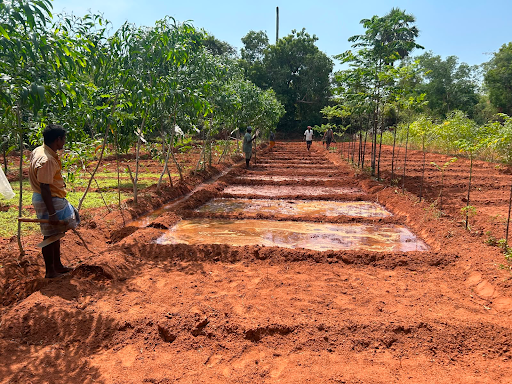
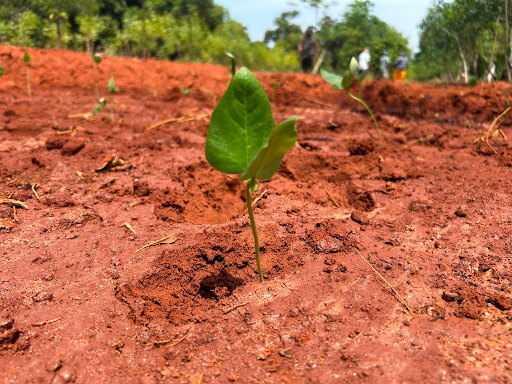
In the middle of September, the ladyfingers started to grow and the flowers of the long beans started to bloom. The brinjal is growing finely also. The farm hasn’t faced much pest damage and it’s doing well overall. We will have to temporarily finish up the farm before November due to the monsoon. After monsoon, we would like to start this experimental farm again, possibly farming the same crops as before, as a practice of continuous cropping.
There is an interesting kind of “energy test” that demonstrates the difference between conventional, organic, natural agriculture seeds, etc. In this test, there needs to be at least two people. One has to hold the seed with his or her arms straight down, hands together, legs straight, and feet completely together. The other has to push the hand holding the seed downward as hard as possible. Depending on the farming method of the seed, the strength of the person holding it will vary. In most cases, the people holding the conventional seeds crumble when they are pushed, while those holding the natural agriculture seed barely move, or not at all. This experiment can be done by not only seeds, but with vegetables or leaves as well.
This test shows a difference between the seeds grown by different farming methods. As of now there is no scientific evidence of what is going on in this test, but people who hold seeds with chemicals and pesticides usually crumble. Perhaps there is a difference in the “energy” of the conventional and natural agriculture seeds.
We tried our first “Energy Test’’ and taste comparison of the ladyfingers on the 24th of September, with one staff member and two volunteers. Since the project started only a few months ago, I thought there wouldn’t be much difference in the taste or ‘energy’, but to my surprise, they immediately knew the difference in both tests. In “Energy Test”, they were all surprised by the difference in their strength when being pushed. They unknowingly tasted each and figured out which was which. The staff member made an observation that the natural agriculture one was more dense in terms of texture and the seeds were bigger. One of the volunteers noticed the fuzz of the organic one was more poky. I also noticed a difference – the natural agriculture one had a more gentle taste compared to the organic. As time progresses, there should be more concrete differences, which we hope to share in the near future.
Before coming to AuroOrchard, I was raised in an environment that was mostly part of Shumei. Practicing organic farming instead of Natural Agriculture and being part of a community besides Shumei was a new experience for me. This experience made me discover the differences between Natural Agriculture and Organic farming more clearly. Before then, I only knew the differences from texts, but never really experienced what it is, and I feel lucky to be able to do so. During my month in AuroOrchard, I heard some stories about conventional farmers in India struggling due to the high costs of pesticides and some other adversities, which opened my eyes to what modern farming has come to.
Being part of a community, especially AuroOrchard, which I think is more of an international community due to the fact that there are people from all over the world who come to learn the methods here, was a very interesting experience. Seeing people come to a community from other countries to learn about something new made me wonder, despite our differences, at the end of the day, we seek one thing – something better for ourselves and others. Volunteering in AuroOrchard was also a learning experience of getting along with people of completely different backgrounds. It made me realise the importance of communication, the skill of expressing yourself.
I truly believe natural agriculture tackles the core problems that conventional and organic farmers face. This method avoids the problems conventional farming faces, such as damaging the soil through the use of chemicals, high fertilizer costs that can lead to debt, and more. Less labor is required because this method does not use animal manure, which organic farming requires, creating the capacity to grow more crops. I myself am not a farmer and was not aware of the problems farmers today struggle with. Hearing stories of farmers facing adversity and experiencing organic farming brought to my attention what farmers have to deal with, which I was blind to. My experience at AuroOrchard made me believe that natural agriculture can solve these problems also. I hope this farming method can shine a light in their heart that brings ease and joy.
During my time at AuroOrchard, surrounded by the beauty of nature, I felt truly grateful for the opportunity to work with my hands and body in the fields alongside local volunteers and staff. Through hands-on experience in preparing the land, weeding, transplanting, watering, and harvesting, I was able to learn about the basic processes involved in growing crops. Experiencing each step myself gave me a much deeper understanding and appreciation of agriculture. What impressed me most was the sense of energy and vitality I received from the field itself. There were times when, after several consecutive days of farm work, I felt physically tired or lacked energy. However, the moment I stepped into the field, I felt the heaviness in my body gradually disappear. I was able to engage in the work with renewed energy, concentration, and a sense of vitality. This was a very surprising and meaningful experience for me.Through this experience, I began to feel more deeply that crops are living beings, just as we are, and that our own lives are sustained by the lives of these plants. This realization made me look at agriculture and the relationship between people, nature, and food from a different perspective.
I was also deeply moved by the sight of the young plants we had transplanted. Although they were still small, they had already begun to put down their roots firmly into the earth and reach upward toward the sky. There was something very beautiful and powerful in seeing them grow. I am sincerely grateful to everyone at AuroOrchard and to the team members who shared this experience with me. This time in the field has given me not only practical knowledge of agriculture, but also a deeper appreciation for nature, life, and the connection between people and the earth.
Masanobu Fukuoka’s Natural Farming was one of the first ideas I had come across when I began my journey with agriculture 13 years ago. I was deeply inspired by the notion of doing nothing– imagining an agriculture which runs on its own. The experience of last 13 years has shown me that sadly there is nothing called natural farming–farming itself is not natural. Of course, in this context the natural farming approaches mean farming close to natural processes– but I think it is important to make that distinction–at least for me it has been important to understand that basic tenet in my work.
Irrespective, I am interested in different farming approaches that go beyond the physical solutions of crop management. This was my motivation to connect with the Shumei foundation–to understand their method and put it to test in our conditions. As a researcher in agriculture, I also remain skeptical of approaches which may claim high spiritual foundations without being rooted in real-life work. To be able to build this work in AuroOrchard, therefore it has been important for me to run these researches with transparency, with information and some level of scientific repeatability. The last part is always hard on the farm with so many variables and people involved.
AuroOrchard currently depends heavily on dung from the cows, chickens and at times even outside (horses etc. from within Auroville). Can we transcend this dependence? What would that need? This is an important question that we need to reflect on in the coming years as we plan to make our farming more intensive.
I am grateful to Kenichi san, Vishal, Junta and Sean for this partnership, for this multiple visits, and approaching these experiments with openness and the curiosity to learn together. We will continue the experiments after the monsoon. This time with a better organisation. The initial results are already quite encouraging and allow us to question why we do what we do. I am not attached to any particular idea or school of farming but my hope is that through these experiments we will open up a new line of conversation around farming in Auroville- the involvement of consciousness in working with the land–and how we can intentionally put that to work–considering the material approaches have hit a wall, and remain limited despite years of work.
Join our newsletter for exclusive updates!
AuroOrchard is certified organic by the Tamil Nadu Organic Certification (ORG/SC/1906/001683) Department accredited by APEDA (Agricultural and Processed Food Products Exports Development Authority), New Delhi, Ministry of Commerce and Industry, Government of India.
AuroOrchard Poultry is recognised under the Certified Humane Program, a globally recognised, independent, international auditing body dedicated to creating a more humane world for farm animals.