Certified Humane International program …
We have been working on this certification for the last 6 months, and our poultry has gone through significant improvements with support from a wonderful pool of resource people who deeply care about ethics of animal care in agriculture. This ce Home » Blog » Certified Humane International program for the Poultry Certified Humane International program for the Poultry March 2026 · Anshul Aggarwal AuroOrchard has just completed the certification process of the Certified Humane International (CHI) program. We have been working on this certification for the last 6 months, and our poultry has gone through significant improvements with support from a wonderful pool of resource people who deeply care about ethics of animal care in agriculture. This certification is quite stringent with a great deal of paperwork, in-person inspection and annual audits. The CHI standards are quite extensive and detailed and have given us a strong foundation and reference to build on. You can read more about CHI standards here. This process has also helped us know more about the conversation on ethical poultry farming in the world, and how different farmers around the world are practicing this in their own ways based on their context and resources. While the certificate in itself is not a big achievement, it affirms our commitment to an unending pursuit of growing the highest quality food for Auroville. Our sincere gratitude to our wonderful community for their support and encouragement in doing this work. You can find some answers to common questions on AuroOrchard eggs here. Previous Article Featured Articles Monthly Updatesㅤㅤㅤㅤㅤㅤㅤㅤ 25 Mar 2026 Year-end updatesㅤㅤㅤㅤㅤㅤㅤㅤ 20 Dec 2025 Certified Humane International program … 27 Mar 2026 Time to Summernate: Ayurveda Healthy Tips by 26 Mar 2026
Frequently Asked Questions about Eggs
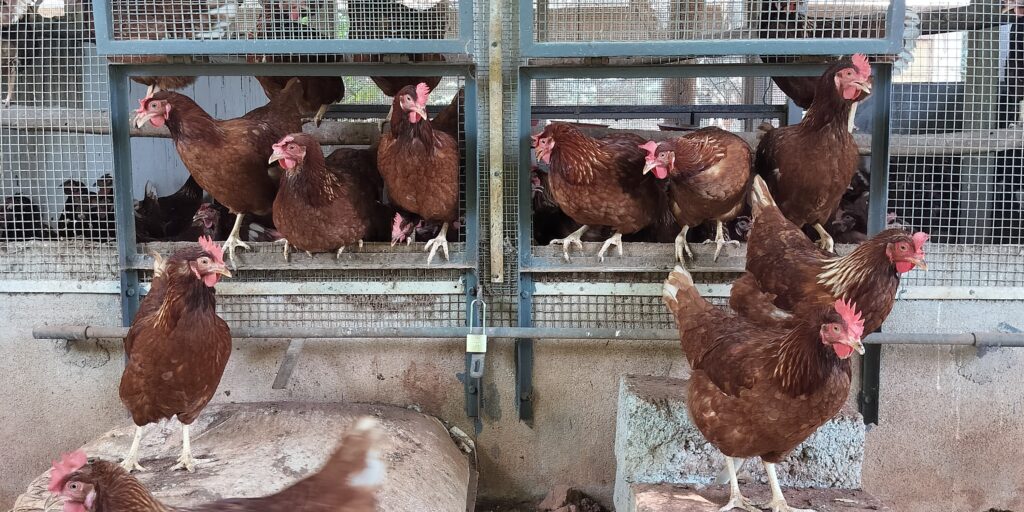
Previously, I wrote about the dilemmas of working with animals in agriculture, emphasising that the question is not so much whether to work with animals, but how to do so responsibly. Our poultry raises many of these questions, and none of them have simple or fixed answers. We are discovering what is possible today, while also reflecting on what the ideal might be for animals in agriculture in Auroville. Home » Blog » Frequently Asked Questions about Eggs from AuroOrchard Frequently Asked Questions about Eggs from AuroOrchard February 2026 · Anshul Aggarwal Previously, I wrote about the dilemmas of working with animals in agriculture, emphasising that the question is not so much whether to work with animals, but how to do so responsibly. Our poultry raises many of these questions, and none of them have simple or fixed answers. We are discovering what is possible today, while also reflecting on what the ideal might be for animals in agriculture in Auroville. This post responds to questions we have received over time from community members and visitors about our poultry and eggs. If you have further questions, please write to us at auroorchard@auroville.org.in, and we will include them here. What do terms like caged, cage-free, and free-range mean? These terms describe how birds live: Caged systems keep birds in small cages with very limited movement. Cage-free systems remove individual cages but usually keep birds indoors in large sheds. Free-range systems, like ours, allow birds regular outdoor access where they can walk, forage, scratch, and dust-bathe in sunlight and fresh air. Each system reflects different priorities— efficiency, space, labour, and care. How is free-range different from organic? Free-range describes how birds live (access to outdoor space, ability to forage and express natural behaviours). Organic describes what goes into the system, especially feed and inputs. In most organic standards, birds must also have outdoor access, but “free-range” eggs are not necessarily organic unless the feed and inputs meet organic requirements. What kind of poultry system does AuroOrchard follow? AuroOrchard follows a free-range, pasture-based approach integrated with the orchard. Birds live outdoors for much of the day and are rotated through designated areas. Poultry is part of the farm ecology, contributing to nutrient cycling, composting, and soil health, and is not treated as a standalone “production unit”. What is the origin of the concept of ‘free-range’? Traditional agricultural communities naturally followed the free-range poultry system where chickens ran around the yards around the house. This changed drastically across the world as agricultural production became more organised, mechanised, and industrialised. The modern concept of “free-range” arose in the mid-20th century after the Second World War, particularly in the United States and Europe, as poultry farming became industrialised and egg and meat production shifted toward: Battery cages Indoor confinement High stocking densities Controlled lighting and feed Maximum output per bird These systems prioritised efficiency over natural behaviour. “Free-range” developed as a counter-term, meant to distinguish birds that were not permanently confined indoors or in cages, for regulatory and marketing distinction. As a regulatory and market label, “free-range” generally means: The hens are not kept in cages or indoor confinement. They have access to space to roam, graze, and engage freely with their environment having a greater contact with sunlight, fresh air, and soil. Free-range systems promote: Behavioural freedom and enrichment (Hartcher & Jones, 2017) Because these birds live as birds should, many community members report a richer flavour than the ones produced in factory conditions (Comparison of AuroOrchard eggs with Pondy eggs). What free-range standards does AuroOrchard follow? We follow Certified Humane standards, which are among the most comprehensive and widely-recognised animal welfare standards for laying hens globally, and we undergo annual audits. AuroOrchard (per 100 birds) Certified Humane Standard (per 100 birds) Indoor Space 15 sq. m. 14 sq. m. Outdoor Space 200 sq, m. 19 sq. m. Outdoor time 6 hours (10 am to 4 pm) 6 hours Indoor Perching Space 17 m 15 m Nesting area 2 sq. m. 0.8 sq. m. Feeder space 4 m 4 m Drinker space 2 m 2 m Other specific details about lighting, daily care, biosecurity, record maintenance for better follow up, egg collection and sorting standards etc. can be found here. What do the birds eat? The birds have access to a feeder where they can eat anytime during the day. The feeder is refilled twice a day in the morning and the afternoon. This feed is bought from commercial feed suppliers. We have tried to get the exact composition of the feed but none of the feed suppliers give this information. Instead, they have given us a general nutritional profile: Crude Protein: 16–18% Crude Fat: 2.5–5%Crude Fibre: 4–7% Metabolizable Energy: 2,600–2,800 kcal/kgCalcium: 3.5–4.5%Available Phosphorus: 0.35–0.50 The supplier has also assured us that the feed is free from any avian- or mammalian-derived protein, and any growth promoters and sub-therapeutic antibiotics. In addition, the birds are also fed daily with a diversity of green leaves (Moringa, Papaya, Wild Tamarind etc.). The birds also eat wild grasses, worms and everything else that they forage in the free range. Why doesn’t AuroOrchard produce its own poultry feed? While this would be ideal, AuroOrchard doesn’t grow grains and does not have the right soil conditions and is set up to do so. If we buy grains from other farms, the feed cost will be very high and will immediately affect the price of the egg. We have been exploring (without much success though) if we can get someone to make the feed for us so that we can ensure what exactly goes into the feed. Are AuroOrchard eggs organic? No. We do not claim that the eggs are organic. Since the feed is bought from outside and we have no way to say with 100% certainty that this feed is organic, we cannot say that the eggs are organic. Most likely, the grains used by commercial feed suppliers are grown in the so-called conventional manner. Are antibiotics or hormones used?
The Dilemma of Animals in Agriculture
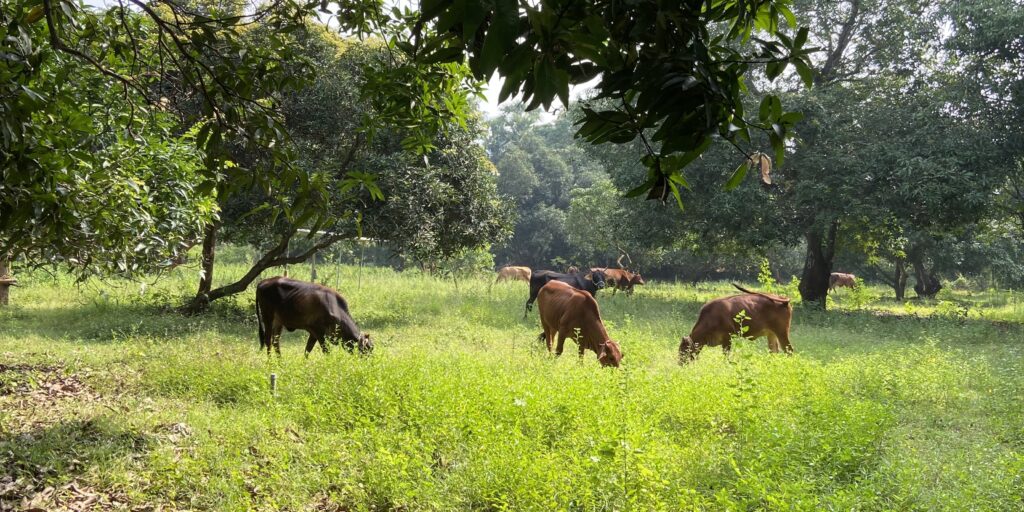
We would not need to go hunting for our connection to our food and the web of life that produces it. We would no longer need any reminding that we eat by the grace of nature, not industry, and that what we’re eating is never anything more or less than the body of Home » Blog » The Dilemma of Animals in Agriculture The Dilemma of Animals in Agriculture December 2025 · Anshul Aggarwal “We would not need to go hunting for our connection to our food and the web of life that produces it. We would no longer need any reminding that we eat by the grace of nature, not industry, and that what we’re eating is never anything more or less than the body of the world. I don’t want to have to forage every meal.” — Pollan, M., The omnivore’s dilemma: A natural history of four meals (2006), p. 378 According to analyses by the Sentience Institute (USA), over 90% of farmed animals globally are living in inhumane facilities known as “factory farms” at present. The intensive confinement of animals on these farms leads to a range of psychological and physical health problems, and many of these animals endure painful deaths on account of health complications caused by their breeding or environment. Some animals are debeaked, castrated, or mutilated in other ways without anesthesia. The stunning methods used to knock some animals unconscious before slaughter fail regularly, and errors on industrial slaughter lines result in atrocities such as nearly one million birds being boiled alive every year. Nearly all fish die by being painfully suffocated and crushed by other fish in nets that pull them out of the water. Of all land animals in factory farms, over 60% are chickens raised for meat, about 30% are chickens raised for eggs and about 10% are cattle, sheep and pigs. Large international surveys indicate that the vast majority of the global population— approximately 86–92% — consumes meat or other animal-based foods with only a small share identifying as vegetarian or vegan (Statista (2023); Ipsos (2018)). Global meat production has more than doubled since 1961 (OWD) and animal based protein makes up about 20% of the global diet (OWD). In a world where global demand for animal protein seems to be rising (OECD-FAO, (2025)), how can we reconcile the massive impact that animal farming has on animals as well as on our ecology and environment? Scientific evidence shows that humans started settling down as agricultural civilisations over ten thousand years ago. This move represents an important change for humanity from the wilderness of nature to an intentional participation with nature. It marks a separation of humanity from the forests, pointing to a self-discovery within the collective context of a polis. And animals like chickens, sheep, goats, cows and horses followed the humans into this agricultural polis–they became domesticated. What emerged was not merely a technical shift in food production, but a deep transformation in the human–animal relationship. For instance, the horse and the cow, especially in the Indian culture, represent power and knowledge respectively, the symbols of human evolution from the unconscious vital towards a great consciousness of self-reflexivity. They become important symbols of vedic rituals as well as metaphors of self-transcendence. Humans and animals have, therefore, shared a long domestic relationship of mutual interchange in the form of care and food, as well as a deep spiritual kinship. However, as agriculture becomes industrialised, this relationship of care has turned into a relationship of extraction–beings have turned into resources– only to be exploited for human consumption. Today, amidst multiple schools of farming and food possibilities, the farmers face the following challenges: “We would not need to go hunting for our connection to our food and the web of life that produces it. We would no longer need any reminding that we eat by the grace of nature, not industry, and that what we’re eating is never anything more or less than the body of the world. I don’t want to have to forage every meal.” — Pollan, M., The omnivore’s dilemma: A natural history of four meals (2006), p. 378 According to analyses by the Sentience Institute (USA), over 90% of farmed animals globally are living in inhumane facilities known as “factory farms” at present. The intensive confinement of animals on these farms leads to a range of psychological and physical health problems, and many of these animals endure painful deaths on account of health complications caused by their breeding or environment. Some animals are debeaked, castrated, or mutilated in other ways without anesthesia. The stunning methods used to knock some animals unconscious before slaughter fail regularly, and errors on industrial slaughter lines result in atrocities such as nearly one million birds being boiled alive every year. Nearly all fish die by being painfully suffocated and crushed by other fish in nets that pull them out of the water. Of all land animals in factory farms, over 60% are chickens raised for meat, about 30% are chickens raised for eggs and about 10% are cattle, sheep and pigs. Large international surveys indicate that the vast majority of the global population— approximately 86–92% — consumes meat or other animal-based foods with only a small share identifying as vegetarian or vegan (Statista (2023); Ipsos (2018)). Global meat production has more than doubled since 1961 (OWD) and animal based protein makes up about 20% of the global diet (OWD). In a world where global demand for animal protein seems to be rising (OECD-FAO, (2025)), how can we reconcile the massive impact that animal farming has on animals as well as on our ecology and environment? Scientific evidence shows that humans started settling down as agricultural civilisations over ten thousand years ago. This move represents an important change for humanity from the wilderness of nature to an intentional participation with nature. It marks a separation of humanity from the forests, pointing to a self-discovery within the collective context of a polis. And animals