Discovering Farm Work and Adapting to a New Environment
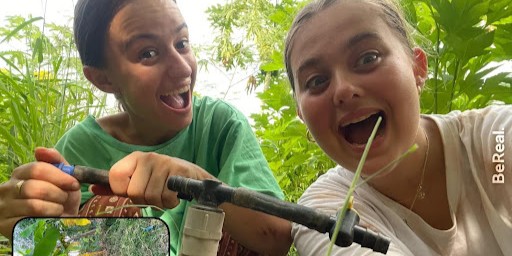
During my first few weeks at AuroOrchard, I discovered agricultural work through a variety of activities in the Vegetable Garden and the orchards. These first days allowed me to become familiar with the daily Home » Blog » Discovering Farm Work and Adapting to a New Environment Discovering Farm Work and Adapting to a New Environment November 2026 · Alexandra Gafilet During my first few weeks at AuroOrchard, I discovered agricultural work through a variety of activities in the Vegetable Garden and the orchards. These first days allowed me to become familiar with the daily life of the farm while gradually adjusting to the Indian climate and a different pace of life. I mainly took part in weeding around young eggplant plants and between rows of spinach. Once the rows had been weeded, I helped spread compost over the crops. As I had only just arrived in India, it took me some time to get used to the temperatures and working conditions. At times, it was difficult to manage a full day of work, but I knew my body needed time to gradually adapt to this change. I also learned how to care for eggplant plants by removing certain leaves to encourage their growth and cutting off those that showed signs of infection. These first tasks helped me understand that agricultural work is not just about planting and harvesting. It also requires observation, patience and regular maintenance to ensure that plants can grow in good conditions. I then joined the Orchard team, working in the jackfruit orchards and around the papaya trees. The activities there were different from those in the Vegetable Garden. I helped cut branches and clear certain areas around the trees. This variety allowed me to discover different aspects of agricultural work and better understand the specific needs of each area of the farm. I appreciate this diversity. Although some tasks, such as weeding, require time and repetition, I find it more motivating to be able to vary my activities, change my surroundings and learn new techniques. This helps me stay curious and gain a better understanding of how the farm operates as a whole. Discovering a Different Approach to Farming Working at AuroOrchard is also allowing me to discover agricultural practices that differ from those I am familiar with. Farming methods depend, in particular, on the climate, the environment and the choices made by each farm. At AuroOrchard, the organic approach places considerable importance on natural methods for maintaining crops and managing the problems that arise. This involves observing plants carefully, identifying signs that may indicate a problem and looking for suitable solutions without necessarily resorting to synthetic chemical products. I find it interesting to discover this different approach to agriculture. It encourages us to understand plants and their environment better rather than systematically looking for an immediate solution. I am still at the beginning of this learning process, but the explanations provided by the team are already helping me understand some of its basic principles. Learning by Doing and Finding Solutions One of the aspects I particularly appreciate about this experience is the opportunity to develop practical skills. I am discovering a field I knew very little about, where I need to learn how to observe, handle new tools and find solutions to the difficulties I encounter. I learned how the farm’s irrigation system works and took part in some repairs. This involved cutting pieces of pipe, finding the right connectors and understanding how to get the system working again. I learned by working alongside Nidin, which helped me better understand the different steps and how to carry them out. I enjoyed this very practical approach because it allows me to understand something by actually doing it. Rather than simply listening to an explanation, I get to handle equipment, test things out and work out how to solve a real problem. These experiences have shown me that it is possible to learn a great deal even when starting from scratch. You have to accept that you will not know everything straight away, take the time to understand and be willing to give things a try. As I take on different tasks, I am gradually becoming more confident and discovering that I can find my own way through certain situations. I have also come to understand that being independent does not necessarily mean doing everything alone. It also means knowing when to ask for help, listening to other people’s advice and looking for the information you need to move forward. It is a balance between what we learn from the people around us and what we are then able to put into practice ourselves. Beyond agricultural work, this experience is encouraging me to become more resourceful and approach unfamiliar situations with greater curiosity. Encounters and Conversations: Another Way of Learning Agricultural activities are not the only things that have shaped these first few weeks. Encounters and conversations also play an important role at AuroOrchard. I have had the opportunity to talk with people whose backgrounds, ideas and ways of seeing the world are sometimes very different from my own. Everyone has their own story and their own reasons for being here. I find it enriching to discover what has led these people to live or work in this environment. Our conversations sometimes go beyond everyday exchanges. We talk about our experiences, our choices, our relationship with work and what gives meaning to what we do. These discussions allow us to discover different perspectives and sometimes question ideas we had previously taken for granted. Some conversations lead me to reflect on the place of work in our lives, while others explore our motivations or the way we want to organise our daily lives. I have also noticed a particular spiritual dimension in this environment. I cannot quite explain it yet, but it is part of what I am discovering here, particularly through the people I meet, the intentions they bring to their work and the conversations
Nasa Tul: An indigenous perspective…
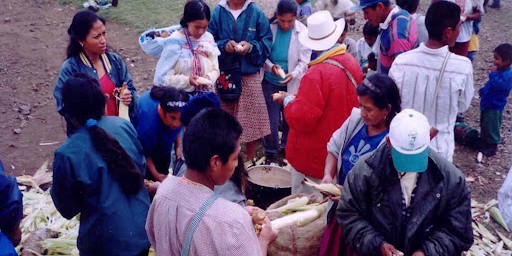
Recently, I had the opportunity to collaborate with Colombian biologist and researcher Lucía Vásquez Celis on a booklet about the Tul, or Nasa Tul, for Colombia’s Land Restitution Home » Blog » Nasa Tul: An indigenous perspective on agriculture from Colombia Open Learning Sessions at the farm Nasa Tul: An indigenous perspective on agriculture from Colombia September 2026 · Anshul Aggarwal Recently, I had the opportunity to collaborate with Colombian biologist and researcher Lucía Vásquez Celis on a booklet about the Tul, or Nasa Tul, for Colombia’s Land Restitution Unit. Lucía has many years of experience engaging with the Indigenous peoples of Colombia and their territorial processes. The Nasa are one of Colombia’s many Indigenous communities. Their ancestral territories are located primarily in Cauca, in southwestern Colombia. They have their own language, Nasa Yuwe, systems of community government, spiritual authorities and collective territories known as resguardos. The Nasa have endured colonisation, displacement, armed conflict and continued appropriation of their lands. In response, they have developed strong movements for cultural survival, territorial recovery and political autonomy. Their collective organisation is guided by four closely connected principles: unity, land, culture and autonomy. You can access the document here: Español (original) / English (translation) For the Nasa, territory is far more than the area of land they inhabit. It is a living space where community, nature, ancestors, spirituality and collective memory come together. Defending the territory therefore means defending a way of life. Agriculture forms an important part of this way of life through a system known as the Tul. The Tul is a space where food and medicinal plants are cultivated, seeds are conserved and knowledge is passed between generations. The booklet describes it as a weave (tejido) of the Earth, made with food, medicinal and spiritual plants. Trees, crops, animals, people, water and the other beings of the territory all participate in this weave. The land provides food, medicine, water and shelter, while people carry responsibilities towards the land. Foundations and Principles of the Tul The Nasa people of Cauca, Colombia The foundations of the Tul lie in the Nasa worldview and their collective life. The Nasa understand life through relationships among different worlds, beings and spiritual forces. At the centre of this worldview is Wét wét Fxi’ze nxi (pronounced Wet wet fyee-eh-zeh n-yee), which can be translated as living in harmony, closely related to the broader Latin American concept of Buen Vivir. Harmony here emphasises the continuous work of bringing the individual, community, territory and other beings of nature into a balanced relationship. Another important idea for the Nasa is sentipensar: feeling-thinking. It questions the separation of thought and feeling, recognising that knowledge arises through the body, land, memory, emotion and collective experience. This worldview takes collective form through the Nasa life plans. These are community processes through which people decide how they will live together, care for their territory and exercise autonomy. They are based on spirituality, respect for Mama Kiwe or Mother Earth, reciprocity and participation. And these foundations become a lived practice through the Tul. Forests, mountains, wild animals, rivers, lagoons and springs are recognised as sources of life that require care and respect. Water is sacred because life emerges from it. The Tul also expresses the Nasa relationship with Mother Earth. The Nasa understand themselves as her children: the Earth gives them life and food, and when they die, they return to her. Caring for the territory therefore includes allowing some areas to rest, protecting water sources and defending the land from activities that cause ecological and social harm. Nasa women play an important role in this work as caretakers of territory and weavers of life. The Nasa people of Cauca, Colombia Community is equally important to the Tul. Work is often carried out collectively through minga, a traditional form of community work among Indigenous peoples of the Andes. People come together to undertake work that benefits a family, the community or the territory, including planting, harvesting, building, repairing paths and caring for water sources. More than shared labour, minga is a space for exchanging knowledge, making collective decisions, sharing food and strengthening relationships. It is based on reciprocity: people offer their time and effort knowing that others will support them when needed. Through the Saakhelu ceremony, people give thanks to Mother Earth, honour the sun, moon and animals, and awaken conserved seeds through dance, music and medicinal plants. The Tul is also a place of education. Children learn through participation: by planting, harvesting, caring for seeds, sharing food, speaking their language and observing how their parents and elders relate to the Earth. In this way, the Tul carries Nasa knowledge and culture from one generation to the next. The Tul is therefore much more than farming. It is an entire system of life rooted in territory and shaped by the principles of unity, land, culture and autonomy. Tul as an ancestral medicine system integrates both forests and agriculture A dialogue with Integral Yoga In my contribution to this document, I brought the Tul into dialogue with ideas from Integral Yoga. Both hold unique worldviews, and yet both open important questions about the unity of life and the place of the human being within it. Sri Aurobindo, drawing from the Upanishads, writes that all matter is food and that the eater is, in turn, eaten. Food can therefore be understood as part of a continuous exchange of matter, energy and life. Every being is nourished by other beings and eventually becomes nourishment itself. Agriculture makes this relationship tangible. The farmer offers the labour and capacities of the body to the land. The land offers its body for the growth of food. Food offers itself to nourish another body. Agriculture connects land, farmer, food and community through an ongoing movement of giving and receiving. And from this point of view, the farmer does more than just grow food; the farmer also becomes food. Our attention, time, strength, knowledge and care enter the land and
Remembering the Beginnings…
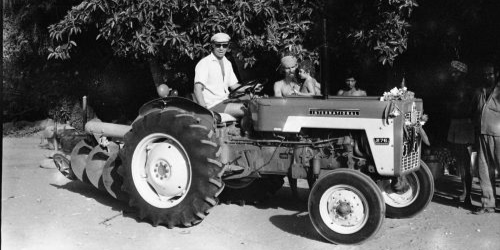
This interview with Gérard from 2020 , by the Lands for Auroville Unified team, takes us back to the earliest beginnings of the farm. Gérard came to the Sri Aurobindo Ashram in 1955 at the age of 23. After working at the Ashram bakery and swimming pool, he spent Home » Blog » Remembering the Beginnings of AuroOrchard With Gerard Cruz (2020) Remembering the Beginnings of AuroOrchard With Gerard Cruz (2020) August 2026 · Anshul Aggarwal This interview with Gérard from 2020 , by the Lands for Auroville Unified team, takes us back to the earliest beginnings of the farm. Gérard came to the Sri Aurobindo Ashram in 1955 at the age of 23. After working at the Ashram bakery and swimming pool, he spent several years caring for an orchard-farm in Mountain Paradise in the Himalayas, growing apples and peaches. Looking back, he describes this period as his apprenticeship in horticulture. In 1967, the Mother asked him to visit a piece of land near Promesse and consider how it might be developed. She later asked whether he would take responsibility for the land and grow fruits and vegetables for the emerging community of Auroville. Gérard returned from the Himalayas towards the end of 1968 and began the gradual work of developing AuroOrchard. The story also carries some lesser-known parts of the farm’s history. The Ganesh temple was already present on the land, and its continued care was one of the conditions under which the Mother acquired the farm. While the temple’s physical connection with the farm was lost in the land exchange in 2023, the daily puja has continued uninterrupted even until today since the beginning, now under the care of Diwakar. What comes through most strongly in Gérard’s memories is his trust in the work he was given and his gratitude for the life that unfolded through it. More than fifty years later, AuroOrchard continues to grow food for Auroville, carrying forward the purpose with which it began. As Gérard reflects: “My heart remains filled with gratitude for this exceptional experience.” You can read the full interview here: https://land.auroville.org/gerard-development-auroorchard/ Previous Article Featured Articles Words of appreciation…ㅤㅤㅤㅤㅤ 27 Aug 2026 Monthly Updatesㅤㅤㅤㅤㅤㅤㅤㅤ 26 Aug 2026 Words of appreciation…ㅤㅤㅤㅤㅤ 27 Aug 2026 Words of appreciation…ㅤㅤㅤㅤㅤ 26 Aug 2026
Words of appreciation…ㅤㅤㅤㅤㅤ
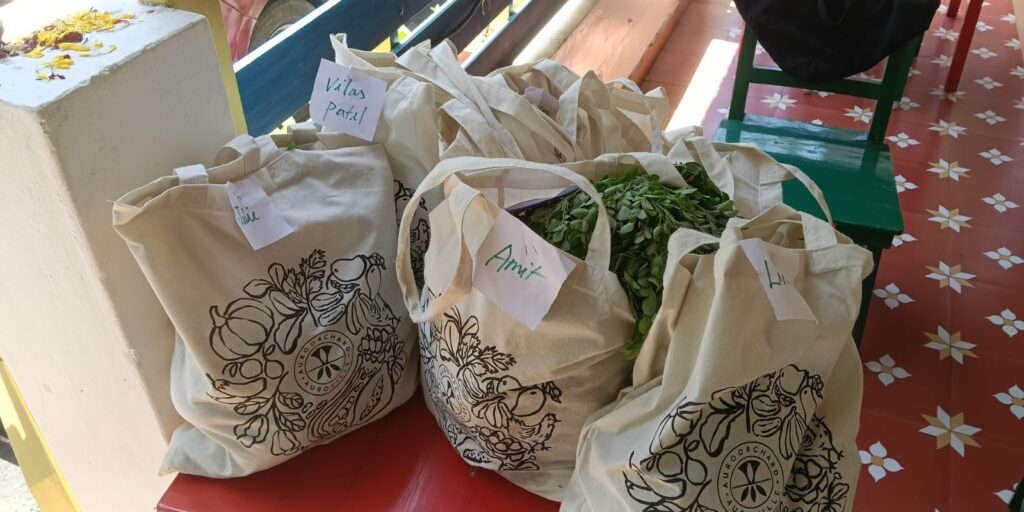
We’re deeply grateful for the encouragement and trust we receive from our community. There is still much to learn, improve, and do. We receive this feedback with humility and gratitude, as a reflection of the relationships and collective effort that make this work possible. Home » Blog » Words of appreciation from the community Words of appreciation from the community August 2026 · Anshul Aggarwal We’re deeply grateful for the encouragement and trust we receive from our community. There is still much to learn, improve, and do. We receive this feedback with humility and gratitude, as a reflection of the relationships and collective effort that make this work possible. A few words from our community on their experience of receiving baskets from the farm: A wonderful way to eat amazing food, enjoy top-notch products…and support Auroville’s farms. All are of exceptional quality- the super fresh fruits and veggies, and the processed foods: amazing taste, long preservation, well presented! Personally, it is a great luxury to receive a fresh vegetable from Auroville farm. I’m very grateful to the people working in the orchard to provide us this service. I’m super happy about your products! Seasonal and very fresh, it’s tasty and good. I tasted pesto, jam and ale, which are all very good! Good job. One of the best places to eat local, organic and seasonal food at AV. A wide selection available year-round, and a genuine effort on the part of the farm to produce fruits and vegetables of excellent quality. Produce we can trust to be organic. Every basket received is full of fresh produce and good will. We support organic farming and farmlands and forests in Auroville. A lot more support was needed. It’s wonderful work that AuroOrchard does and continues to keep bringing new produce. The basket service is a blessing for me as i don’t have any free mornings to go shopping at Ptdc. It’s also very consistent which keeps me assured. Response from Anshul and a few I have interacted with is prompt and addresses the query. The food is wonderful, always feels fresher, safer and more flavourful than any I can find in a store. I’ve been regularly purchasing produce from AuroOrchard organic farm, and the quality has been consistently outstanding. The fruits and vegetables are incredibly fresh, full of natural flavour, and you can truly taste the difference compared to regular market produce. What I appreciate most is the reliability—they maintain the same high standard every time. The produce feels clean, wholesome, and grown with care. This service is very valuable, and the fact that all produce is organic makes it even more valuable. I feel the difference in quality with AuroOrchard being a better quality. The rates of raw products are neither very high nor very low. The basket system is extremely helpful & is a hassle free experience. Amazing quality, very precise delivery, great service. Earlier I could never access AV farm produce, as nothing much is left at 1pm at PTDC. I guess that way neither ptdc nor av farms could really know the demand for their produce. Now it’s so easy! I keep sharing the link for the weekly order and the farm walk…we are blessed with fresh organic food directly from.the farm… prepared with so much care and farming expertise. I’m amazed by the way you responded to an intense situation and the outcome of it which shows more consciousness, adaptability, resilience and the work capacity. The work that AuroOrchard does is absolutely outstanding. Despite all the challenges, blockages, big injustice and even violence AuroOrchard has faced, you not only persevere but have improved tremendously over the last 2-3 years. I admire your strength, courage and endurance! I really appreciate your efforts to find new solutions for egg mass production. Somehow, it doesn’t feel right to me to keep animals to produce food for humans, but as long as we eat eggs at least lets find the most animal-friendly way to produce them. I’m happy to know that you try your best and that you will improve it even more! Your new ready made food production program is great, very creative and innovative! I always enjoy seeing your new products and love to try them out, especially your new syrups and drinks. My absolute favorite products are your turmeric powder, the various greens and the brown eggs. Amazing! Super efficient, top quality products. Such quality, creativity and abundance… cannot be better! A dream coming true for any organic food and farming lover. Thanks for all the efforts going into the direct sales! On top of the orders and my emails are always answered. Good quality products. Wonderful work, very useful Very positive vibrations. Products are good quality with reasonable price. Team mates are good, some are extraordinarily talented , simple and helpful. I wish AuroOchard all the best. Auro Orchard forms an excellent bridge for volunteers and newcomers in auroville. i often hear of people working in Auro orchard in a meaningful way, even if for a short period, and it makes me happy. I also appreciate immensely that the team is flexible and always experimenting and trying things – rare in this sector. Thank you AuroOrchard team and earth! Previous Article Featured Articles Words of appreciation from the communityㅤㅤㅤㅤㅤ 26 Aug 2026 Soil Test Experiments… 26 Aug 2026 Words of appreciation from the communityㅤㅤㅤㅤㅤ 26 Aug 2026 Soil Test Experiments… 26 Aug 2026
Reflections from Volunteersㅤㅤㅤㅤㅤ
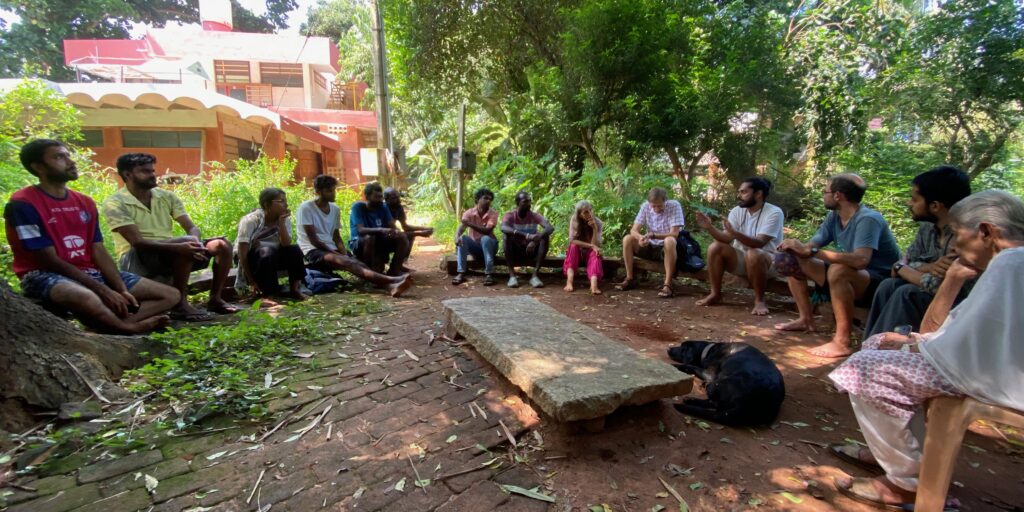
Our effort has been to open the space on the farm for learning agriculture as well as coming into a deeper contact with the land and oneself. We firmly believe the farm to be a site for Integral Education, with ample opportunities for development of the physical, vital, mental, spiritual, as well as the psychic. These are the reflections from some of our past volunteers showing the potential and possibilities of this work. Home » Blog » Ayurvedic Recommendations for Winter Reflections from Volunteers March 2026 · Anshul Aggarwal Our effort has been to open the space on the farm for learning agriculture as well as coming into a deeper contact with the land and oneself. We firmly believe the farm to be a site for Integral Education, with ample opportunities for development of the physical, vital, mental, spiritual, as well as the psychic. These are the reflections from some of our past volunteers showing the potential and possibilities of this work. My time at Auroorchard was a deeply valuable experience. I find it incredibly important that we spend time on the land – growing, preserving and innovating with food and Auroorchard provides that opportunity! I found the Auroorchard to be a living lab, where people can execute projects and research that can serve the multitude of projects on the farm, from regenerative farming to cultural paradigm shifts to education. Thanks to Anshul, Auroorchard takes a holistic approach to food farming, which is essential in both local and global food transitions that we desperately need. I hope the farm can grow, evolve and thrive for many years ahead. — Nikita Bharat, Netherlands AuroOrchard has left my heart full, thanks to the open-hearted people who work there and the mesmerizing beauty of the farm itself. It has been a true pleasure documenting the life of AuroOrchard and diving into the techniques of the natural way of farming. I feel deeply grateful for having been a part of the farm, even for a short period of time. — Taisiia Latypova, Russia I stayed at the farm for a week, and the experience truly stayed with me. I had zero background in farming, yet everyone there welcomed me with warmth and patiently taught me the basics. Every day brought a new learning — not just about farming practices, but about people, their journeys, and the stories they shared while we worked together. Even in that one week, I felt a deep connection to the people and the sense of community on the farm. It was a meaningful and memorable experience. — Sai Kiran, Andhra Pradesh, India I worked at AuroOrchard for a month, really it’s a wonderful experience to me and I gained a lot of knowledge from the farm.And now I am implementing the learnings at my place. And the people who are there are great and provided a lot to me. And everyone who is interested in farming should visit this place. — Ramesh G, Tamil Nadu, India It was amazing volunteering at AuroOrchard. Volunteering brought new learnings about farming, a nourishing breakfast and company of like minded fellows from different walks of life. Anshul used to solve my doubts and was great at doing thought experiments. Guided farm walk also helped a lot. I thoroughly enjoyed being at the farm. I saw so many birds I had not even known and made some great friends too. Thanks again for the opportunity ! — Abhijeet Kulkarni, Maharashtra, India It’s a simple truth that AuroOrchard made me feel far more deeply than I ever had before. My weeks at AuroOrchard showed me how every role, no matter how small or humble, becomes meaningful when directed toward a shared purpose: growing food for the community in the most natural and conscious way possible. During my stay, I listened to locals, Aurovilians, volunteers, travellers and tourists. Everyone carried a fragment of the larger story: a story shaped by the vision of The Mother and Sri Aurobindo, rooted in inner evolution, collective harmony, and the aspiration to manifest a more conscious world. Auroville itself is built on this experiment of human unity, and AuroOrchard reflects that ideal in the soil, the sweat, and the spirit of everyday work. The people I met now long-standing acquaintances and friends were bound not by background but by shared values. Together we watched sunrises on days that began in quiet reflection and sunsets that carried the satisfaction of honest labour. Even the pre-monsoon showers felt like a blessing, softening the earth we were working to nurture. We weeded, mulched, composted, pruned Malabar spinach. Simple tasks, yet profoundly grounding. Anshul’s guidance, the helpfulness of every volunteer and worker contributed in their own way. And that’s the beauty of the place: there is space for all, for every profession, every stage of life, every wandering soul seeking meaning or direction. Volunteering here isn’t just service; it is a form of education. You learn what it truly takes to bring food to a table. You learn to value every grain, every leaf, and the labour behind it. You learn the quiet art of not wasting. You learn the power of a community that gives because giving is part of living. Not everyone can give time, not everyone can give resources—but each of us can give something. And each offering, however small, helps sustain spaces like AuroOrchard spaces that heal the earth, and in many ways, heal us too. If you ever wish to reconnect with the essentials nature, community, purpose let Auroville hold you for a while. And let AuroOrchard put your hands back into the soil. It has a way of changing you, gently, irrevocably. — Rashmika Rajaram, Karnataka, India AuroOrchard means everything to us because it’s where we met. Living together for a love of health, AuroOrchard couldn’t have been a more profound farm to put our feet, hands, heart & mind in all things Nature. With Anshul at the helm and incredibly kindred volunteer souls, this place is
Time to Summernate: Ayurveda Healthy Tips …

According to Ayurveda, the qualities of summer are hot, sharp, and penetrating. That’s why our pitta dosha – the subtle fire that controls metabolism and transformation – can cause us to overheat. The sun saps the energy from the body, from the plants and the earth, increasing heat and dryness. Home » Blog » Time to Summernate: Ayurveda Healthy Tips by Dr. Be Time to Summernate: Ayurveda Healthy Tips by Dr. Be March 2026 · Dr. Be According to Ayurveda, the qualities of summer are hot, sharp, and penetrating. That’s why our pitta dosha – the subtle fire that controls metabolism and transformation – can cause us to overheat. The sun saps the energy from the body, from the plants and the earth, increasing heat and dryness. Pitta needs to be looked after to maintain a good energy, mental clarity, joyfulness, good digestion and blood circulation, a beautiful glow on the skin and a sound sleep. When Pitta is out of balance it will give skin problems, hot flashes, exhaustion, indigestion or loose stool. Emotionally, excess Pitta manifests through irritation, short-temper, impatience, judgement/criticism, perfectionism… Before Pitta reaches uncontrollable heights, remain cool, calm and pamper the liver: With the food: As Agni (digestive fire) weakens, it is better to eat light, unctuous (slightly oily), cooling food such as salads and juices. Favorable taste: Bitter taste, Sweet taste (to take moderately in case of diabetes and high triglycerides). Salty taste should be taken reasonably Drink water stored in earthen pot Raw food/salads are taken at lunch mainly Proteins: mungdal, chickpeas, beans, sprouts, nuts and seeds, non-veg: white meat, fish, seashell, dairies for breakfast or lunch, eggs Cereals for energy: jasmine rice, barley, red rice, millet (fermented ragi) Vegetables: pumpkin, bittergourd, bottlegourd, snakegourd, ashgourd, cucumber (taken separately), salads, green leafy vegetables, broccoli, cabbage, celery, carrots, drumstick (moringa), zucchini, plantain Fruits: amla, pomegranate, banana, ramphala, chiku, papaya, apple, grape, date, watermelon and melon (to be taken separately), coconut Beverages: buttermilk, sweet lassi, coconut water, mint, lemongrass, cardamom, chamomile, nannari (sarsaparilla), amla juice, watermelon juice, vegetable juice, cucumber milk (blend ½ cup of peeled cucumber in 1 cup of milk – cow or other veg milk – with a pinch of sugar), electrolyte (1 lemon juice + 1tsp of sugar + 1 pinch salt in a glass of water), Lipids: ghee, olive or sunflower or coconut oil Spices: cumin, coriander, black pepper, turmeric, fennel seeds, fresh aromatic herbs (dill, coriander, fennel, mint, parsley, saffron) Avoid: Pungent and sour tastes (especially for people who are Pitta dominant) Pitta increasing items: chillies, fermented food (apart from idli and dosai), deep-fried, sour buttermilk or curd, red meat, alcohol (strong liquor, red wine), coffee … Drinking beverages coming from the fridge or freezer during meals Ice-cream at the end of a meal (best to be taken when the digestion is finished, around 4pm) Routine to favour: Avoid direct sun contact specially between 11am and 4pm, and protect from the heat by keeping a humid towel/cap on the head A nap of half an hour after lunch is allowed Body massage with coconut oil – if there’s no time every day to apply oil on the body, then massage ears, hands and feet + pour 4-5 drops of coconut oil on the fontanelle Bath with cool water and apply a paste of sandalwood on the face, heart and lower abdomen (these are the 3 main parts that should remain fresh to maintain the coolness in the whole body); foot bath in the evening with vetiver roots, rose water or hibiscus flowers Swimming, aquagym, any water activities. Qi-Gong, Tai Chi, light running: max 30 minutes early morning or late evening; walks in green environment, forest Soft yoga, pranayama (Sheetali, Sheetakari, ida nadi inhalation-left nostril inhalation), meditation with Gayatri mantra Walk under the moonlight, full moon bath Wear loose and comfortable cotton or linen clothes (white, blue, green, gray colours) Cooling jewellery: sandalwood beads, jade, pearl, amethyst crystals, moonstone, silver, aquamarine To refresh the ambiance use lemon or orange peel, jasmine flowers, lavender, wet cloth hanging at the open window, vetiver curtains Cooling plants for the summer: Amalaki – Amla: refrigerant and full of Vitamin C, rejuvenating fruit Aloe vera: rejuvenates blood and tissues Aegle Marmelos – Bael fruit: make juice from the pulp and decoction with leaves, it calms body and mind. It is slightly laxative, do not take during pregnancy Coriander: seeds soaked in water for urinary infections, kidney weakness Red Hibiscus: leaves and flowers for shampoo and conditioner; flowers for herbal tea Manduka parni – Centella asiatica leaves: rejuvenating and tonic for brain and nerves Pudina – Mint leaves: herbal tea or dishes Radha consciousness – Clitoria Terneata flowers: herbal tea or juice Sarsaparilla – Nannari syrup: soothing and cooling Shataavari – Asparagus racemosus: cooling, calming Pitta, very good for Vata women to harmonize hormones Vetiver roots: for bathing Yashtimadhu – Licorice: to refresh the body and to calm irritation, inflammation or ulcer in the digestive tract Wishing you a nurturing and loving winterBe @ Sante PS: all these recommendations are more elaborated in my book “Take care of yourself with Ayurveda”, available at Maroma in Aspiration, the bookshop of Visitor Centre and Auroville Press Publishers in Aspiration Previous Article Featured Articles Monthly Updatesㅤㅤㅤㅤㅤㅤㅤㅤ 25 Mar 2026 Year-end updatesㅤㅤㅤㅤㅤㅤㅤㅤ 20 Dec 2025 Time to Summernate: Ayurveda Healthy Tips by 26 Mar 2026 Eating With the Daylightㅤㅤㅤㅤㅤ 26 Mar 2026
Food Sovereignty and Seeds of AuroOrchard
Since the Second World War, the agriculture paradigm has shifted dramatically to keep pace with the evolving industrial and economic paradigms. The culture of mono-cropping has grown on some ill-found assumptions and hard realities of the changing social structures in farming communities. As much as monoculture is believed to be the only way to produce high-yields, and a dominant solution to feeding the world, it is also easier for farmers who have no option than to resort to mechanization due to lack of hands working on the fields. The farmers who lack the resources to buy machines or employ family members on the farm suffer the most. However, despite the illusory success of turning large acres of land into monocrop systems, the inequity in food distribution couldn’t have been higher than ever. As per studies done in recent times, collectively we grow food already for about 10 billion people (calorie equivalence) but over a third of this food is wasted while harvesting, storing, shipping and so forth (Holt-Giménez et al., 2012). Home » Blog » Food Sovereignty and Seeds of AuroOrchard Food Sovereignty and Seeds of AuroOrchard March 2026 · Anshul Aggarwal Since the Second World War, the agriculture paradigm has shifted dramatically to keep pace with the evolving industrial and economic paradigms. The culture of mono-cropping has grown on some ill-found assumptions and hard realities of the changing social structures in farming communities. As much as monoculture is believed to be the only way to produce high-yields, and a dominant solution to feeding the world, it is also easier for farmers who have no option than to resort to mechanization due to lack of hands working on the fields. The farmers who lack the resources to buy machines or employ family members on the farm suffer the most. However, despite the illusory success of turning large acres of land into monocrop systems, the inequity in food distribution couldn’t have been higher than ever. As per studies done in recent times, collectively we grow food already for about 10 billion people (calorie equivalence) but over a third of this food is wasted while harvesting, storing, shipping and so forth (Holt-Giménez et al., 2012). Small farms feed the world Interestingly, over 70% of the food that we end up eating, still comes from small-farms (25 acres or less) managed by communities and families for subsistence, and not from large mechanized monocrop systems as we are made to believe. Also small farms have been found to be 4-5 times more productive than large farms because of their intensive diverse cropping integrated with animal rearing(Lerman & Sutton, 2008; Small farmers feed the world, Grain, 2014). We do have enough food to feed the planet and almost three quarters of it comes from small farms. So where does large scale industrial agriculture fit in this story and how can it help if production is not really the primary challenge? The industrialization of agriculture has led to large scale disempowerment of small farmers, degraded rural lands and culture and polluted our soil, water and air and the poor stay hungry no matter how much more food is produced on this planet. Our overwhelming stress on strategies and policies to feed the world are focused only on producing more food. But we forget that this also means more food of a certain quality. As the world wakes up to appreciate the subtle nuances of relationships of humans with nature, other humans and themselves, the subtle qualities of food and their relationship with human health must also be considered. Cheap food does not mean good food and as a global collective, feeding the world population is rather an insufficient objective. That all on this planet should have access to clean and wholesome food is an idea worth living and fighting for, and large scale industrial agriculture has very little to offer in this regard. The solution of lack of access could lie in decentralization and localization of production and distribution. But the road ahead is difficult, especially for small farmers. Changing climatic patterns and a demand from consumers of non-seasonal, non-local produce due to changes in diet preferences, loss of knowledge of using traditional and local foods along with loss of traditional seed varieties due to lack of skill and subsidies on hybrid seeds has led to a loss in agricultural biodiversity and a degradation of local food systems. As a result farmers have had to grow food based on the lopsided market demands and economic incentives. This trend is, of course, changing slowly and research and experimentation in rediscovering a balance of natural farming in the current ecological and social paradigms is emerging both on the fields and within the new food distribution enterprises. Human role in agro-bio-diversity One of the aspects of re-discovering this balance and re-establishing the lost relationship with the land is letting go of our conceptions of order and monocultures towards revitalising the biodiversity in our ecosystems. Since human impact has surpassed that of all others, we have been shaping the evolutionary process of biodiversification, consciously and unconsciously. Our very existence has a definite impact and our role in the ecosystem implores us to walk, work, eat and modify our environment for survival. Yet, in the last few centuries or even since agriculture began thousands of years ago, our impact on our environment has been steadily increasing as we slowly seem to be losing track of what is important and are moving from modification to exploitation. Communities based on land and in forests have evolved with their ecosystems since millennia. They themselves have been a part of the biodiversity of the land. Not only have humans evolved within the ecosystems, they have also contributed in protecting and furthering the evolution of these systems. The Amazon forests, which are now being referred to as the oldest food forests, are the perfect example of how human culture can support and enhance biodiversity and create a synthesis of wild and humanized ecosystems (Panko, 2023;
The Lost Generation of Farmers
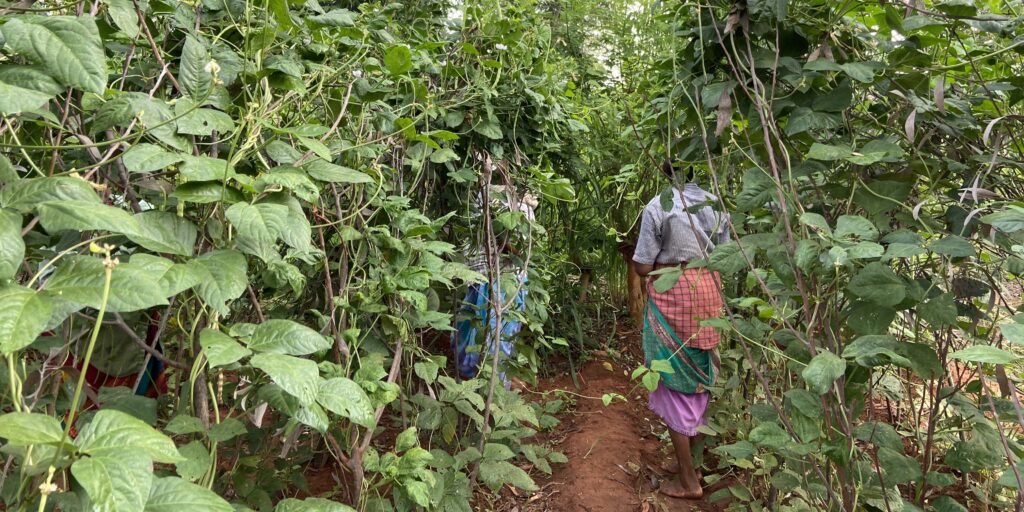
In Tamil Nadu, farm workers (cultivators and labourers) have dropped from ~62% of the total workforce in the state in 1981 to ~41% in 2001, and in a more recent study from 40% in 2012 to 22% in 2022 Home » Blog » The Lost Generation of Farmers The Lost Generation of Farmers December 2025 · Anshul Aggarwal “However they roam, the world must follow still the plougher’s team; Though toilsome, culture of the ground as noblest toil esteem.” — Thirukural | v. 1031 In Tamil Nadu, farm workers (cultivators and labourers) have dropped from ~62% of the total workforce in the state in 1981 to ~41% in 2001, and in a more recent study from 40% in 2012 to 22% in 2022 (Vijayabaskar, 2017; Gunasekar, 2025). The number keeps declining and is only representative of the same trend across the country and the world . The causes are complex and range from fragmentation of land leaving farming unviable on small lands (95% of farmers have land less than 5 acres), heavy work load, indebtedness, discrimination, lack of welfare schemes or accessibility and better paying opportunities as urban labour (Gunasekar, 2025). The National Sample Survey of 2005 reported that 40% of the farmers did not like farming and were of the opinion that, given a choice, they would take up some other career. 27% found it ‘not profitable’, another 8% reported that it is ‘risky’ and another 5% did not like it for ‘other reasons’. Research also shows that about 45 farmers commit suicide in India every day with an increase of 2.5% every year (Nagraj et al., 2014). These numbers are highly conservative as farmer deaths remain under-reported and farmers who do not own land, especially women and children are excluded (Haluwalia, 2025). The reasons again are complex ranging from socio-cultural, financial and psychological. Thus, youth is being lost from agriculture to the increasing urbanisation, we are also slowly bleeding out the existing farmers. Scholars have imagined this culmination of this shift into a “post-agrarian” state, a state of transition from agricultural sector to the manufacturing and service sector (Vijayabaskar, 2017) – eventually, a world without agriculture. In a recent article, Torero, the Chief Economist of the Food and Agriculture Organization of the United Nations, points out the declining number of people involved in agriculture, the rising median age of the current farming populations and the lack of job opportunities for young people. His thesis is that agriculture is more than just “growing food” and that young people can be lured into agriculture through tech-startups, supply chain solutions and so on. There is also a general sense amongst agrarian scholars that creating jobs in the urban sector will lead to social emancipation of agriculture workers. They largely suggest that as long as rural youth find quality jobs outside of the farms, the state would have exercised good political and social intervention. While this is appreciated, it still doesn’t answer the fundamental question- what agriculture can we have in the next fifty years if there are no farmers at all?– the farmers who are involved in “growing food”. Who will grow food in the coming decades if the post-agrarian paradigm was to be fully realised and leaves a vacuum in rural life and agricultural work? How can social, cultural and spiritual skills be reproduced that make the very foundation of agriculture? This story is even more stark in Auroville, where we aspire to be self-sufficient through karma yoga and spiritual realisation in material work. Out of the 2665 adult Aurovilians (Census 2025), only 49 are farming, and this includes part-time farmers as well. That’s less than 2% of Aurovilians working on the farms–1 Aurovilian farmer for 55 Aurovilians. This number is also one-third of the number of labour hired from the villages around Auroville for permanent or seasonal farmwork (around 140 people). We have outsourced our difficult work to the villages for cheaper labour while we engage in ‘higher’ pursuits of a spiritualised community. We must acknowledge that we are not only far from self-sufficiency in terms of food quantities, but also in terms of work despite the fact that the community keeps growing. Moreover, the median age of the existing farmers is rising with only a few young Aurovilians involved. So, where is the next generation of farmers of Auroville? And how can we even expect to have young people join the farms when the perception of farming is that of a ‘profession of poverty’, constant battle with wildlife, lack of acknowledgement for Auroville grown food within the community and a growing mistrust and lack of support (financial and otherwise) from the Auroville governance for farmers? In the last two years, AuroOrchard has made a deliberate effort to welcome new volunteers, newcomers and young Aurovilians on the farm by offering them an opportunity for different kinds of works (field work–vegetables, orchards, harvesting, cooking, food preservation, documentation, research, education). We now have 7 newcomers on the farm, learning about farming and helping us build a new team for the future. All these newcomers are supported directly by the farm with no support from the central fund. This puts a lot of financial pressure on the farm and restricts us from taking more young people and engaging them in meaningful work as they embark on their journey in Auroville. To support a new generation of farmers, we have started diversifying our income through preserved products from the farm and educational programs. And yet, this is not enough. This year, we are raising funds to support this young team. Additionally, we are trying to reason with the Auroville governance that this is worth investing in–for engaging newcomers as well as supporting one of the most crucial activities for sustenance and growth- growing food. We need a radical reorientation of our policy for the farms, which also means giving up all the neoliberal and capitalist measures that seem to have completely overtaken all aspects of Auroville’s work. Agriculture will need to be
The Dilemma of Animals in Agriculture
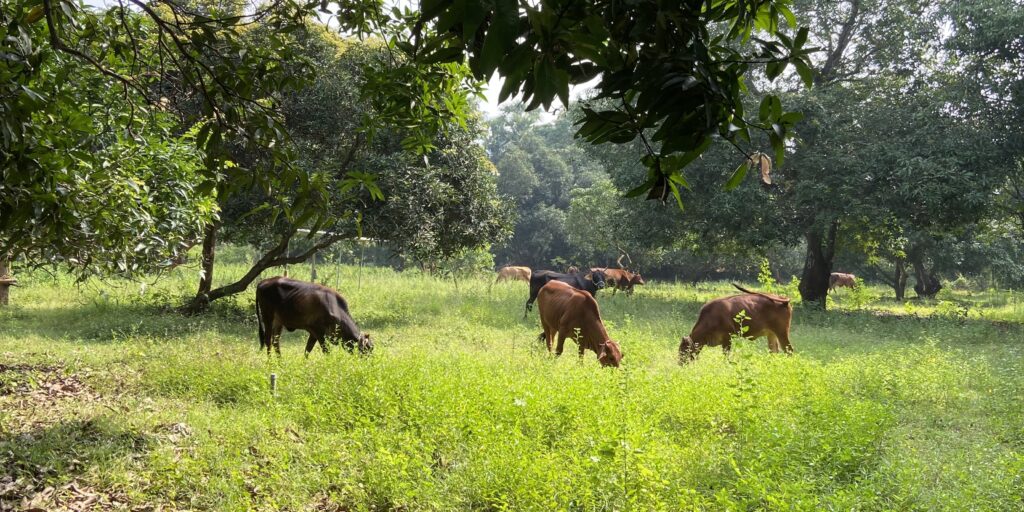
We would not need to go hunting for our connection to our food and the web of life that produces it. We would no longer need any reminding that we eat by the grace of nature, not industry, and that what we’re eating is never anything more or less than the body of Home » Blog » The Dilemma of Animals in Agriculture The Dilemma of Animals in Agriculture December 2025 · Anshul Aggarwal “We would not need to go hunting for our connection to our food and the web of life that produces it. We would no longer need any reminding that we eat by the grace of nature, not industry, and that what we’re eating is never anything more or less than the body of the world. I don’t want to have to forage every meal.” — Pollan, M., The omnivore’s dilemma: A natural history of four meals (2006), p. 378 According to analyses by the Sentience Institute (USA), over 90% of farmed animals globally are living in inhumane facilities known as “factory farms” at present. The intensive confinement of animals on these farms leads to a range of psychological and physical health problems, and many of these animals endure painful deaths on account of health complications caused by their breeding or environment. Some animals are debeaked, castrated, or mutilated in other ways without anesthesia. The stunning methods used to knock some animals unconscious before slaughter fail regularly, and errors on industrial slaughter lines result in atrocities such as nearly one million birds being boiled alive every year. Nearly all fish die by being painfully suffocated and crushed by other fish in nets that pull them out of the water. Of all land animals in factory farms, over 60% are chickens raised for meat, about 30% are chickens raised for eggs and about 10% are cattle, sheep and pigs. Large international surveys indicate that the vast majority of the global population— approximately 86–92% — consumes meat or other animal-based foods with only a small share identifying as vegetarian or vegan (Statista (2023); Ipsos (2018)). Global meat production has more than doubled since 1961 (OWD) and animal based protein makes up about 20% of the global diet (OWD). In a world where global demand for animal protein seems to be rising (OECD-FAO, (2025)), how can we reconcile the massive impact that animal farming has on animals as well as on our ecology and environment? Scientific evidence shows that humans started settling down as agricultural civilisations over ten thousand years ago. This move represents an important change for humanity from the wilderness of nature to an intentional participation with nature. It marks a separation of humanity from the forests, pointing to a self-discovery within the collective context of a polis. And animals like chickens, sheep, goats, cows and horses followed the humans into this agricultural polis–they became domesticated. What emerged was not merely a technical shift in food production, but a deep transformation in the human–animal relationship. For instance, the horse and the cow, especially in the Indian culture, represent power and knowledge respectively, the symbols of human evolution from the unconscious vital towards a great consciousness of self-reflexivity. They become important symbols of vedic rituals as well as metaphors of self-transcendence. Humans and animals have, therefore, shared a long domestic relationship of mutual interchange in the form of care and food, as well as a deep spiritual kinship. However, as agriculture becomes industrialised, this relationship of care has turned into a relationship of extraction–beings have turned into resources– only to be exploited for human consumption. Today, amidst multiple schools of farming and food possibilities, the farmers face the following challenges: “We would not need to go hunting for our connection to our food and the web of life that produces it. We would no longer need any reminding that we eat by the grace of nature, not industry, and that what we’re eating is never anything more or less than the body of the world. I don’t want to have to forage every meal.” — Pollan, M., The omnivore’s dilemma: A natural history of four meals (2006), p. 378 According to analyses by the Sentience Institute (USA), over 90% of farmed animals globally are living in inhumane facilities known as “factory farms” at present. The intensive confinement of animals on these farms leads to a range of psychological and physical health problems, and many of these animals endure painful deaths on account of health complications caused by their breeding or environment. Some animals are debeaked, castrated, or mutilated in other ways without anesthesia. The stunning methods used to knock some animals unconscious before slaughter fail regularly, and errors on industrial slaughter lines result in atrocities such as nearly one million birds being boiled alive every year. Nearly all fish die by being painfully suffocated and crushed by other fish in nets that pull them out of the water. Of all land animals in factory farms, over 60% are chickens raised for meat, about 30% are chickens raised for eggs and about 10% are cattle, sheep and pigs. Large international surveys indicate that the vast majority of the global population— approximately 86–92% — consumes meat or other animal-based foods with only a small share identifying as vegetarian or vegan (Statista (2023); Ipsos (2018)). Global meat production has more than doubled since 1961 (OWD) and animal based protein makes up about 20% of the global diet (OWD). In a world where global demand for animal protein seems to be rising (OECD-FAO, (2025)), how can we reconcile the massive impact that animal farming has on animals as well as on our ecology and environment? Scientific evidence shows that humans started settling down as agricultural civilisations over ten thousand years ago. This move represents an important change for humanity from the wilderness of nature to an intentional participation with nature. It marks a separation of humanity from the forests, pointing to a self-discovery within the collective context of a polis. And animals
Hands-On Approachㅤㅤㅤㅤㅤㅤㅤㅤㅤ
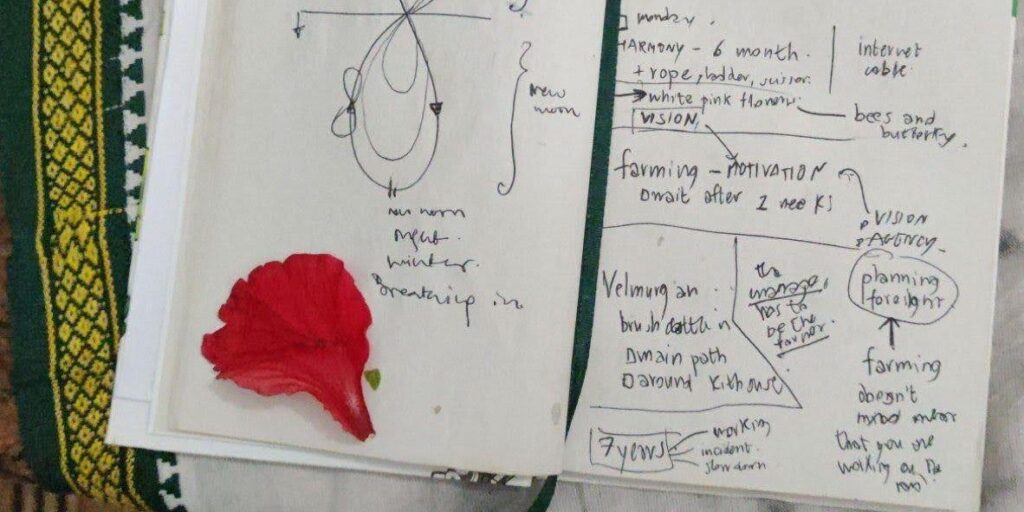
But you can truly learn when your feet and hands are on the field. The greatest knowledge is that which is applied to daily life. Home » Blog » Hands-On Approach Hands-On Approach 25 November 2025 · Fabio Karlino “Nowadays everyone could become (intellectually) a farmer.We have books, schools, courses, youtube videos …”But you can truly learn when your feet and hands are on the field.The greatest knowledge is that which is applied to daily life. And this happens in AuroOrchard.Ideas are welcome, brainstorming is magnificent, vision is encouraged.But let’s start from the ground, let’s start talking with naturebecause farming is a conversation with nature and with ourselves. First, as humans, we should grow discipline in the orchard of our good habits.The discipline to be constant, be patient and wait for the seedsthat we’ve planted with love, welcome them by preparing their bedswhere they’re gonna sleep, breathe and live. Why farming?What does it mean to be a farmer?How could human artificial activity be called ‘natural farming’?The mind is hungry for answers. Be patient, the answers will come through experience.You don’t need to rush to search on the artificial web,look inside you, wait for the universe to provide you the keysnot encapsulated in words and concepts but feelings, experiences. Then a good talk with another human,especially if it is an experienced one like Anshul,could really help to recalibrate and transfer learning. The core of farming is food.This is the basic but fundamental starting point.Around this first principlehumans create families, communities, organizations. To be a farmer is not just being on the land with dirty hands,Farming means planning, forecasting, researching, experimenting.It’s an equilibrium, a balance between physical and intellectual activity,between materialism and spirituality for the parallel evolution of both. Natural farming does not exist. Have you ever seen a farm naturally grow somewhere with no human intervention?What we define natural farming are all techniques and practices used in agriculturein order to mimic the natural processes. Just like in a forest the leaves naturally cover the soil making it humid and fertilein the same way we are mulching by putting branches and leaves from the pruning.The bio inputs of the animals and microorganisms that live in the forestare replicated with a layer of compost and biomass. Is there room for improvement? Of course.What will the future of farming look like? We are creating it.What’s the best way to learn? Hands-on approach. Previous ArticleNext Article Featured Articles Monthly Updatesㅤㅤㅤㅤㅤㅤㅤㅤ 28 Nov 2025 Abundance Product of the Month 22 Oct 2025 Flow of fire and water on the farmㅤㅤ 03 Dec 2025 Hands-On Approachㅤㅤㅤㅤㅤㅤㅤㅤㅤ 29 Nov 2025