We get asked this question quite a lot! As Permaculture becomes more and more popular and perhaps projected as a wonderful solution for diversity and abundance, it is a general perception that “being a Permaculture farm” is the next big innovation in farming. ⠀⠀⠀⠀⠀⠀⠀⠀⠀⠀⠀⠀⠀⠀⠀⠀⠀⠀⠀⠀⠀⠀⠀⠀⠀
The human relationship with productive forests is older than settled agriculture. Archaeological research shows that hunter-gatherers were actively shaping tropical forest ecologies tens of thousands of years ago through burning, plant movement, selective protection and the concentration of useful species. It would be inaccurate to describe all these practices as agroforestry in the present technical sense. Still, they show that humans were managing trees, plants and forest mosaics for food long before fields of domesticated crops became the basis of settled societies. Many Indigenous and traditional systems continue this long history: home gardens, forest gardens, shifting cultivation, mixed orchards, trees maintained within crop fields and animals grazing beneath tree cover. Modern agroforestry has organised these diverse practices into a recognised field of farming and research, but it did not invent the idea of cultivating with trees. Today, the Food and Agriculture Organization defines agroforestry as the deliberate integration of woody plants—trees, palms, shrubs or bamboo—with crops or animals, arranged together in space or through time. While the term is relatively modern, the practice of growing food within wooded landscapes is very old.
Syntropic agriculture, also described as successional agroforestry, is a more recent approach within agroforestry, developed through the work of Swiss farmer and researcher Ernst Götsch.Götsch began field experiments in Europe during the 1970s and later continued his work in Costa Rica and Brazil. After settling in Bahia in the early 1980s, he developed cacao-based systems that combined food crops, fruit trees, service plants and longer-lived forest species. His work gradually became known as syntropic agriculture. In Götsch’s use of the word, syntropy refers to the capacity of living systems to generate increasing organisation, differentiation and complexity. We can create syntropy by understanding how plants can be arranged and managed so that each stage helps create the conditions for the next.
Syntropic agriculture uses familiar agroforestry elements—trees, crops, succession, ground cover and biomass—but gives particular attention to:
It is therefore more than planting many crops together. It is an actively managed process in which the farmer continually observes how the plants are interacting and changes the system as it develops.
Some plants produce food. Others are planted mainly to provide temporary shade, occupy space, protect the soil or generate biomass. Some remain for only a few months. Others become part of the permanent orchard.
A syntropic field is planned with two important considerations.
The first is space. Plants are arranged according to the amount of light they require and the height they may eventually occupy. A coconut, avocado, papaya, pineapple and sweet potato use different parts of the vertical space. The second is time. Plants are arranged according to their life cycles and their place in the development of the system. Maize, pumpkin, watermelon and rosella may occupy the first few months. Papaya, moringa and lemongrass may remain for several years. Avocado, jackfruit, citrus and cacao form the longer-term orchard. The first appearance of the field is therefore not its final form. Short-lived plants are harvested. Support plants are pruned repeatedly. Some trees are eventually removed as the main fruit crops require more light and space. A papaya, for example, may protect a young avocado from direct summer sun and produce fruit during the first few years. As the avocado develops, the papaya may need to be cut back or removed. Its role was to help establish the next stage of the system.
This combination of vertical stratification, different life cycles and planned succession is central to the design.
Syntropic agriculture is now being explored in different forms and at very different scales. Its best-known examples are tropical cacao, coffee and fruit systems in Latin America, but the approach has also been adapted to market gardens, school gardens, Mediterranean orchards, temperate fruit and nut systems, and larger experiments combining grains, grasses and rows of trees. Scientific research is also beginning to examine syntropic farming more closely. A 2025 review brought together 67 empirical studies. Most were from tropical countries, with almost three-quarters coming from Brazil and Bolivia. Only one study in the review came from Asia, from Yunnan in China; none of the studies listed were from India. The review found encouraging results in areas such as agrobiodiversity, nutritional diversity, soil fertility, carbon storage, water cycling and plant health. Productivity comparisons with other farming systems were mixed. It also identified considerable demands for labour, knowledge, tools and active management. There is, therefore, a growing body of conceptual writing, practitioner experience and scientific study. What we have found less readily available is open, detailed documentation from dry tropical farms showing actual field dimensions, species quantities, irrigation arrangements, planting chronology, pruning, survival and the changes made over several years. This is the context in which we place our work at AuroOrchard. AuroOrchard has sandy soil, intense summer heat and long periods without significant rain. Young fruit trees require irrigation during establishment, and the plants grown for shade and biomass draw from the same limited water. These conditions shape decisions about density, spacing, species, succession and pruning. Through our trials, we hope to develop and share some practical examples of dry tropical syntropic agroforestry.
Before planting, we began preparing a working species database. It currently contains more than 120 plants classified according to botanical family, vertical stratum, life cycle, time to maturity, lifespan, light requirement, function and possible spacing.
From this database, we developed a master consortium that organises plants into different stages and strata. It includes short-lived crops, plants that may remain for several years, long-lived fruit and forest trees, food crops and plants grown mainly for support or biomass.
We also prepare row-by-row plans and a chronology covering:
Our first detailed trial began in June 2024 on a quarter-acre plot of approximately 1,000 square metres that had previously been used for vegetables.
Before planting the orchard, we covered the soil with moth bean and later sunn hemp. Both were cut and left on the ground to form the first layer of mulch.
Avocado was the main long-term fruit crop. It was planted with papaya, moringa, acacia, Melia dubia, Albizia lebbeck, castor, Mexican sunflower, maize, pumpkin, sweet potato and C4 grasses.
The rows were organised in repeating bands approximately four metres apart from centre to centre. Within each band, tree, crop and biomass lines were placed at intervals of around 50 centimetres.
Papaya and the fast-growing support trees were planted first. Once they had created some protection, the avocado seedlings were introduced below them.
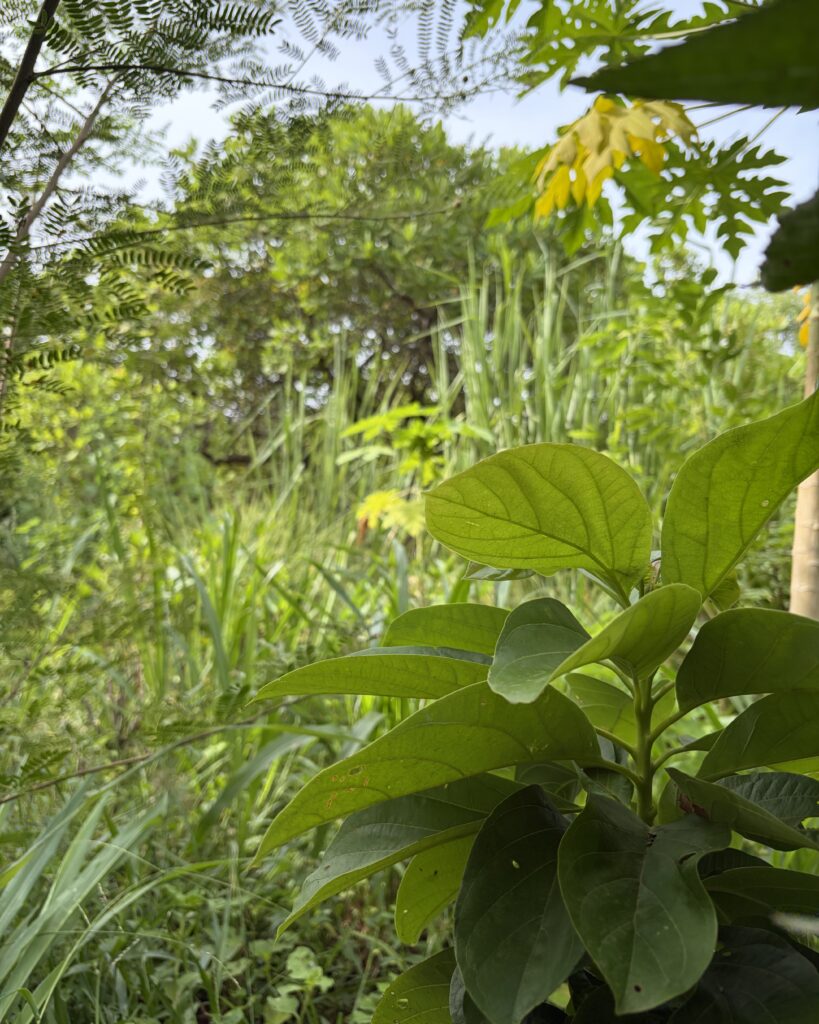
One of the clearest observations from this trial was the response of avocado to shade. The young avocado plants growing beneath papaya and other surrounding vegetation established much better than avocado plants exposed directly to the summer sun elsewhere on the farm.
The papayas began producing within six months. Grasses and fast-growing trees supplied material that could be cut and placed on the ground. Four major pruning cycles were carried out during the first eight months.
The field also showed us how much attention these systems require. Some plants grew much faster than expected. Some needed frequent cutting. Others struggled or disappeared. Irrigation had to be monitored closely, and the original arrangement could not remain fixed as the papaya and avocado developed.
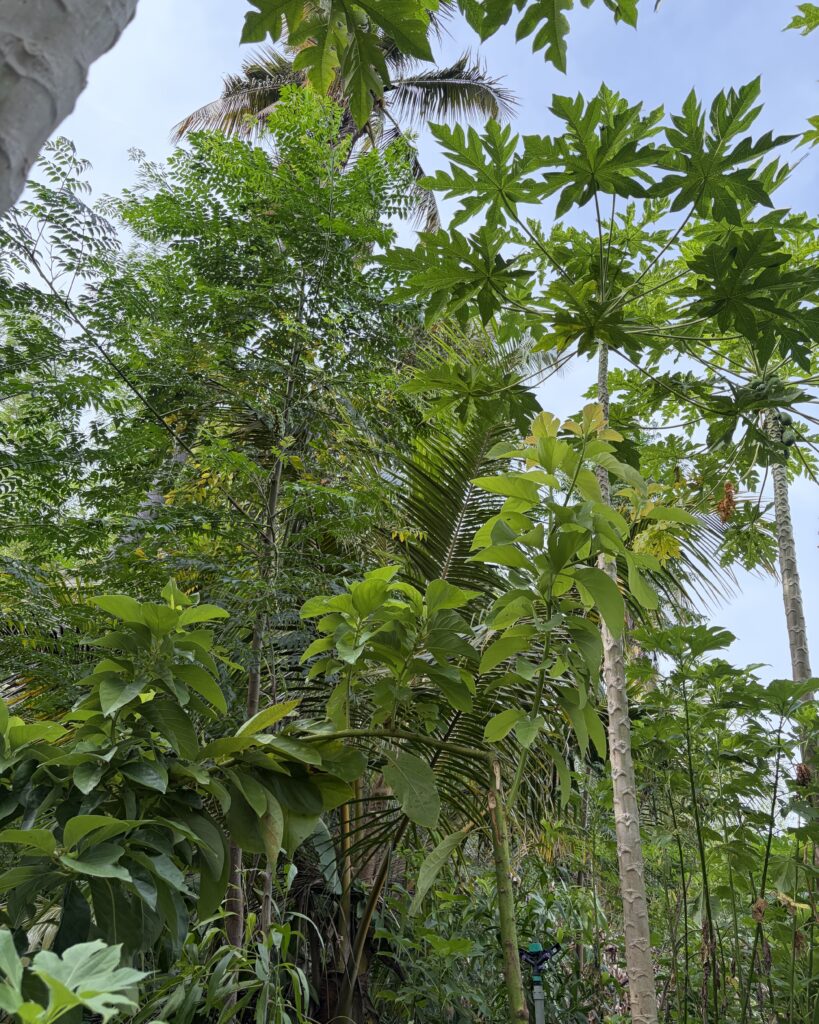
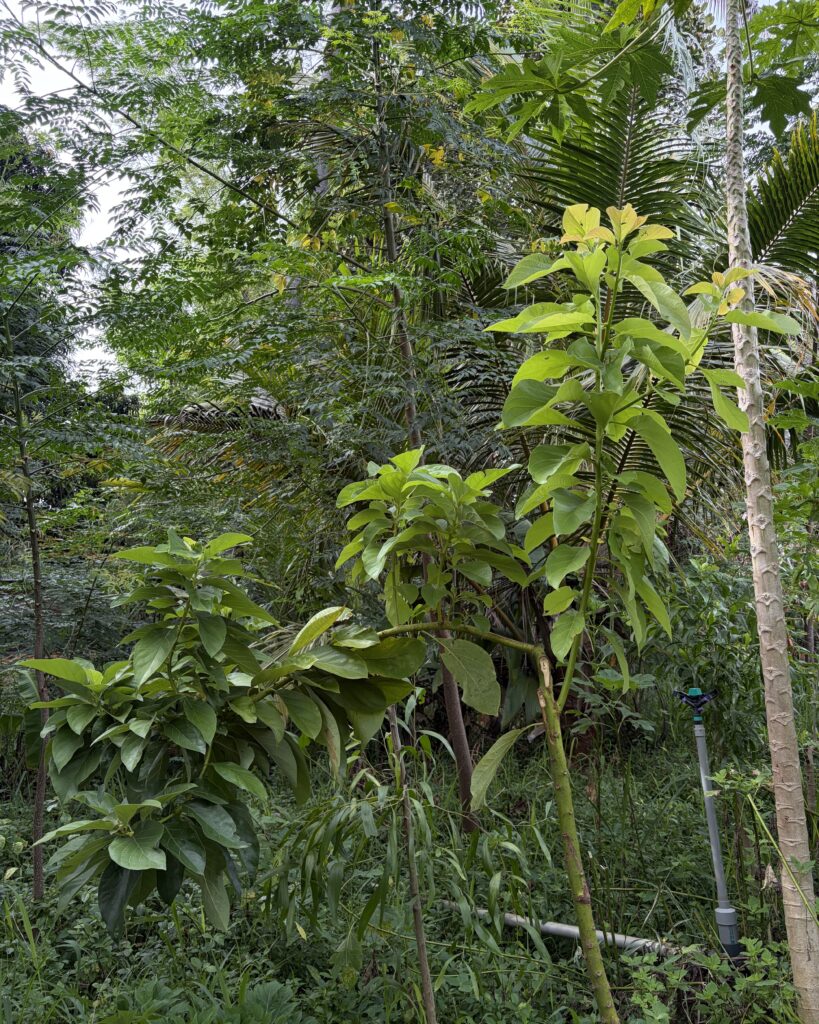
In June 2025, we planted a jackfruit-based system in a narrow field measuring approximately 70 metres by 5 metres, covering 350 square metres.
Jackfruit, papaya and lemongrass occupy the outer tree lines. Between them are repeated lines of rosella, Mexican sunflower, cow grass and castor.
The design includes approximately 44 jackfruit trees, 73 papayas, 248 lemongrass plants, 306 rosella plants, 153 Mexican sunflowers, 306 cow-grass planting positions and 153 castor plants.
The narrow shape makes the field accessible from either side. It also gives us a relatively simple system in which to observe the relationship between long-lived jackfruit, temporary papaya shade and repeatedly pruned biomass plants. This is a fairly young orchard and we continue to observe-. how much biomass can the inner lines produce? How frequently should they be cut? How long can the papayas remain before they begin competing with the jackfruit? Which species will continue growing well through repeated dry seasons?
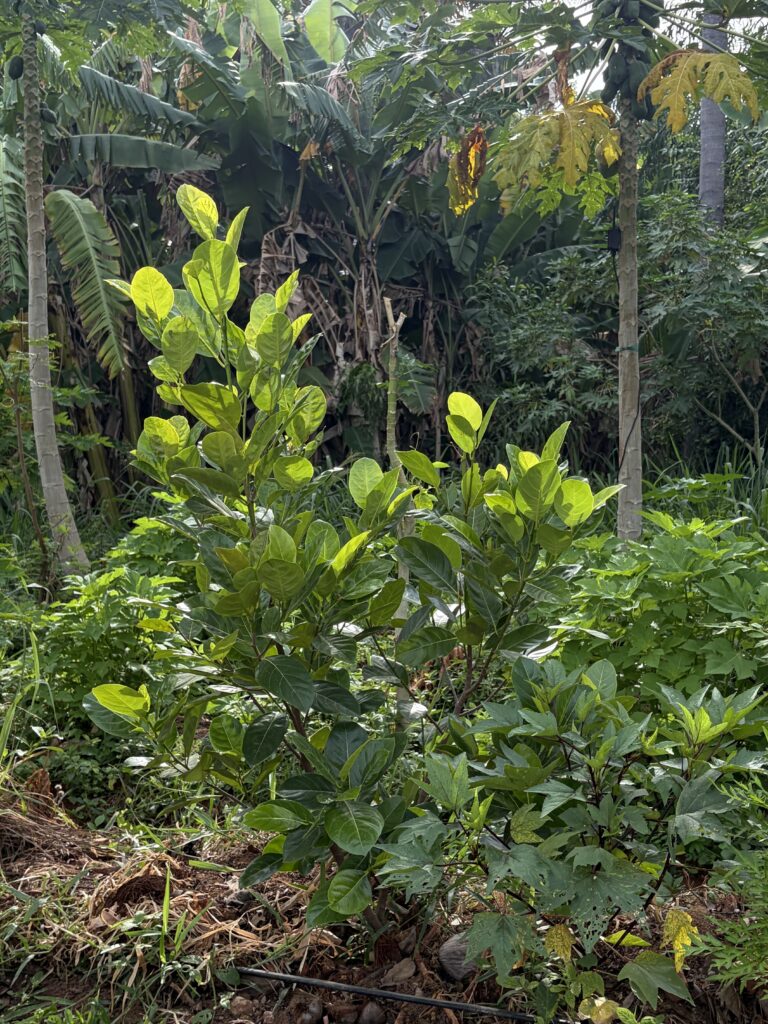
A second avocado field was designed over approximately 65 metres by 15 metres, covering 975 square metres.
The permanent design is based on 45 avocado trees at an eventual spacing of about 5 by 5 metres. Between them are 135 papayas, 150 moringa trees, 75 subabul trees, rosella, Mexican sunflower, lemongrass, maize and cow grass.
This system is more regular than the first experiment. The planting follows repeated tree, biomass and access lines, making it easier for the team to understand where each plant belongs and how it should be managed. The mature orchard is relatively simple: avocado trees at their final spacing. The complexity lies in the first few years, while the spaces between the trees can still produce papaya, short-cycle crops, shade and biomass. As the avocado canopy expands, much of this vegetation will be pruned heavily or removed.
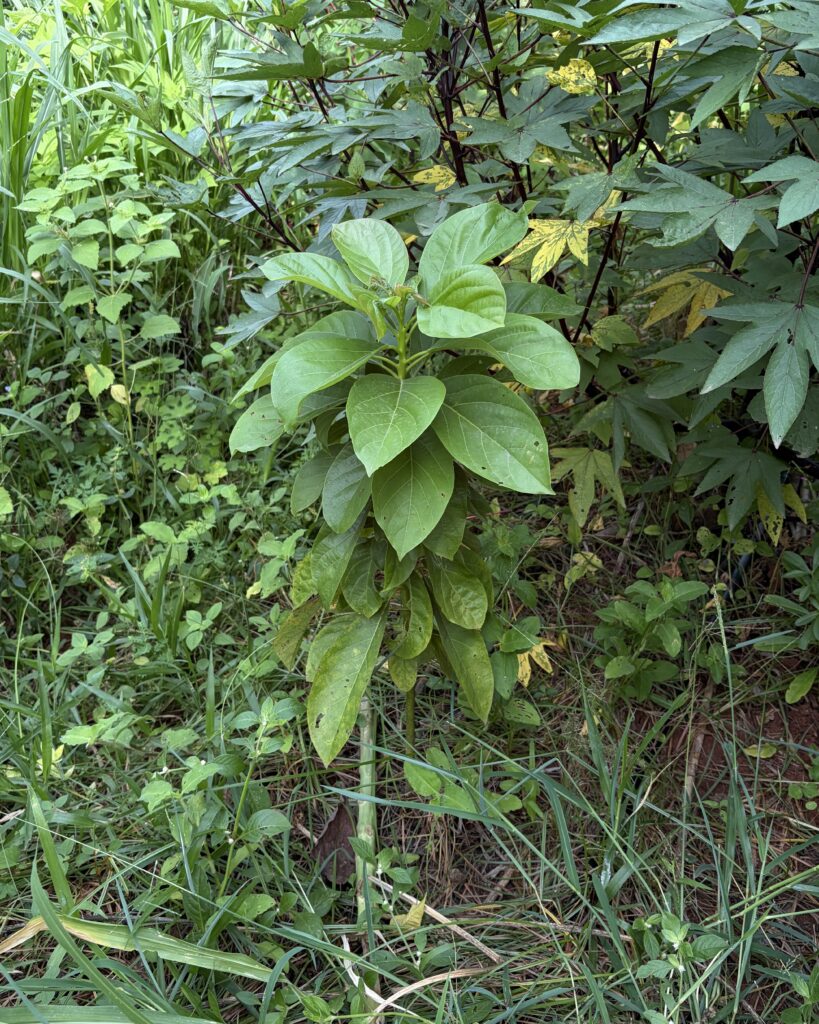
The proposed lemon system covers approximately 40 metres by 13 metres and will be planted this monsoon. Lime trees are placed at a final spacing of around 5 by 5 metres. Papaya, moringa, rosella, castor and Mexican sunflower occupy the spaces between them during the earlier stages.
Young citrus may benefit from some protection, but mature lime trees require increasing access to sunlight. The system therefore needs to become more open as it ages. Papaya, castor, moringa and other support plants will be pruned or removed as the lime trees develop.
Our proposed 2026 cacao trial is a strip measuring approximately 30 metres by 6 metres.
The design contains 20 cacao plants, together with kumquat, leucaena, castor, Mexican sunflower and watermelon. Other possible plants in the wider succession include papaya, drumstick, rosella, pineapple, lemongrass and galangal. Cacao generally develops under some protection, which makes it a particularly challenging crop for our conditions and therefore an interesting experiment.
These systems are still young. Most of the principal fruit trees will require several more years before we can properly evaluate their production, health and long-term relationship with the other plants. However, we have immediately seen the impact of the biomass addition in the soil. Also, the plants seem to be stronger and healthier, perhaps due to growing up in a community of diverse plants. All climatic zones are very unique and Dry tropical syntropic agroforestry systems need their own experimentation for successful syntropic and agroforestry models. Our contribution is the ongoing record of the work: the species considered, planting plans, spacing, irrigation, pruning cycles, survival, labour, harvests, failures and changes made from one design to the next. We hope that sharing these details will offer useful starting points for farmers working in similar conditions, while also inviting questions, comparison and further experimentation.
AuroOrchard: Experiments with Syntropic Agriculture
https://auroorchard.auroville.org/experiments-with-syntropic-agriculture/
FAO: Overview of Agroforestry
https://www.fao.org/agroforestry/about-agroforestry/overview/en
Roberts et al. (2017): The Deep Human Prehistory of Global Tropical Forests and Its Relevance for Modern Conservation
https://www.nature.com/articles/nplants201793
Agenda Götsch: What Is Syntropic Farming?
https://agendagotsch.com/en/what-is-syntropic-farming/
Agenda Götsch: Ernst Götsch
https://agendagotsch.com/en/ernst-gotsch/
Agenda Götsch: Life Cycle, Stratification and Succession
https://agendagotsch.com/en/life-cycle-stratification-and-succession/
Agenda Götsch: Natural Succession in Syntropic Farming
https://agendagotsch.com/en/natural-succession-in-syntropic-farming/
Agenda Götsch: Design for the Mediterranean—Enriching an Olive Grove
https://agendagotsch.com/en/design-mediterranean-enriching-olive-grove/
Agenda Götsch: Large-scale Syntropic Farming—Results and Challenges
https://agendagotsch.com/en/large-scale-syntropic-farming-results-and-challenges/
Jacobi et al. (2025): Syntropic Farming Systems for Reconciling Productivity, Ecosystem Functions, and Restoration
https://www.sciencedirect.com/science/article/pii/S2542519625000476
Join our newsletter for exclusive updates!
AuroOrchard is certified organic by the Tamil Nadu Organic Certification (ORG/SC/1906/001683) Department accredited by APEDA (Agricultural and Processed Food Products Exports Development Authority), New Delhi, Ministry of Commerce and Industry, Government of India.
AuroOrchard Poultry is recognised under the Certified Humane Program, a globally recognised, independent, international auditing body dedicated to creating a more humane world for farm animals.