Recently, an Aurovilian asked me when AuroOrchard got its name. I couldn’t give them a clear answer. Over the years, I have heard many stories from Gérard and Bithi about the early days of the farm. These stories have many layers, and with the passage of time it becomes difficult to remember which detail belongs where, or in what order things happened. The Aurovilian who had asked me found some archival material. This post summarises these findings that I felt we should keep as part of the farm’s history. The documents don’t give us the exact date when the Mother named AuroOrchard, but they do tell us something about the land before it had that name and how, a few years later, she wanted it to be farmed. I have tried to bring these pieces together here for anyone curious about our beginnings.
On 28 March 1965, three years before Auroville’s inauguration, Navajata wrote to the Mother about the purchase of agricultural land for the future township. There was a well, a pump, a small house, mango and cashew trees, palms and a Ganesh temple. The sellers had asked for a written undertaking that the temple would be maintained and that someone would continue to perform the puja. The following day, Amrita took the letter to the Mother and recorded her reply: “all right.” The land records give the date of purchase as 29 March 1965: 60.5 acres for ₹65,000.
Two months later, in a conversation with Satprem, the Mother spoke of the understanding that people could continue to come to the temple to offer their prayers. She recalled a visit by Panditji from Rameshwaram. He was pleased to see the temple, and when asked what should be done about the rites, he replied, “Oh, Ganesh will look after that, don’t worry!” The Mother laughed as she told the story. It saddens me that today the temple is completely cut off from the farm. And yet Diwakar lovingly performs the rituals every day. Ganesh is looking after that.
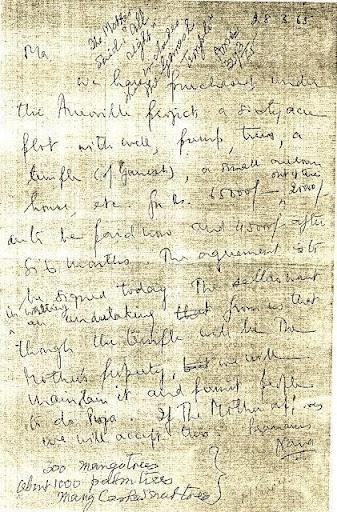
We usually date the beginning of AuroOrchard as a farm to 1968, when it took up the work of growing food for Auroville. The purchase of the land was earlier. By 1971, we find the name in the Mother’s own handwriting, in a note about how the land was to be cultivated. In March of that year, Raoul Mercier, who was looking after AuroOrchard, wrote to the Mother asking whether Auroville should promote the use of inorganic fertilisers and pesticides. Her answer began, “NO, NO, NO.” When the question came up again in June, the conversation turned to cow-dung manure and to the Mother’s own experience of growing bananas. Shyam Sunder recorded her words: “What is needed is labour, care and attention.” He added that, in his experience, plants and animals responded to love and personal labour. “Yes, yes,” she replied. In her handwritten note, the Mother authorised that all the land of AuroOrchard be reserved for biological cultivation.
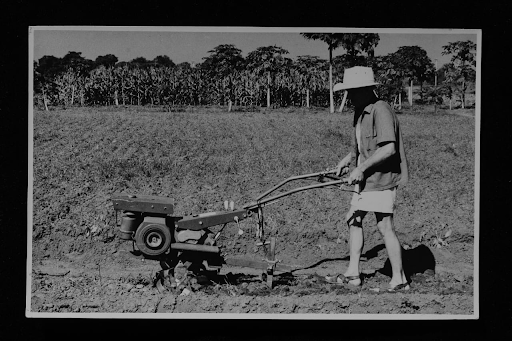
I find it heartening to catch something of the mood of those times in these exchanges. Reading it all these years later, I feel something of the aspiration that Gérard and Bithi have tried to convey in their stories.
Recently, we both Bithi and Gerard had shared about their experiences of the beginnings of the farm:
We still have the question about the name. Perhaps someone reading this will remember another detail or have a letter or photograph to share. I would be glad to add it to the farm’s records. For those of us working here today, there is also something to carry back into the field. The next time we are tending the bananas, we have those few words of the Mother to keep us company: “labour, care and attention.”
Sources: Navajata’s letter of 28 March 1965 and Amrita’s note of 29 March; the Mother’s conversation with Satprem, 29 May 1965; Shyam Sunder’s Down Memory Lane, pp. 116–117; Collected Works of the Mother, vol. XIII, p. 240.
Join our newsletter for exclusive updates!
AuroOrchard is certified organic by the Tamil Nadu Organic Certification (ORG/SC/1906/001683) Department accredited by APEDA (Agricultural and Processed Food Products Exports Development Authority), New Delhi, Ministry of Commerce and Industry, Government of India.
AuroOrchard Poultry is recognised under the Certified Humane Program, a globally recognised, independent, international auditing body dedicated to creating a more humane world for farm animals.