Recently, I had the opportunity to collaborate with Colombian biologist and researcher Lucía Vásquez Celis on a booklet about the Tul, or Nasa Tul, for Colombia’s Land Restitution
Recently, I had the opportunity to collaborate with Colombian biologist and researcher Lucía Vásquez Celis on a booklet about the Tul, or Nasa Tul, for Colombia’s Land Restitution Unit. Lucía has many years of experience engaging with the Indigenous peoples of Colombia and their territorial processes. The Nasa are one of Colombia’s many Indigenous communities. Their ancestral territories are located primarily in Cauca, in southwestern Colombia. They have their own language, Nasa Yuwe, systems of community government, spiritual authorities and collective territories known as resguardos. The Nasa have endured colonisation, displacement, armed conflict and continued appropriation of their lands. In response, they have developed strong movements for cultural survival, territorial recovery and political autonomy. Their collective organisation is guided by four closely connected principles: unity, land, culture and autonomy.
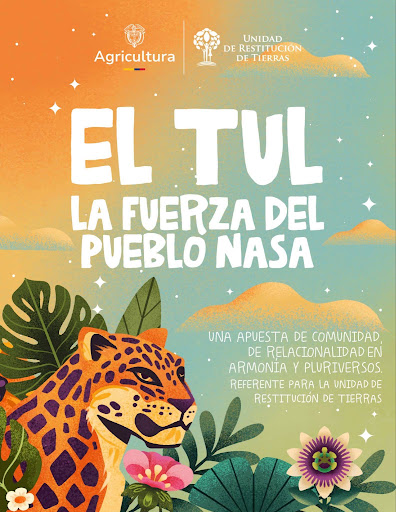
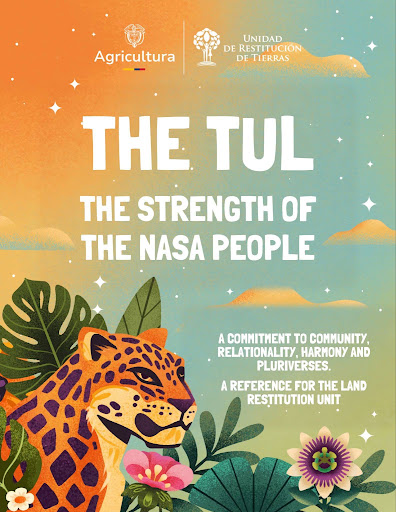
You can access the document here: Español (original) / English (translation)
For the Nasa, territory is far more than the area of land they inhabit. It is a living space where community, nature, ancestors, spirituality and collective memory come together. Defending the territory therefore means defending a way of life. Agriculture forms an important part of this way of life through a system known as the Tul. The Tul is a space where food and medicinal plants are cultivated, seeds are conserved and knowledge is passed between generations. The booklet describes it as a weave (tejido) of the Earth, made with food, medicinal and spiritual plants. Trees, crops, animals, people, water and the other beings of the territory all participate in this weave. The land provides food, medicine, water and shelter, while people carry responsibilities towards the land.
Foundations and Principles of the Tul
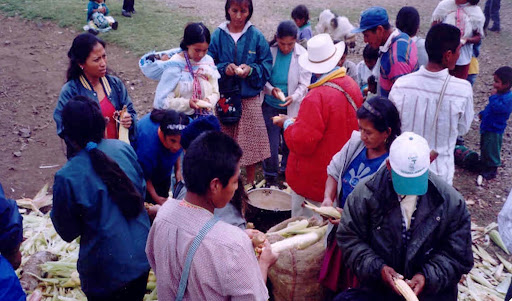
The Nasa people of Cauca, Colombia
The foundations of the Tul lie in the Nasa worldview and their collective life. The Nasa understand life through relationships among different worlds, beings and spiritual forces. At the centre of this worldview is Wét wét Fxi’ze nxi (pronounced Wet wet fyee-eh-zeh n-yee), which can be translated as living in harmony, closely related to the broader Latin American concept of Buen Vivir. Harmony here emphasises the continuous work of bringing the individual, community, territory and other beings of nature into a balanced relationship. Another important idea for the Nasa is sentipensar: feeling-thinking. It questions the separation of thought and feeling, recognising that knowledge arises through the body, land, memory, emotion and collective experience.
This worldview takes collective form through the Nasa life plans. These are community processes through which people decide how they will live together, care for their territory and exercise autonomy. They are based on spirituality, respect for Mama Kiwe or Mother Earth, reciprocity and participation. And these foundations become a lived practice through the Tul. Forests, mountains, wild animals, rivers, lagoons and springs are recognised as sources of life that require care and respect. Water is sacred because life emerges from it. The Tul also expresses the Nasa relationship with Mother Earth. The Nasa understand themselves as her children: the Earth gives them life and food, and when they die, they return to her. Caring for the territory therefore includes allowing some areas to rest, protecting water sources and defending the land from activities that cause ecological and social harm. Nasa women play an important role in this work as caretakers of territory and weavers of life.
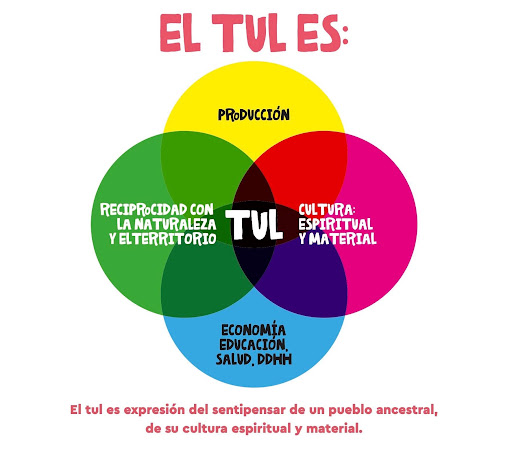
The Nasa people of Cauca, Colombia
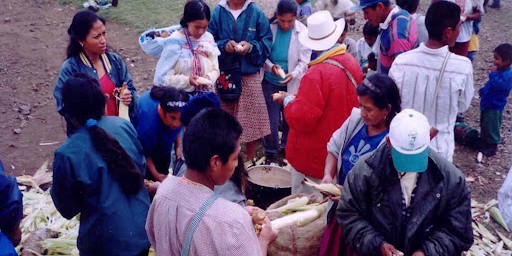
Community is equally important to the Tul. Work is often carried out collectively through minga, a traditional form of community work among Indigenous peoples of the Andes. People come together to undertake work that benefits a family, the community or the territory, including planting, harvesting, building, repairing paths and caring for water sources. More than shared labour, minga is a space for exchanging knowledge, making collective decisions, sharing food and strengthening relationships. It is based on reciprocity: people offer their time and effort knowing that others will support them when needed. Through the Saakhelu ceremony, people give thanks to Mother Earth, honour the sun, moon and animals, and awaken conserved seeds through dance, music and medicinal plants.
The Tul is also a place of education. Children learn through participation: by planting, harvesting, caring for seeds, sharing food, speaking their language and observing how their parents and elders relate to the Earth. In this way, the Tul carries Nasa knowledge and culture from one generation to the next. The Tul is therefore much more than farming. It is an entire system of life rooted in territory and shaped by the principles of unity, land, culture and autonomy.
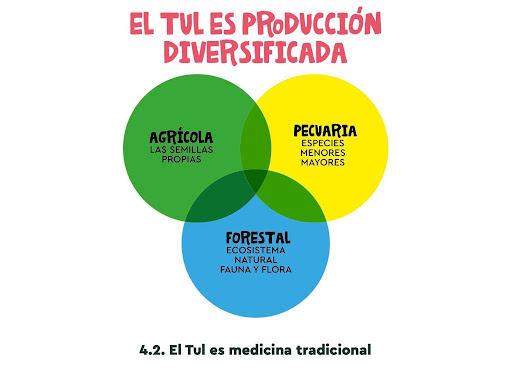
Tul as an ancestral medicine system integrates both forests and agriculture
A dialogue with Integral Yoga
In my contribution to this document, I brought the Tul into dialogue with ideas from Integral Yoga. Both hold unique worldviews, and yet both open important questions about the unity of life and the place of the human being within it.
Sri Aurobindo, drawing from the Upanishads, writes that all matter is food and that the eater is, in turn, eaten. Food can therefore be understood as part of a continuous exchange of matter, energy and life. Every being is nourished by other beings and eventually becomes nourishment itself.
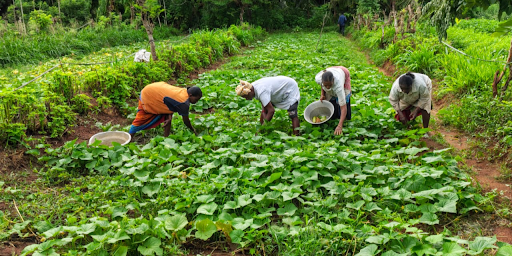
Agriculture makes this relationship tangible. The farmer offers the labour and capacities of the body to the land. The land offers its body for the growth of food. Food offers itself to nourish another body. Agriculture connects land, farmer, food and community through an ongoing movement of giving and receiving. And from this point of view, the farmer does more than just grow food; the farmer also becomes food. Our attention, time, strength, knowledge and care enter the land and become part of what it produces.
From the perspective of Integral Yoga, matter is part of spiritual life. The body, food and physical work can participate in the evolution of consciousness. Agriculture may therefore become a field of inner, social and ecological transformation.
This leads to a different set of questions. Can agriculture respond to physical hunger while also addressing our hunger for relationship and meaning? Can food be understood through offering and shared joy, instead of consumption alone? Can the farmer’s body serve the body of the land? Can cultivation also cultivate the human being?
Learning from the Tul
The Nasa Tul reminds us that a food system carries a particular way of perceiving and relating to the world. Food is connected with territory, memory, spirituality, reciprocity and community. These dimensions have become increasingly obscured within large industrial food systems. The Tul, alongside other living Indigenous agricultural traditions, offers important clues to the questions of what food is for, what relationships it carries and what agriculture can become.
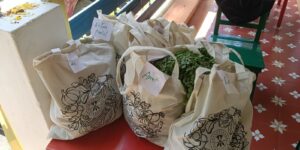
At the same time, the Tul is not a model that can simply be transferred to any place. It can, however, help us reflect on our own agricultural practice. At AuroOrchard, we regularly ask how a farm can grow food while caring for soil, water, plants, animals and people. The Tul affirms that a farm cannot be understood only through what leaves it in a basket. A farm also carries seeds, memories, knowledge, relationships and ways of perceiving the world. Integral Yoga offers an evolutionary aspiration: the possibility that material life may become increasingly conscious. And the Tul shows how agriculture, territory, community and spirit can be held together within daily life.
Join our newsletter for exclusive updates!
AuroOrchard is certified organic by the Tamil Nadu Organic Certification (ORG/SC/1906/001683) Department accredited by APEDA (Agricultural and Processed Food Products Exports Development Authority), New Delhi, Ministry of Commerce and Industry, Government of India.
AuroOrchard Poultry is recognised under the Certified Humane Program, a globally recognised, independent, international auditing body dedicated to creating a more humane world for farm animals.