Following is an English translation of the French interview with Christian conducted by Emilie Ponceaud Goreau and Anthony Goreau Ponceaud and published in Open Edition of Journals, a French platform for the humanities and social sciences. Christian worked on the farm from 2012-2019, and was the key driver in
Following is an English translation of the French interview with Christian conducted by Emilie Ponceaud-Goreau and Anthony Goreau-Ponceaud and published in Open Edition of Journals, a French platform for the humanities and social sciences. Christian worked on the farm from 2012-2019, and was the key driver in transitioning the farm to fully organic. In this interview, he describes how he began his work at AuroOrchard and reflects on his ideas about agriculture, consumption, and creating a new relationship with the soil.
Reference: Emilie Ponceaud-Goreau and Anthony Goreau-Ponceaud, “Entretien avec Christian Tarpin. Ferme AuroOrchard, 12 décembre 2019,” Les Cahiers d’Outre-Mer [online], 281 | January–June, published online January 1, 2022.
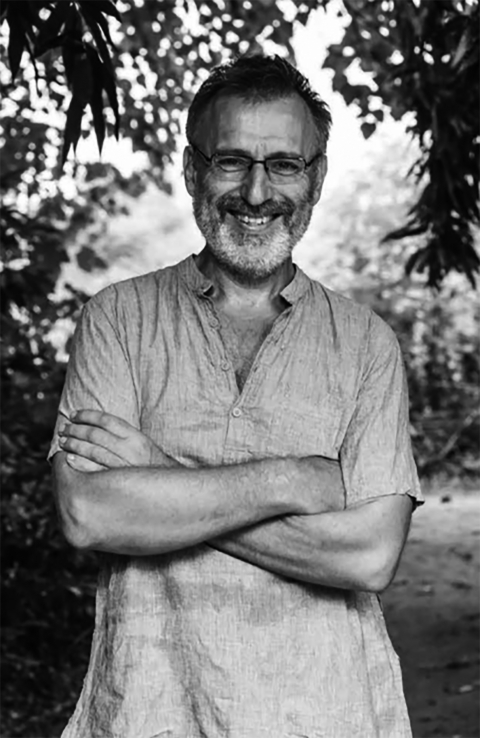
Photograph 1: Christian Tarpin, originally trained as a civil engineer and urban planner specializing in mobility systems, is now a farmer at AuroOrchard, the historic farm of the Auroville community, founded by Gérard and Bithi in 1969.
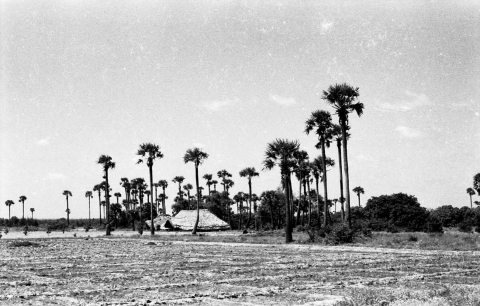
Photograph 2: The “Groundnut Field” and the First Cowshed of AuroOrchard
I discovered the farm on February 15, 2012, shortly after Cyclone Thane had passed through (December 31, 2011). It was devastated, yet I fell in love with it. Forty years of conventional agriculture had damaged it; the cultivation practices, maintaining the soil bare and clean, ready to receive new crops, had destroyed its fertility. This is true in general, but even more so in this climate. On top of that, the cyclone had passed through and caused major damage. I still remember Gérard1 standing in front of the four hectares where there are 300 large mango trees, extending his hand and saying: “and there, the mango orchard”… and I could see nothing, the trees were so entangled, broken… The road entering it was not even visible anymore! But I also saw that Gérard had done incredible work.
Hmm… To understand that, we will have to take quite a few detours…
In fact, the climax ecosystem of this region is the Tropical Dry Evergreen Forest (TDEF)2. This country experiences intense sun and intense rains; only trees are strong enough to withstand and protect the soil from these aggressions. The region is also described as arid because evaporation exceeds precipitation. In reality, it is bistable: either one strips and damages the land and moves toward desert, or one protects and cares for it and moves toward forest. Agroforestry is therefore unavoidable… agriculture must navigate, oscillate between these two “temptations”: desert or forest.
The history of this place is linked to that of Pondicherry. The city was built mainly out of wood, which explains the deforestation. It was also burned and rebuilt several times because of the quarrels between the English and the French. In the eighteenth century, the inhabitants also cleared a ten-kilometre “buffer zone” around the city to protect themselves from leopards and elephants. Auroville was established in this place, intentionally desertified by humans. The landscape evolved toward desertification, especially because cattle are left free to roam here; it is a local tradition.
At the beginning of Auroville in the 1970s, the plateau was desert-like, though it nevertheless became green during the rainy season… The inhabitants had developed a rainfed agricultural system consisting of enclosing the fields at the end of spring in order to protect them from cows; they sowed as soon as the first rains of the small monsoon arrived in June, and harvested one or two crops. Afterwards, they opened the fields again, the animals ate the stalks, trampled the soil, deposited their excrement… This ecosystem was fragile; the older Aurovilians experienced sandstorms.
Today only 2% of the original forest that once covered the eastern coastal strip of the Indian subcontinent remains. Most often, only the sacred groves around temples survive; when entering them, the presence of these old trees is striking, one can breathe there… It would take centuries to recreate this forest! The history of the landscape here has been deeply marked by human beings. It was once an extremely rich, wooded landscape, but today we continue moving toward the desert. When I arrived at AuroOrchard eight years ago, I had difficulty outlining the farm on Google Maps because the surroundings were still green. Today the green form of AuroOrchard emerges like an island of resistance, green amidst the red of exposed earth! We are still pushing the cursor toward desertification because this is an “economic development” zone, highly coveted along the highway…
I always had gardens; I was self-sufficient in vegetables, cultivating more than 1,000 square meters of land to feed my family. It was part of my life, but I had no training as a farmer, even less in tropical agriculture. At first, I considered myself an apprentice; I listened to Gérard, conducted small experiments, and continued the BRF3 approach that he had started in 2011. It was a very good direction, which I developed extensively. Bernard and Deepika4, the founders of Pebble Garden, the seed-conservation vegetable garden where I volunteered, encouraged me.
I began here in February 2012, initially one day per week. I observed what was being done, learned their methods, and gradually became more and more involved. By October 2012 I was full-time, responsible for the vegetables… One day, because of an excess of potassium, a field bloomed with green, slimy, foul-smelling algae, like the green tides in Brittany, and I really became angry: “either we switch to organic farming or I leave.” Gérard received this very positively and said to me: “I’m too old to launch into that, I know nothing about it and I don’t believe in it” , in fact, he still doesn’t believe in it! , “but if you do it, we are with you.” That is how it began.
Given the state of the planet, we should in fact regenerate everywhere. Human beings, both individually and collectively, behave on Earth today in an extremely selfish, immature, and extractive manner… like a child stealing from the refrigerator the chicken leg that his mother had saved for the next day, without worrying about refilling the fridge. The extractive approach means “hitting” a resource while considering it free and/or unlimited, or in any case without taking responsibility for it.
This tradition founded economic science thanks to Jean-Baptiste Say, who wrote in 1803 in his Treatise on Political Economy this terrible sentence: “Natural resources are inexhaustible, for otherwise we would not obtain them freely. Since they can neither be multiplied nor exhausted, they are not the object of economic science.” At that time, Earth’s resources seemed inexhaustible, and this could be understood: when he said that, human beings and all the animals associated with humans perhaps represented 5% of terrestrial vertebrate biomass. By 1900 it was probably already 10%; by 2000, 90%; and in 2018, according to figures published in an academic article5, it was 96% of everything moving on Earth6… The problem is that we have not changed our mentality!
The extractive model still assumes that the planet is a gigantic refrigerator supplied by a hypothetical Mother Nature, and that there will always be a chicken inside from which we can steal a leg. The problem is that Mother Nature can no longer bear the burden of the ecological footprint imposed by humanity. We absolutely must change the rules of the game, become gardeners of the Earth, and recreate abundance. To say “recreate abundance” is already terribly arrogant because we do not have the power to create abundance… it is already there! We simply need to respect it, help it flourish. And give thanks to it; I think that is the fundamental movement. It is about moving from extractive to contributive, from parasitism to symbiosis, from adolescence to maturity, from destruction to regeneration, from scarcity to abundance.
In the vision opened to us by the thermodynamics of open systems, developed by Ilya Prigogine in the 1970s. Life on Earth, the biosphere, is what is called a “dissipative structure,” unfolding because it is nourished by a flow of energy, powered by the hot point that is the sun and dissipating toward the cold point that is the depths of the cosmos. I insist on the importance of both: without the sun there would be no life, but without the cold depths of the cosmos we would be burned alive. And this energy is immeasurable.
I often cite this figure because it really makes one think: humanity’s electricity consumption for an entire year equals five minutes of the Earth being illuminated by the sun, and the total annual energy budget… one hour! Without energy there is no life, but do not tell me that energy is scarce; in reality we are swimming in an abundance of energy. And this abundance comes almost exclusively from the sun.
Then, who knows how to use the energy of the sun and transform it into chemical energy usable by living beings, who knows how to “create something where there was nothing”? Fundamentally, plants, and ONLY plants, through the mechanism of photosynthesis… Let us look more closely:
We must return to the fact that all living beings, including plants, possess a metabolism that “oxidizes” sugars, or more generally carbon chains C, by means of oxygen O₂ (“oxidize” comes from “oxygen”), and releases carbon dioxide CO₂. The very same CO₂ that is causing us problems with the greenhouse effect. This oxidation reaction releases energy. That is why it is more or less universally used as the basis of metabolism, because it allows living beings to become active on Earth. But the counterpart is that the oxidized form is more stable than the non-oxidized form. One also says that the potential energy of the oxidized form is “low,” because the useful energy has already been released. It is like letting a marble roll to the bottom of a bowl, or a car roll down a slope… One recovers energy and can do something with it, but the problem is that the marble does not spontaneously climb back up the bowl, nor the car back up the slope. It is a one-way movement.
Incidentally, this explains why CO₂ will not spontaneously disappear; it is stable. That is why the greenhouse effect we have created is something that will remain with us for a long time, tens or hundreds of thousands of years…
How does one wind the spring again, how does one rebuild potential chemical energy? Well, through the inverse reaction, called reduction. And in order to carry out such a reaction, one must be capable of capturing and reinjecting energy… Now, only plants know how to do this, through photosynthesis, which starting from carbon dioxide CO₂, water, and light energy, knows how to reconstruct sugars and releases oxygen O₂.
And in plants, this activity far surpasses in importance their own metabolism, which means that overall, plants are reductive: they are the beings on Earth that rebuild the primary energy of Life and nourish the ENTIRE food chain. They are the source of fertility. And all the ingredients for this reaction are abundant! We have seen that energy is abundant thanks to the sun. CO₂ is also abundant; it is very minor in the atmosphere7, but more than sufficient for plants, especially now that we have emitted too much of it! Water, H₂O, paradoxically is not limited in this country where on average 1.27 meters of rain fall every year. Properly collected and managed responsibly, water is abundant.
The final abundance is nitrogen N. This is the stress point for conventional farmers, whom industrial systems have managed to convince that nitrogen is rare… It would be a joke if it were not tragic, because nitrogen makes up 78% of the atmosphere; phosphorus is a real problem, but not nitrogen! Plants cannot directly absorb atmospheric nitrogen, but living soil does this very well. As soon as soil life is restored, atmospheric nitrogen becomes available to plants.
CHON , carbon, hydrogen, oxygen, and nitrogen , this is the basic recipe of life on Earth. Together they represent 96 to 98% of the bodies of living beings. All are abundant, and all fall from the sky! It is amusing, actually, because one could say, without exaggerating too much, that plants and animals, all of us, are made of air. One feels lighter, no? And air, thank God, is still abundant and free…
So regeneration is not very complicated; it begins by growing plants. It is a gift! This is what I call here on the farm the “grow something principle”! Every time we grow plants, we recreate possibilities for life. Because yes, plants are food for us animals, certainly, but above all they are food for the soil. The method we follow here, and that should be followed everywhere, is to grow plants and return those plants to the soil in order to nourish and protect it.
I have the impression that man , let us say the masculine , at some point chose to look at the world from the angle of how he could profit from it; he focused on the “plant-animal” pair. In doing so, he pushed the feminine into the background. In the cycle of life, the feminine is rather the “plant-soil” pair. The soil is this obscure, discreet, very Yin metabolism, capable of forgiving everything, welcoming everything, recycling everything, and making available once again the elements that allow new life to emerge. What I am describing are qualities usually attributed to the feminine archetype. Conventional agriculture, under the gaze of man, focused on the Yang, on “I grow crops because I want to eat.” It is an instrumental approach: to make a car run, you put fuel in the tank; to grow plants, you put NPK fertilizers at the roots. Magic! But we forget the soil, we forget fertility!
It is very simple: the soil is a living being. Children are taught in school that living beings consist of plants and animals, but this is false, or at least misleading. There are plants, animals, AND soil , and even then, one should not say it in that order, but rather: plants, soil, and animals. Life appeared on Earth in that order, and fertility is rebuilt in that order. For life to begin on Earth, photosynthesis was necessary , this capacity to create something from sunlight and CO₂ alone. The first living beings needed a support; first they found water, the universal medium of life on Earth, and then soil. These were stromatolites, cyanobacteria, prochlorococcus… They are still here, though somewhat forgotten by humanity, except when fashion suddenly decides that people should consume spirulina.
Life first comes from the plant, then the soil, and afterwards the animal. The role of the animal only makes sense if the foundation is there; a pyramid is not built from its tip. The fundamental movement is to let plants grow. Afterwards, one can be clever… plant a little for food, but above all plant a lot to feed the soil. As soon as the soil is fed, it recreates the foundations of fertility. If it is not fed, it dies, like every living being. It is astonishing how poorly the soil is understood: we know only 2 or 3% of the living beings in the soil8, even though the survival of humanity depends on them9. I really appreciate the movement in France called “gardening on living soil,” because it expresses this beautifully. By saying “it is the plant that creates the soil,” they remind us that the real attention should not first be on growing plants, but on growing soil so that everything else can emerge.
For the farm, I use the term “bio-regenerative”10. The words “permaculture” and “agroecology” bother me a little because they do not clearly say what they do… We do not need incantations; we need practices. I often say that only the plant creates value… It is fundamentally negentropic11, meaning that it creates information. Where there was nothing, and while taking almost nothing from the resources of its environment, a plant grows… Every other metabolism or activity is necessarily oxidative, entropic, consuming energy and degrading resources. Industry claims that it “creates value” because it generates profits… This is ridiculous because, from the point of view of life, at the fundamental level, it is ALWAYS destructive! A smartphone is a miracle of organization, but its cost in terms of the disorganization of the environment is unbearable. This becomes brutally obvious when one asks the question of its recycling!
Animals have a role to play concerning the other elements , phosphorus P, potassium K… These elements, unlike nitrogen and carbon which have rather rapid atmospheric cycles, are stable mineral elements, very terrestrial. Conventional agriculture has placed itself on an intravenous drip of phosphorus extracted from mines located in five countries around the world. Phosphorus will reach its peak within the next thirty years, and its supply will become strained by 2040. This phosphorus extracted from mines is spread across fields, washed away, carried by groundwater and rivers, and finally lost to us as it becomes diluted in the oceans, where it also causes damage.
Yet phosphorus is made available through two principal pathways in a garden or farm: the work of roots and the work of animals. The roots of trees and large plants have the capacity to extract mineral elements from the bedrock through acidic secretions that dissolve the rock and allow the absorption of these elements. These earthy elements, though representing only 2–3% of plant bodies, create the “taste of terroir.” A healthy ecosystem draws resources from the atmosphere but also from the lithosphere. This works very well in most environments… though not so well here: this is a very old sedimentary land where the bedrock is practically inaccessible to roots. The tree, and the plant in general, is structured around a vertical axis: roots underground allow it to capture elements, dissolve them, raise them through the sap, and make them available within an aerial structure. Leaves fall, branches break, the plant dies… and thus recycles itself onto the soil, making its elements available once more. Plants therefore function as elevators; they are “vertical movers.” If we cannot reach the bedrock because it lies too deep here, we can nevertheless bring back up the elements leached downward by rain. These large plants, shrubs, and trees that you see are absolutely not planted for harvests, but because they have roles to play , creating shade, helping water infiltration, and lifting nutrients upward.
Animals, for their part, have a mouth in front, an anus behind, and limbs that allow them to move toward the direction of the mouth and away from the direction of the anus. We are ALL programmed to move toward food and away from our excrement. The opposite would obviously be problematic! These are the kinds of obvious truths we should tell children; it would make them laugh while also teaching them about the nature of the world.
Animals are therefore “horizontal movers,” dispersing seeds and materials. I owe these concepts to the botanist Francis Hallé. One must not forget that life is a matter of material flows! Without the cooperation of animals, I think the physiognomy of the Earth would be completely different. Animals are gardeners simply through the fact that they move , and not only humans12. An animal traces its preferred pathways through the forest; eventually plants stop growing there, and in a way the animal is gardening. By feeding itself, it stirs, fertilizes, redistributes…Human beings love apples, so they cultivate apple trees and plant them everywhere.
We also encourage animals and the return of biodiversity at AuroOrchard because it is a sign that fertility is returning. As soon as we allowed plants to express themselves, the return of biodiversity was astonishing. If I remember correctly, it took only three months for lizards to reappear, and nine months for a bird of prey to come and hunt them! At first I complained, but then I quickly understood that it was a good sign… the ecological pyramid, the food chain, was rebuilding itself. Now we have porcupines, wild pigs, and even a boar! As a joke we say we are now waiting for the tiger and the bear! The porcupine causes us trouble because merely to drink it would cut down three papaya trees in a single night; so we organized the permeability of the farm to allow wild fauna to enter, but we stop them before the gardens with an electric fence. When the boar arrived last year, three women workers encountered it on the path… they were terrified. See how well things are arranged… We animals live above the soil, soil life unfolds below it, and the plant , with roots below and leaves above , creates the link between the two. We need everyone in order to inhabit the biosphere!
India is beginning to mobilize around the issue of water. But for the moment, public policies still encourage the exhaustion of groundwater: in several states, including Tamil Nadu where we are, leaders maintain free electricity for agricultural pumping. This is clearly an electoralist measure, a way of buying votes in a country where farmers represent 55–60% of the population. Everything is organized to encourage an agriculture based on pumped water, to the detriment of the older agriculture based on rainfall , what is called “rainfed agriculture”13. All the surface water systems that once existed , ponds, channels… , are disappearing. If one looks at the region on Google Maps, it is dotted with ponds. There are no rivers here, no natural surface water; the elders had to shape the landscape themselves. But over the last fifty to seventy years, the surface-water network has deteriorated and decayed, in favor of borewells and pumping.
The main aquifer beneath our feet, called Vanur, is on the path toward exhaustion. Having fallen well below sea level, it is progressively invaded by saltwater. The phenomenon has been predicted since the 1980s, but nobody acts. At first, people near the coast were worried because the wells were going deeper, but over the last ten years, anxiety has increased because the wells are no longer going deeper , instead, salinity is rising. I do not have recent figures, but I remember that in 2012 Vanur was being pumped four times faster than it was being replenished, and this imbalance is growing exponentially, whereas it would take thousands of years for the aquifer to regenerate.
Auroville is, overall, more virtuous than the average. But since our territory represents only 1% of the surface area of the bioregion , Pondicherry, Villupuram, Auroville, Cuddalore , our efforts carry little weight compared to the surrounding madness. Among us there are a few courageous people, passionate and deeply committed, but as an institution Auroville has not seriously taken hold of the water problem. Growing food and recreating fertility , we know how to do that. Recovering water is also very simple: one builds small bunds to stop runoff, channels to guide water toward percolation pits. We simply need good tools. I call this “Neanderthal technology”… And once this is done, the water becomes available again… in the aquifers, twenty meters beneath our feet!
But that is where another problem appears: water must be extracted from the well, and for that energy is needed. So water and energy are linked… This energetic dimension of regeneration is not easy. Even if we know technically what must be done, it requires a lot of money. And here, we do not have many rupees. Thanks to a donor, we were able to convert our main well to solar power. At least now the vital base of the farm is secured through solar energy and no longer depends entirely on the electrical grid. The fact that pumping electricity is free makes our effort appear foolish; it is an investment “in pure loss,” as an economist would say, since we were not paying for electricity anyway. But we did it in order to become more resilient.
Too few Aurovilians have made the choice to invest in solar installations and solar pumping, at least partially. Energy may very well become scarce. If, because the grid fails, we die of hunger, that is neither intelligent nor regenerative! In Auroville, too few of us think and act in this direction of resilience and regeneration. Yet I thought that when the Mother said, “Auroville, the city the Earth needs,” this was supposed to awaken consciousness regarding these issues. Today, in 2019, we know what the Earth needs! It is written in all the newspapers… But apparently it is still not obvious for the community.
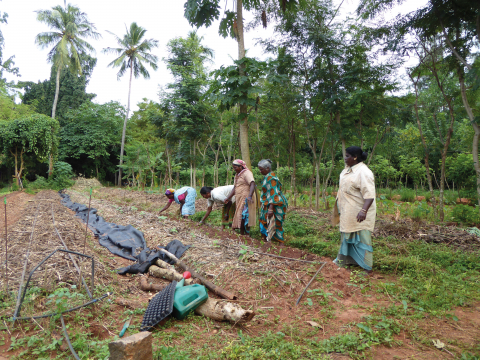
Photograph 3: The AuroOrchard farm in 2019 (at the time this photograph was taken, the farm employed 14 Indian workers).
I think that the community, opposed here to the isolated individual upon whom consumerism has been built , must be revalorized for a very simple reason: the world is experiencing a contraction in the availability of energy. Our civilizations, except perhaps for a few Bushmen or Amazonian Indigenous peoples, devour fossil energy and destroy natural resources in order to produce GDP. The two “fuels” of this madness are becoming scarce. We will have to slow down, to degrow. Eighty percent of transportation relies on fossil energy. In the United States, the average food item travels several thousand kilometers before reaching the plate. This is not sustainable. We cannot do without water and food, which lie at the base of Maslow’s pyramid14. Concerning water, we must shift back toward surface-water systems, which require less energy, and we must grow food locally. The contraction of scale around the community therefore seems to me an energetic necessity, one that will transform landscapes.
Incidentally, relocalizing food also requires , and we are doing this at AuroOrchard , the re-domestication of forgotten local varieties. This is the work being done at Pebble Garden, and we are also doing it here, notably through the rehabilitation of roots and tubers such as taro, cassava, elephant foot yam, and others, which grow healthily and abundantly in this environment without any treatment. They are perennial, generous plants and could become the basis of our future food systems. This too transforms the landscape! However, I feel that the world is not mature enough for the communal turn that some dream of at Auroville. I have experienced this directly… We live with the myth of consensus decision-making, but this principle is inoperative in the current state of human beings.
At the same time, I know that the hierarchical concentration of power that accompanies ownership by individuals or corporations is failing, and we no longer want it for reasons of social justice. Perhaps more modestly, we should already work on the “commons”? It is no longer about forming a total community; there are some people with whom I can form a community, but there are many others with whom I do not wish to. It is like with neighbors: I am not obliged to love them in order to cooperate with them. We can agree to manage commons together because we know that we all need them in order to live. We will have to address the problem of property, agree on intelligent management, establish rules. Perhaps sociocracy can help us, with its principle of decision by consent… For me, this is where a new Politics, a new art of living together, can emerge.
My motivation today is “to recreate nourishing commons.”
With still 55–60% of the population living from the land, plus those who may now live in cities but remain connected to families in villages15, there exists an important capacity for resilience. The day we are truly cornered and the pumps stop functioning, people will roll up their sleeves, take their tools, and cultivate again… I think India possesses an extraordinary resilience, like all countries that are still structured around small family farms. We are always shown images of “glorious” agriculture with ten combine harvesters lined up as far as the eye can see across immense American fields… but this agriculture represents only 25% of global food production. The other 75% comes from small farmers, often cultivating less than one hectare, sometimes with a single ox, and most often simply with their own arms16. Those are the people who will save us.
India also possesses enormous strengths: there are still tigers and leopards in India… elephants only four hours from here. Climatically, tropicality and warmth allow vegetation and soil to grow twelve months a year. There is almost nothing to do in order for forest to regrow here: simply protect the land from intrusion and degradation by animals and humans, and from erosion where slopes exist. You can hang your hammock and watch the forest grow. Without planting anything, after three years the trees are already taller than us! In the lemon orchard just behind us, we discovered that in only two years, one inch of soil had been created , around 2.5 centimeters. The pipes bringing water had been laid on the grass in 2014. When we looked for them again in 2016, they had disappeared! We eventually found them buried one inch deep… and obviously they had not sunk into the earth by themselves , it was the soil that had grown.
When Charles Darwin discovered this phenomenon of soil aggradation in nineteenth-century England, he measured a growth rate of one centimeter per century! So yes… the regenerative capacity here is absolutely incredible. For me, India is a country with a tremendous capacity for resilience, but one that is also facing terrible challenges. This country will have to make certain turns in rather brutal ways and will likely be deeply affected through climate, water, and the poisoning of natural environments. Unfortunately, this will also involve a somewhat drastic population adjustment. But the ecosystem of India is ready to digest all of this and recreate a paradise. I have confidence in this country. Its slogan is “Incredible India!”, isn’t it?
I think it depends more on the person, on sensitivity. Skills and knowledge are part of the personal puzzle, but if the puzzle is oriented toward regeneration, the person will do something regenerative with whatever they possess; and if it is not, they will not. I had the very strange feeling that everything I had done up until then had prepared me for what I was doing upon arriving at the farm , it was my life path.
“To commit myself to regeneration” was more a spiritual urgency than anything else.
Technologies make us dream, but they also deceive us. I spent twenty-five years hoping to resolve the contradictions of the world through technology.
All that was needed was to grow plants.
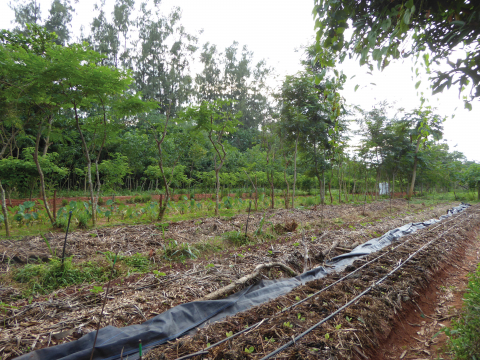
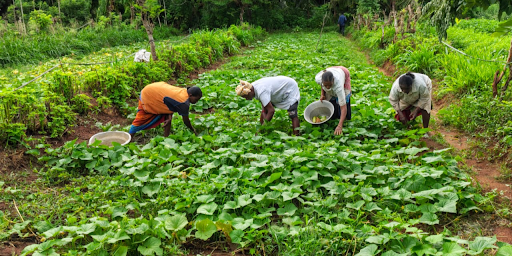
Photograph 4: In the foreground are young lettuce plants. The hedge in the second plane is planted with Indigofera, together with a few Senna (Cassia) siamea; behind that is a plantation of taro, then a second hedge planted with Gliricidia, and in the background one can see bamboo in front of a row of Casuarina (Filao).
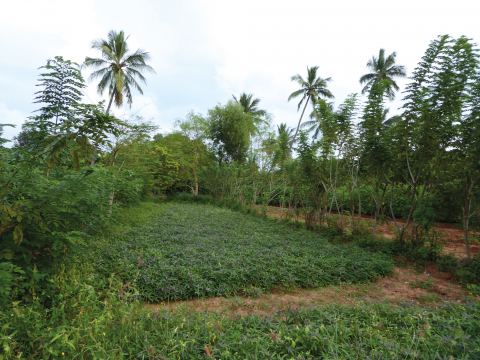
Photograph 5: A sweet potato field bordered by hedges of Gliricidia.
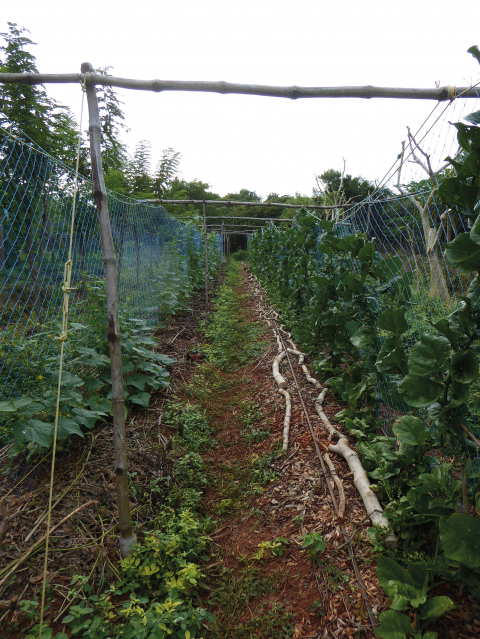
Photograph 6: Two climbing crops grown on fishing nets: cucumber on the left, and on the right Malabar spinach, Basella alba.
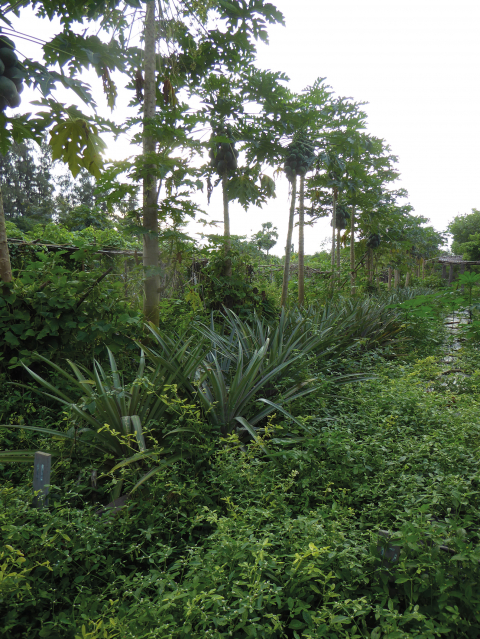
Photograph 7: Association of three plants: in the foreground and to the north, pineapples…Behind them and to the south, papaya trees upon which jicama vines are climbing. Christian discovered that jicama and papaya thrive together, and furthermore, the papayas provide the pineapples with the shade they need for most of the year before they finally ripen under the summer sun. During summer, because Auroville is located at 12° latitude, the sun shifts toward the north.
According to a The Hindu article published on February 17, 2019:
The Hindu article on policy bias against rainfed agriculture
three out of five Indian farmers cultivate using rainwater rather than irrigation. Yet government investment per hectare there is twenty times lower than in irrigated regions, and the principal government agricultural programs are not designed to benefit them.
Join our newsletter for exclusive updates!
AuroOrchard is certified organic by the Tamil Nadu Organic Certification (ORG/SC/1906/001683) Department accredited by APEDA (Agricultural and Processed Food Products Exports Development Authority), New Delhi, Ministry of Commerce and Industry, Government of India.
AuroOrchard Poultry is recognised under the Certified Humane Program, a globally recognised, independent, international auditing body dedicated to creating a more humane world for farm animals.