Glimpses of a solar futureㅤㅤㅤㅤ
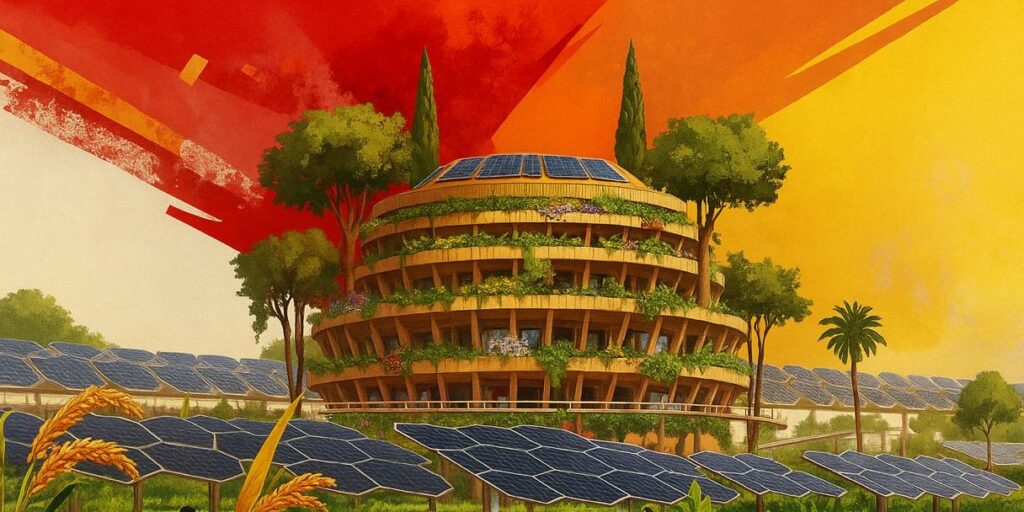
In the Sāṃkhya school of Indian philosophy, the unfolding of matter from spirit gives rise to the senses and to the five elemental manifestations of the material world. From space, emerges air, the principle of movement, and fire, the principle of transformation. Then comes water, carrying flow, continuity, and the subtle pulsations of energy through matter. From the settling of this movement is born earth, the solid ground where life takes form and rests in its full potential. Home » Blog » Glimpses of a solar future Glimpses of a solar future December 2025 · Fabius It all started with 0.1 acres of solar panels. We knew that energy demand would rise and become more and more important.The whole world was trying to find alternative sources of energy and society was slowly changing old systems in order to welcome a new era of electrical abundance. The main source? Sun.All forms of energy come from the Sun. Petrol, coal, wind, water, humans, all dependent and born from the stars. Technology has been trying to mimic the nuclear fusion process of our nearest star but why not just rely on the main source? The Sun delivers radiation of light and we were just converting a tiny fraction of it. It was upon these reflections that a small group of farmers and pioneers started to put into practice the theory by using the land of a farm called “AuroOrchard”, in Auroville, Tamil Nadu, India. It was 2026 when 0.1 acres were smartly covered by solar panels.Solar panels were installed to a height that made agriculture possible under them, the technique was called “agrivoltaics”.The same soil was not only used to embrace the radiations of the Sun and convert them into electricity, it was also hosting the seeds of different plants who were enjoying the shadow, especially during the increasingly hot summers. The 0.1-acre pilot included salt batteries, accumulators that provided eco-friendly and safe alternatives to traditional lithium batteries. Salt, sodium chloride were easily accessible from the nearby ocean. After one year of positive testing and calculations, in 2027, different refrigerators were installed in order to preserve the food, reduce the waste and increase the quality. Encouraged by bountiful harvests and energy surplus, AuroOrchard expanded its vision. Indoor vertical farms emerged in small geodesic domes, employing advanced hydroponic and aeroponic systems under carefully tuned LED lights, sound frequencies lullabied the emerging sprouts. A year-round cultivation of fruits and vegetables, resilient even to extreme weather, became reality. In 2030 AuroOrchard was becoming a beautiful model where technology, nature and spirituality started to harmoniously blend together. Traditional Tamil farming wisdom blended effortlessly with cutting-edge science, inspiring visitors worldwide. Farming started to become more than survival. It was the art to survive, research and thrive especially in hostile conditions. Some aeroengineers started to visit the farm in order to be inspired for their space travels, communities from all over the world were able to access the open sourced projects and implement them in their own land, a new hub was silently growing like the seeds under the crystalline silicon-perovskite cells of the solar panels. Plants began serving new functions beyond nourishment. Researchers developed bio-computing methods using plant neurobiology, harnessing their natural electrical signaling to perform computational tasks and data storage within living systems. In 2040, AuroOrchard’s research deepened into plant consciousness and healing powers. Experiments revealed how plants’ subtle energetic fields could positively influence human well-being, offering complementary pathways toward health through presence and interaction. A whole community was thriving thanks to the farm, which, like a generous mother, provided food, energy, protection, inspiration and unconditional love. It just started with 0.1 acres of solar panels. Previous Article Featured Articles Monthly Updatesㅤㅤㅤㅤㅤㅤㅤㅤ 28 Nov 2025 Abundance Product of the Month 22 Oct 2025 Glimpses of a solar futureㅤㅤㅤㅤ 05 Dec 2025 Flow of fire and water on the farmㅤㅤ 03 Dec 2025
Flow of fire and water on the farmㅤㅤ
In the Sāṃkhya school of Indian philosophy, the unfolding of matter from spirit gives rise to the senses and to the five elemental manifestations of the material world. From space, emerges air, the principle of movement, and fire, the principle of transformation. Then comes water, carrying flow, continuity, and the subtle pulsations of energy through matter. From the settling of this movement is born earth, the solid ground where life takes form and rests in its full potential. Home » Blog » Flow of fire and water on the farm Flow of fire and water on the farm December 2025 · Anshul Aggarwal In the Sāṃkhya school of Indian philosophy, the unfolding of matter from spirit gives rise to the senses and to the five elemental manifestations of the material world. From space, emerges air, the principle of movement, and fire, the principle of transformation. Then comes water, carrying flow, continuity, and the subtle pulsations of energy through matter. From the settling of this movement is born earth, the solid ground where life takes form and rests in its full potential. Farming is an interaction of all these elements—an ongoing exchange between soil, water, light, air, and the consciousness of the one who tends them. While the Sun remains the primary fire and source of energy, we now also work with another form of fire: electricity, which powers pumps, motors, vehicles, tools, and the quiet machines woven into daily life on the farm. Similarly, rain brings water in its natural rhythm, but we have also learnt to draw from the rainwater stored underground. The farm has three borewells, each serving a specific area and purpose. In this way, the ancient flows of fire and water manifest today as the flows of electricity and irrigation lines across the land. These flows move together; they remain the source of energy for all work on the farm. Over the last fifty-eight years, these flows have gradually expanded to cover a large part of the farm. But further extension is needed to serve areas still cultivated sub-optimally. One might ask: why expand this infrastructure at all? Shouldn’t some parts remain free of artificial flows? Aren’t the Sun and the rain enough? Isn’t natural vegetation sufficient? These questions are part of an enduring dilemma in human life. Our footprint on the planet is large; the footprint of farming especially so. Agriculture is the world’s largest consumer of water, a driver of deforestation and biodiversity loss, a source of carbon emissions, and—in its industrial form—the cause of immense ecological, animal, and human suffering. In such a scenario, it is natural to think that the solution lies in withdrawal: if only humans stepped back, perhaps the earth would regain its balance. We witnessed glimpses of this during the Covid pandemic, when air grew cleaner and wildlife briefly reclaimed spaces near cities. But this brings us to a deeper question: what then is the role of humanity at all? It cannot be inaction. And as our experience shows, even the smallest human action today has ecological and social consequences. Integral Yoga would tell us that our role is not domination but participation—a conscious collaboration with the creative force of nature for mutual growth and progress. Agriculture is one of the clearest expressions of this human–nature participation. Thus, expanding human activity on the farm can arise from two very different impulses–domination, colonisation, and control, or service to the land and to the community—enhancing the ecosystem, the soil, the earth, and producing food for the people we serve. We strive (with successes and failures) toward the latter. In the coming year, we aim to expand our micro-irrigation network as we establish new orchard blocks and diversify existing fruit areas. This year we have learned how communities of crops support one another and reduce the overall water footprint of the farm—simply because the soil remains densely covered with vegetation: some plants grown as food for the farm, others as food for the soil, insects, bees, and birds. Our primary focus will be the mango and cashew orchards, the oldest sections of the farm, which at present are monocultures. Our experiments with cultivating pineapple, ginger, turmeric, yam, and taro within existing orchards have given remarkable results, and we hope to continue this diversification. And water needs energy to flow. As our irrigation network expands, so does the need for energy—whether through electrical connections, lines, or solar-powered pumps. Meanwhile, some of the existing infrastructure, built over many decades, now needs repair and renewal. These are our goals for the coming year—to tend to the flows of fire and water on the farm, the two essential elements for movement and transformation without which both the earth and human consciousness remain sterile. And given the changes the farm (and Auroville) has witnessed in the last few years, it is evident that the psyche of the farm too needs a movement and transformation, as it goes through a radical transition socially, politically and economically. Previous Article Featured Articles Monthly Updatesㅤㅤㅤㅤㅤㅤㅤㅤ 28 Nov 2025 Abundance Product of the Month 22 Oct 2025 Flow of fire and water on the farmㅤㅤ 03 Dec 2025 Hands-On Approachㅤㅤㅤㅤㅤㅤㅤㅤㅤ 29 Nov 2025
Hands-On Approachㅤㅤㅤㅤㅤㅤㅤㅤㅤ
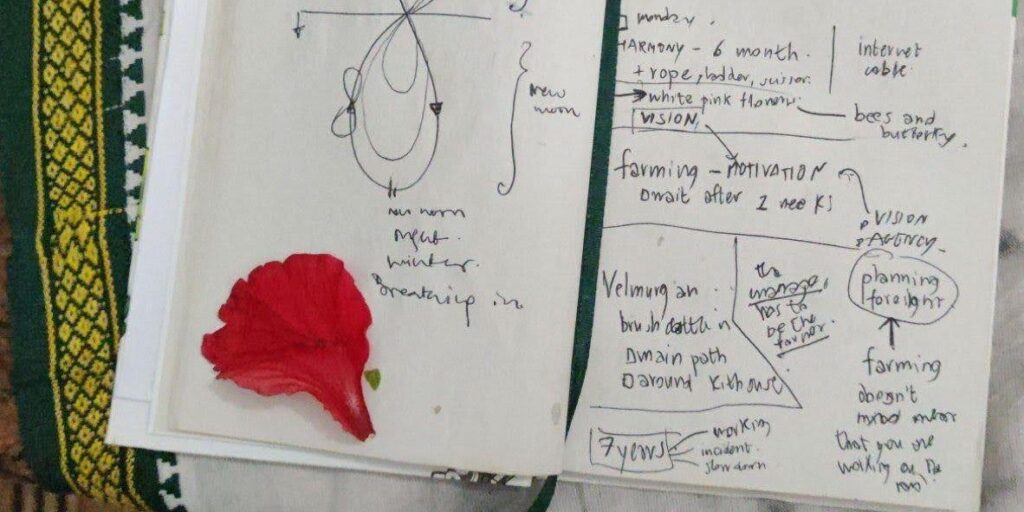
But you can truly learn when your feet and hands are on the field. The greatest knowledge is that which is applied to daily life. Home » Blog » Hands-On Approach Hands-On Approach 25 November 2025 · Fabio Karlino “Nowadays everyone could become (intellectually) a farmer.We have books, schools, courses, youtube videos …”But you can truly learn when your feet and hands are on the field.The greatest knowledge is that which is applied to daily life. And this happens in AuroOrchard.Ideas are welcome, brainstorming is magnificent, vision is encouraged.But let’s start from the ground, let’s start talking with naturebecause farming is a conversation with nature and with ourselves. First, as humans, we should grow discipline in the orchard of our good habits.The discipline to be constant, be patient and wait for the seedsthat we’ve planted with love, welcome them by preparing their bedswhere they’re gonna sleep, breathe and live. Why farming?What does it mean to be a farmer?How could human artificial activity be called ‘natural farming’?The mind is hungry for answers. Be patient, the answers will come through experience.You don’t need to rush to search on the artificial web,look inside you, wait for the universe to provide you the keysnot encapsulated in words and concepts but feelings, experiences. Then a good talk with another human,especially if it is an experienced one like Anshul,could really help to recalibrate and transfer learning. The core of farming is food.This is the basic but fundamental starting point.Around this first principlehumans create families, communities, organizations. To be a farmer is not just being on the land with dirty hands,Farming means planning, forecasting, researching, experimenting.It’s an equilibrium, a balance between physical and intellectual activity,between materialism and spirituality for the parallel evolution of both. Natural farming does not exist. Have you ever seen a farm naturally grow somewhere with no human intervention?What we define natural farming are all techniques and practices used in agriculturein order to mimic the natural processes. Just like in a forest the leaves naturally cover the soil making it humid and fertilein the same way we are mulching by putting branches and leaves from the pruning.The bio inputs of the animals and microorganisms that live in the forestare replicated with a layer of compost and biomass. Is there room for improvement? Of course.What will the future of farming look like? We are creating it.What’s the best way to learn? Hands-on approach. Previous ArticleNext Article Featured Articles Monthly Updatesㅤㅤㅤㅤㅤㅤㅤㅤ 28 Nov 2025 Abundance Product of the Month 22 Oct 2025 Flow of fire and water on the farmㅤㅤ 03 Dec 2025 Hands-On Approachㅤㅤㅤㅤㅤㅤㅤㅤㅤ 29 Nov 2025
Recipe Alert!ㅤㅤㅤㅤㅤㅤㅤㅤㅤㅤㅤ
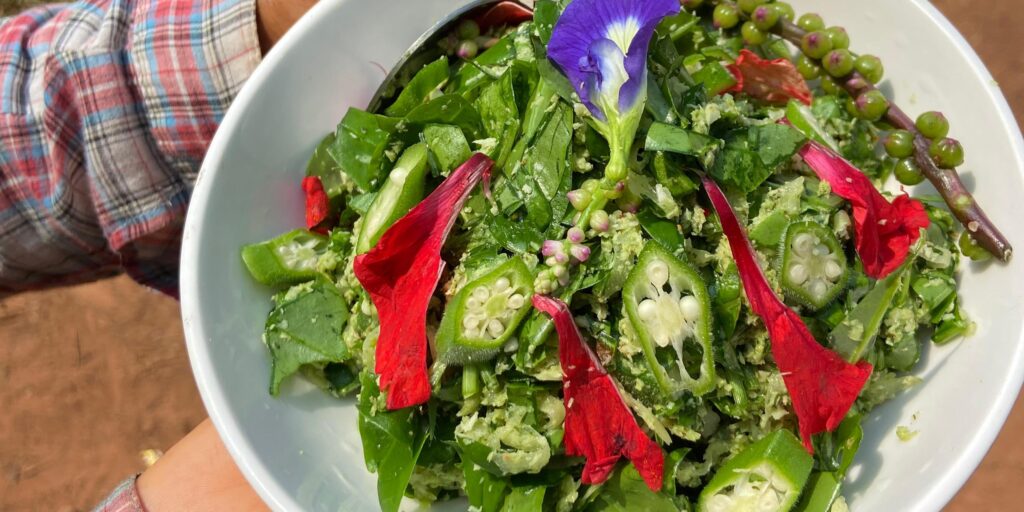
It’s been one week since I arrived at the farm.I’ve just been watching. Slowing down. Learning the rhythm of the farm.Mornings begin with greeting everyone. Today when I walked in, I saw Anshul and Reuben sitting together (a rare sight, because both of them are constantly moving around the farm). When I reached them, I realised they were discussing: which greens to include in the salad box that’s Home » Blog » Recipe Alert! Farm Seasonal Salad November 2025 · Astha Khandelwal Base Shredded raw papaya Ceylon spinach Greens (all tender) A handful spinach A handful arugula A handful tender moringa leaves A few Malabar spinach leaves + tender seeds A few fresh chives A handful tender baby okra (thinly sliced and yes, you can eat them raw!) Dressing Fresh grated coconut Fresh roselle (petals or calyx) Fresh basil Few curry leaf Bird’s eye chilli Lemon juice Salt, to taste Garnish Hibiscus flower Butterfly pea flower Method: Place shredded raw papaya and Ceylon spinach at the base of a bowl. Toss in all the tender green leaves + sliced tender okra. Blend together coconut, roselle, basil, bird’s eye chili, lemon juice and salt into a coarse, bright dressing. Fold dressing into salad just before serving. Finish with hibiscus & blue pea flower petals on top. BTS It’s been one week since I arrived at the farm.I’ve just been watching. Slowing down. Learning the rhythm of the farm.Mornings begin with greeting everyone. Today when I walked in, I saw Anshul and Reuben sitting together (a rare sight, because both of them are constantly moving around the farm). When I reached them, I realised they were discussing: which greens to include in the salad box that’s launching next week. Anshul noticed me and immediately joked, “Reuben ask her, she only eats salad.” So we started listing every edible green that is currently growing.Then Anshul asked me to go around the farm and harvest whatever we could use to make a sample salad today itself. I was excited, but I wasn’t sure if I remembered all the directions properly. Luckily, Reuben became my saviour. He took me around the entire farm, plant by plant.We harvested together. Both of us were genuinely so happy because it’s been so long since we actually harvested something with our hands. There is something extremely grounding about directly touching the soil and the plants again. But I was also feeling a lil guilty like I was taking his kitchen time… but in that exact moment he said: “Astha thank you – I’ve been so occupied in kitchen experiments that I haven’t visited the farm, the soil in so long. It feels so good to be back.” That sentence relieved every bit of guilt. Then the whole team (Charan, Reuben and Ram) gathered around to see the final salad we made. We photographed it. We ate it. We LOVED the flavours. The next day again, we tested a second version.This time the dressing was even better. We also measured the exact quantity and box size.Now, it feels real. WHY WE MADE THIS SALAD: (…and here is where the science comes in) to honour what the land is offeringplants produce more secondary metabolites when they grow in season + in their home climate + under their natural soil conditions. seasonal harvest → higher polyphenols → higher antioxidant potential. to eat greens in a way where nutrients are actually preservedvitamin C, folate and many carotenoids are heat-labile.raw + same-day harvest = maximum micronutrient retention (vs boiled sautéed steamed). raw papaya has digestive enzymesraw papaya contains papain + chymopapain (proteolytic enzymes) which assist protein breakdown and have shown benefit in clinical studies for reducing bloating and improving transit. greens contain chlorophyll — and chlorophyll is molecularly very similar to hemoglobinchlorophyll = tetrapyrrole ring → Mg in centerhemoglobin = same ring → Fe in centerthis structural kinship is why greens are studied for supporting hemoglobin status, antioxidant defense, and binding of dietary mutagens inside the gut. Previous Article Featured Articles Abundance Product of the Month 22 Oct 2025 Monthly Updatesㅤㅤㅤㅤㅤㅤㅤㅤ 22 Oct 2025 Recipe Alert!ㅤㅤㅤㅤㅤㅤㅤㅤㅤㅤㅤ 01 Dec 2025 The Flying House 01 Dec 2025
The Flying Houseㅤㅤㅤㅤㅤㅤㅤㅤㅤㅤㅤ
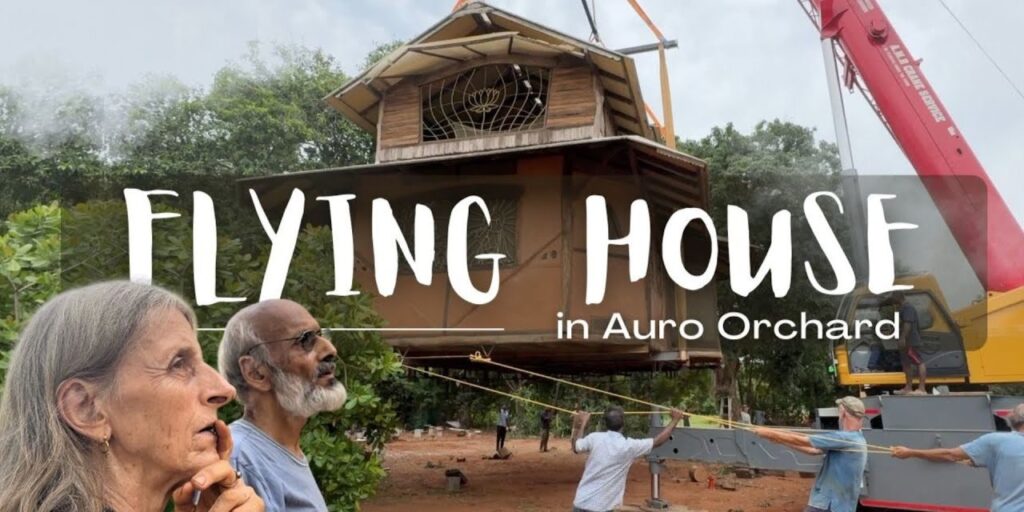
Here we are sharing a ’story within the story’, of the house of two Aurovilians that was discovered to be ‘on the wrong side’ of the new boundary, and was saved and air-lifted thanks to the efforts of a whole community that came together in solidarity. Watch the adventure of Auro Orchard’s Flying House’ in its epic journey of … 35 metres, back onto the soil of Auroville! Home » Blog » The Flying House The Flying House November 2025 · Jasmin Maheshwari https://www.youtube.com/watch?v=Hqe1SwP3qJA Auro Orchard has survived the loss of more than a third of its land and vital infrastructure in the ‘land exchanges’ two years ago. How the farm recovered and today has started to shine with new light, is a story of resilience and grace that is yet to be told. Here we are sharing a ’story within the story’, of the house of two Aurovilians that was discovered to be ‘on the wrong side’ of the new boundary, and was saved and air-lifted thanks to the efforts of a whole community that came together in solidarity. Watch the adventure of Auro Orchard’s Flying House’ in its epic journey of … 35 metres, back onto the soil of Auroville! Previous ArticleNext Article Featured Articles Abundance Product of the Month 22 Oct 2025 Monthly Updatesㅤㅤㅤㅤㅤㅤㅤㅤ 22 Oct 2025 Recipe Alert!ㅤㅤㅤㅤㅤㅤㅤㅤㅤㅤㅤ 01 Dec 2025 The Flying Houseㅤㅤㅤㅤㅤㅤㅤㅤㅤㅤㅤ 01 Dec 2025
Discovering the Golden Eggfruit…
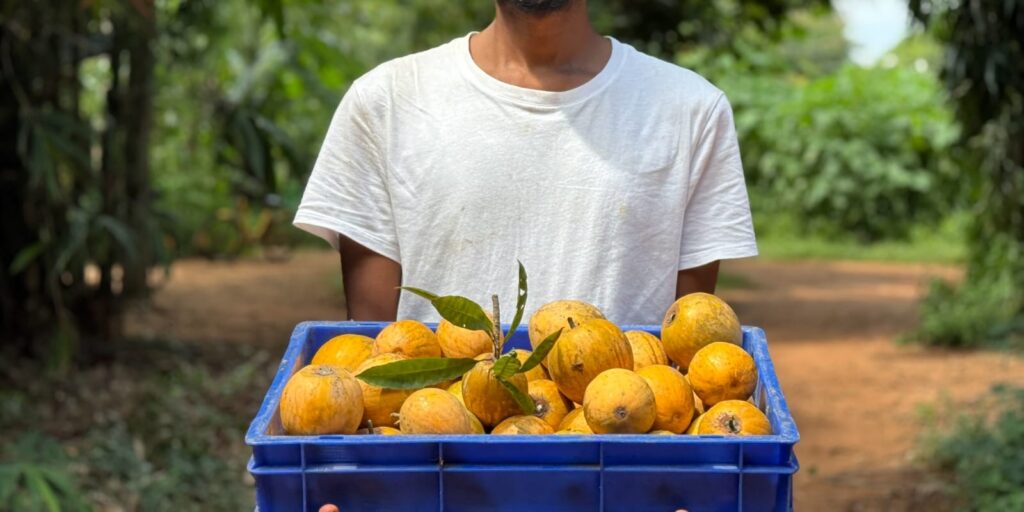
Over the last few weeks at Auro Orchard, I’ve been spending most of my days around the fruit trees, observing, tasting, and doing small bits of research on the fruits growing here. Since I mostly eat fruits throughout the day, this kind of work feels very natural to me it’s both nourishment and exploration at the same time. During these walks, I came across our eggfruit trees, and noticing the bright yellow fruits hanging from the branches felt almost like spotting little suns tucked among the leaves. Harvesting them was a fun experience on its own, and a couple of ripe ones had even fallen perfectly to the ground, soft and ready to eat. The moment I opened one, the texture really stood out: dense, creamy, and yolk-like, almost like scooping out a rich egg yolk but in a sweet, custardy form. The flavor is unlike any other fruit I’ve tried, intensely sweet and extremely satisfying, the kind of fruit you can have only half or one at a time because it fills you up so quickly. Home » Blog » Discovering the Golden Eggfruit: A Sweet Journey at AuroOrchard Discovering the Golden Eggfruit: A Sweet Journey at AuroOrchard November 2025 · Charan Over the last few weeks at Auro Orchard, I’ve been spending most of my days around the fruit trees, observing, tasting, and doing small bits of research on the fruits growing here. Since I mostly eat fruits throughout the day, this kind of work feels very natural to me it’s both nourishment and exploration at the same time. During these walks, I came across our eggfruit trees, and noticing the bright yellow fruits hanging from the branches felt almost like spotting little suns tucked among the leaves. Harvesting them was a fun experience on its own, and a couple of ripe ones had even fallen perfectly to the ground, soft and ready to eat. The moment I opened one, the texture really stood out: dense, creamy, and yolk-like, almost like scooping out a rich egg yolk but in a sweet, custardy form. The flavor is unlike any other fruit I’ve tried, intensely sweet and extremely satisfying, the kind of fruit you can have only half or one at a time because it fills you up so quickly. Eggfruit, also known as canistel, originally comes from Mexico and Central America and later spread to countries in the Caribbean and other tropical regions. Even though it has been around for centuries, it’s still not widely known in India. The tree itself is slow to mature and typically takes around eight years before it begins to produce fruit, which makes the harvest feel even more meaningful. Here at the orchard, as we continue enjoying these unique fruits, we’re also exploring different ways to process them, especially turning them into ice creams and simple frozen desserts to see how their natural creaminess transforms when chilled. It’s been a lovely discovery and definitely one of the more fascinating fruits I’ve spent time with recently. Have you tasted this fruit before? We would love to hear your experience. Over the last few weeks at Auro Orchard, I’ve been spending most of my days around the fruit trees, observing, tasting, and doing small bits of research on the fruits growing here. Since I mostly eat fruits throughout the day, this kind of work feels very natural to me it’s both nourishment and exploration at the same time. During these walks, I came across our eggfruit trees, and noticing the bright yellow fruits hanging from the branches felt almost like spotting little suns tucked among the leaves. Harvesting them was a fun experience on its own, and a couple of ripe ones had even fallen perfectly to the ground, soft and ready to eat. The moment I opened one, the texture really stood out: dense, creamy, and yolk-like, almost like scooping out a rich egg yolk but in a sweet, custardy form. The flavor is unlike any other fruit I’ve tried, intensely sweet and extremely satisfying, the kind of fruit you can have only half or one at a time because it fills you up so quickly. Eggfruit, also known as canistel, originally comes from Mexico and Central America and later spread to countries in the Caribbean and other tropical regions. Even though it has been around for centuries, it’s still not widely known in India. The tree itself is slow to mature and typically takes around eight years before it begins to produce fruit, which makes the harvest feel even more meaningful. Here at the orchard, as we continue enjoying these unique fruits, we’re also exploring different ways to process them, especially turning them into ice creams and simple frozen desserts to see how their natural creaminess transforms when chilled. It’s been a lovely discovery and definitely one of the more fascinating fruits I’ve spent time with recently. Have you tasted this fruit before? We would love to hear your experience. Previous ArticleNext Article Featured Articles Abundance Product of the Month 22 Oct 2025 Monthly Updatesㅤㅤㅤㅤㅤㅤㅤㅤ 22 Oct 2025 The Unstructured Calling: Finding My Rhythmㅤㅤ 30 Nov 2025 Hands-On Approach 29 Nov 2025
The Unstructured Calling: Finding My Rhythmㅤㅤ

Five months ago, I dedicated myself to a period of deep self-experimentation focused on health. Having spent years consuming raw, plant-based foods, I already understood the immense power of food. Yet, the true revelation, refined after a year spent back in the accelerated pace and sterility of city life following my earlier farm volunteering experiences, was the profound importance of a daily, tangible reconnection with nature, the sun, and, crucially, the soil. That time away crystallized what was missing: the rich, microbial life of a natural farm/forest. Home » Blog » The Unstructured Calling: Finding My Rhythm and Resilience in AuroOrchard’s Soil The Unstructured Calling: Finding My Rhythm and Resilience in AuroOrchard’s Soil November 2025 · Astha Khandelwal Five months ago, I dedicated myself to a period of deep self-experimentation focused on health. Having spent years consuming raw, plant-based foods, I already understood the immense power of food. Yet, the true revelation, refined after a year spent back in the accelerated pace and sterility of city life following my earlier farm volunteering experiences, was the profound importance of a daily, tangible reconnection with nature, the sun, and, crucially, the soil. That time away crystallized what was missing: the rich, microbial life of a natural farm/forest. I wasn’t just looking for just physical work; my purpose was to reconnect with the land to enhance my personal growth. Having volunteered at farms with rigid schedules before, this time I sought something different: a place that would honor my slow pace and allow me to explore without a structured plan, enabling me to truly understand where I could contribute. That search led me, quite naturally, to AuroOrchard, the source of my weekly basket. When I shared my interests: working with the soil, embracing food, and developing recipes to preserve nutritional integrity. Anshul’s response was one of profound trust: “Just come to the farm and explore for a week. Engage in whatever you feel like.” That openness made me feel I had truly found my place. I began simply by observing the farm’s daily rhythm: the conversations, the mulching, the sowing, the weeding, and the processing. I was just watching, slowing down, capturing little observations, feeling that magnetic pull to return every morning. The Science of Feeling “Called” This daily, effortless call back to the earth aligns beautifully with the science of the Gut-Immune-Brain Axis. The sense of peace and belonging is not abstract; it’s rooted in measurable biological mechanisms. Working near and engaging with the soil exposes us to environmental microorganisms, notably the “feel-good” bacteria Mycobacterium vaccae. This exposure through inhalation of bioaerosols released during farming can stimulate serotonin production in the brain, inducing states of greater happiness and relaxation, and providing a powerful buffer against stress and anxiety. It is, in essence, the body’s co-evolved response to the presence of these “Old Friends” from the natural world, which our immune systems rely on for proper calibration and resilience. The Grounding Moment and the Salad’s Genesis I’ve spent my initial days just watching… observing the harvesting, mulching, and sowing. (Visit my Instagram profile @dhanyawadearth and check the ‘November Notes’ highlight to see all my observations so far) After a week of gentle observation, my role became concrete. I walked in one morning to find Anshul and Ruben discussing the launch of a new seasonal salad box. “Ruben ask her, she only eats salad” Anshul joked, Soon, I was tasked with walking the farm with Ruben, harvesting every edible green we could use for a sample salad. As we harvested together, Ruben mentioned, “Astha, thank you. I’ve been so occupied in kitchen experiments that I haven’t visited the farm, the soil in so long. It feels so good to be back.” That spontaneous moment was a powerful demonstration of Earthing or Grounding. The human body is electrically conductive, and direct physical contact with the Earth’s surface, like placing bare hands on the soil, allows it to absorb a continuous supply of free electrons. These electrons function as systemic antioxidants, neutralizing the unstable molecules that drive inflammation. The sense of relief and calm Ruben and I both felt was not just emotional; it was a physical electrical reset, reducing our inflammatory load and enhancing our overall well-being. This biophysical connection is a vital, yet often overlooked, part of preventative health. The Nutritional Mandate: Preserving Life Force The subsequent creation of the Farm Seasonal Salad box, which is now happily finding its way into weekly baskets, was guided by principles that bridge soil health and human physiology: Honoring the Seasonal Offering: We prioritize plants that grow robustly in their home climate. This practice ensures plants produce maximum secondary metabolites, yielding higher polyphenols and, consequently, superior antioxidant potential. This is the critical, indirect link to the human gut microbiome: plants grown in microbially rich soils yield nutrient-dense food which, when consumed, provides the best substrate for a diverse and healthy gut ecosystem. Maximizing Micronutrient Retention: We serve the produce raw because essential compounds like Vitamin C, folate, and many carotenoids are heat-labile. By offering a raw, same-day harvest, we ensure maximum micronutrient retention. Digestive & Antioxidant Support: Raw Papaya contains powerful proteolytic enzymes (papain and chymopapain) that assist protein breakdown and improve gut transit. The Chlorophyll in the greens, molecularly similar to hemoglobin, is studied for its ability to support hemoglobin status and act as an antioxidant defense. The successful launch of the Farm Seasonal Salad box is a true testament to the team’s dedicated work and our collective commitment to nutritional integrity. Since the launch, Janani, Raghu, and Ruben have been actively involved in every meticulous step of production: harvesting, cleaning, sorting, drying, chopping, grating, mixing, and packaging. I am particularly proud of how this initiative operates in a closed-loop system, allowing us to receive immediate feedback from customers and act upon it, be it perfecting a dressing or actively seeking sustainable alternatives to plastic packaging, such as our experiments with banana leaves. My time here – from figuring out kitchen revamps to harvesting the
Help us raise funds for 2026!ㅤㅤㅤㅤ
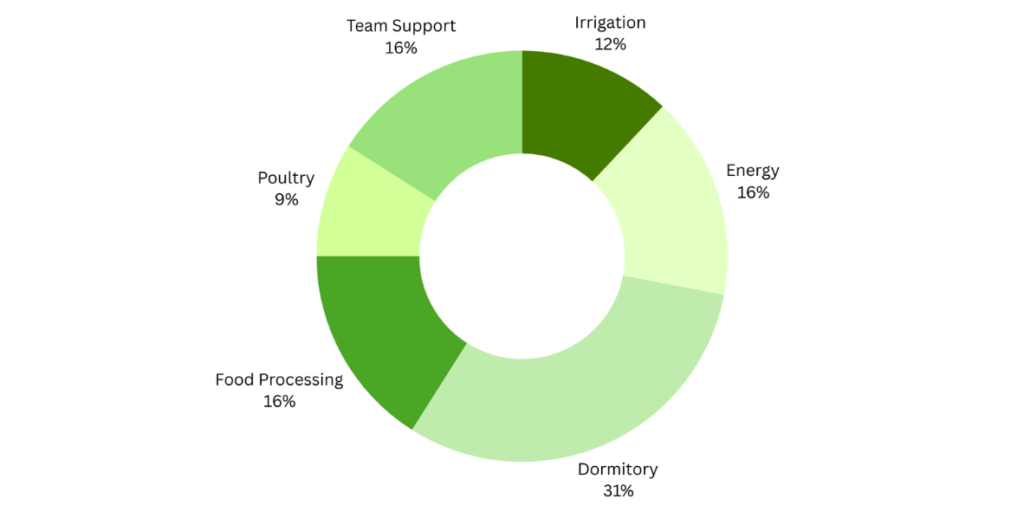
Until last year, we managed to support our team mainly from the farm income. For the coming year, we are seeking some funds to be able to support the newcomers who have just joined the farm, a communication team that helps us share our work with the community and basic support like food and transport for our volunteers. Our goal is to become financially sufficient in the next year to be able to support all our team expenses from the farm itself. Home » Blog » Help us raise funds for 2026! Help us raise funds for 2026! November 2025 · Anshul Aggarwal AuroOrchard is Auroville’s oldest farm, founded in 1968-69 under the guidance of the Mother with the vision of “growing food for Auroville.” Spread over 25 acres of red earth on the eastern coast of Tamil Nadu, it has been a cornerstone of Auroville’s food system for more than five decades. Today, it produces over 50% of the fruits and vegetables and 90% of the eggs from Auroville farms. The farm grows a diversity of crops—mangoes, papayas, bananas, guavas, citrus, roots and tubers, leafy greens, vegetables, and herbs—alongside a small poultry that provides eggs. Each year, these fields and orchards yield several tonnes of fresh food, much of it flowing directly to Auroville’s kitchens and residents. These numbers are never the measure of the work, but rather quiet signs of the farm’s steady rhythm of care and abundance. An overview of AuroOrchard’s production in 2024-25 In the last five decades, the farm has dealt with many challenges and transitions—ecological, physical, social, cultural, financial, and personal. Despite this, and despite the growing uncertainties of the world, it continues to hold to its purpose: growing food for Auroville and tending to the fragile web that binds land, community, and spirit together. For us, growing food for Auroville also means discovering what agriculture can be for a community and for future humanity. We are deeply grateful for the trust placed in us by our donors and AVI USA. We are committed to working sincerely, carefully, and with a deep sense of responsibility to the land and the community.To continue developing the farm in 2026, we are seeking 36,000 USD. Budget allocation for 2026 Irrigation Infrastructure We are expanding our micro-irrigation network as we establish new orchard blocks and diversify existing fruit areas. The expense covers the cost of pipes, plumbing fixtures, and labour for installation and maintenance. Energy: Solar & Electrical Infrastructure Our electricity infrastructure needs upgrading as the farm is expanding both in intensity of the existing activities as well as addition of new work . In the coming year, we need to reorganise domestic loads across the farm, install a new agricultural electricity connection, purchase and install larger batteries to make better use of solar power. This is a major step toward long-term energy independence and reducing operational costs. Poultry: Upgrading existing infrastructure In the coming year, we would like to continue upgrading our poultry- with free-range expansion, coop renovation (roof, flooring, nesting spaces), improvements aligned with humane poultry certification standards. This work directly improves bird welfare and egg quality while restoring an ageing system. Food Processing – New Machines, Tools, Systems A new food-processing team has emerged, and we have begun developing a wider range of value-added products that help reduce post-harvest losses and add economic resilience.The goal for the coming year is to purchase small and mid-scale machines, tools for dehydration, bottling, and processing, storage improvements. This work will directly help in supplementing farm income towards long term financial sustainability. Dormitory This is the major project for 2026. We would like to improve the existing dormitory and build a new one to address the housing needs for long term volunteers and newcomers on the farm. The current set up can accommodate at most 6 people. We would like to build a new, mobile structure that can accommodate an additional 10 people (at least). This will help us invite young people into agriculture education and practice. Team Support Until last year, we managed to support our team mainly from the farm income. For the coming year, we are seeking some funds to be able to support the newcomers who have just joined the farm, a communication team that helps us share our work with the community and basic support like food and transport for our volunteers. Our goal is to become financially sufficient in the next year to be able to support all our team expenses from the farm itself. To donate, please visit: https://give.aviusa.org/page/AuroOrchard?fundraiser=NGNGZJAM&member=SYPDDLKJ Previous ArticleNext Article Featured Articles Abundance Product of the Month 22 Oct 2025 Monthly Updatesㅤㅤㅤㅤㅤㅤㅤㅤ 22 Oct 2025 Recipe Alert!ㅤㅤㅤㅤㅤㅤㅤㅤㅤㅤㅤ 01 Dec 2025 The Flying Houseㅤㅤㅤㅤㅤㅤㅤㅤㅤㅤㅤ 01 Dec 2025
Report on fund utilisation from AVI USA Matching Campaign 2024
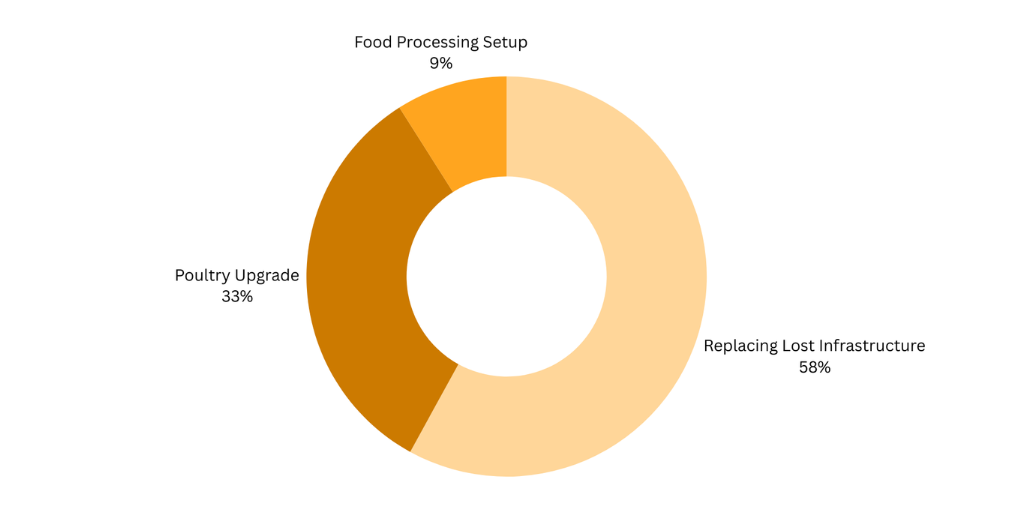
Our Turmeric roots have been sun-dried and turned into flakes that can be easily infused in some hot honey & lemon tea for the changing weather with a pinch of black pepper. Home » Blog » Report on fund utilisation from AVI USA Matching Campaign 2024 Report on fund utilisation from AVI USA Matching Campaign 2024 November 2025 · Anshul Aggarwal During 2024 and 2025, AuroOrchard was fortunate to have been supported with donations raised through AVI USA, AVI Germany, AVI France, AVI Spain and the Abundance Project Coordination Group which coordinates with Stichting de Zaaier in the Netherlands. This support came at a crucial time after the land exchange at the farm helping us rebuild and replace some critical infrastructure as well as invest in expanding our team and diversifying farm activities. This report summarises how the funds were used in 2025, and our plans and aspirations for 2026. Funds raised through AVI USA matching campaign 2024 We were able to raise a total of 8500 USD from December 2024 until November 2025. Break-up for expenses of funds raised through AVI USA from Dec 2024 until Nov 2025 Infrastructure More than half of these funds were utilised to replace crucial infrastructure on the farm that was lost in the land exchange of 2023. This includes: a new electrical connection, entrance cowgate, stabilising new paths, water infrastructure for irrigation and domestic use on the farm. Poultry The next big part of this fund was used to renovate and upgrade our poultry. Over the last three years we have made significant changes to our poultry practice- like changing the breed of the birds and adding maintenance protocols. We have now started upgrading the feeding and drinking systems for the birds. This is a significant expense for all the four coops (around 2000 birds). We were able to make a good start in 2025, but much remains to be done in 2026. Food Processing To diversify farm income and find ways of using abundant produce when it cannot be distributed in Auroville, we started a small food processing activity with a new team on the farm. This needed significant improvement in our community kitchen set up and purchasing some basic equipment and tools. Some of the funds were useful in starting this work. Area Description Elements Money spent in 2025 from AVI USA Campaign Total Donation Money spent in 2025 Budget for AVI USA 2026 Water We continue to expand our micro-irrigation infrastructure as we create new orchards and diversify existing ones. Replace & repair two major water sumps, purchase Irrigation pipes, plumbing fixtures, labour for installation & maintenance ₹ – ₹ 1,02,242.00 ₹ 4,00,000.00 Energy As the farm expands, its electrical infrastructure needs expansion. We are are carefully assessing how we can supplement as much of our need through solar energy. Re-organising existing domestic connections to distributed load, new agriculture connection to replace the one lost in land exchange, better and bigger batteries to use solar energy effectively. ₹ 3,14,013.00 ₹ 3,12,775.00 ₹ 5,00,000.00 Volunteer Dormitory To involve more people in our work, we need spaces where volunteers & newcomers can stay. Dormitory structure, common showers, toilet, kitchen area, plumbing and electricity facilities. ₹ – ₹ – ₹ 10,00,000.00 Food Processing During this year, we significantly expanded our food processing systems. We have a new team looking after this work and we need to buy some new machines and tools to improve and do more. Dehydrator, ₹ 66,146.00 ₹ 3,42,087.00 ₹ 5,00,000.00 Storage shed. Poultry Our poultry activity is over 40 years old. Some of the structures need significant repairs and installation of better systems and technology. As we move forward with an international certification of humane poultry keeping, we need to make some investments in upgrading our systems Free range expansion, Coop renovation-roof, flooring nesting spaces. ₹ 2,54,352.00 ₹ 4,44,539.00 ₹ 3,00,000.00 Team In the past year, we have made a significant attempt in reaching out to our community through stories and updates about the farm. We have also received a few newcomers who are now dedicated to working at the farm. The massive infrastructure replacement and renovation means we need secured funds to support young people who wish to engage with the farm and dedicate their work in Auroville to grow food. Majority of this support came from the farm income from sales of produce. Only a very small part of the donations were used for this. Communication team, volunteer & newcomer support ₹ – ₹ 82,745.00 ₹ 5,00,000.00 Infrastructure ₹ 1,21,981.00 ₹ 3,95,323.00 ₹ – Plantations ₹ – ₹ 4,03,214.00 ₹ – Tools & Machines ₹ – ₹ 34,932.00 ₹ – ㅤ ㅤ TOTAL ₹ 7,56,492.00 ₹ 21,17,857.00 ₹ 32,00,000.00 $ 8,519.05 $ 23,849.74 $ 36,036.04 Expenses from January 1, 2025 until November 15, 2025 To know about our plans for 2026 and help us raise funds, please visit our donation portal here. Previous Article Featured Articles Abundance Product of the Month 22 Oct 2025 Monthly Updatesㅤㅤㅤㅤㅤㅤㅤㅤ 22 Oct 2025 Report on fund utilisation from AVI USA Matching Campaign 2024 17 Nov 2025 Lessons from Auroville Farm Assessment 2023 22 Oct 2025
Lessons from Auroville Farm Assessment 2023

Across the red soils of Tamil Nadu’s southeast coast, Auroville’s farms continue to hold space for one of the most enduring experiments in community-scale organic farming and agroecology. Home » Blog » Lessons from Auroville Farm Assessment 2023 Lessons from Auroville Farm Assessment 2023 October 2025 · Anshul Aggarwal Across the red soils of Tamil Nadu’s southeast coast, Auroville’s farms continue to hold space for one of the most enduring experiments in community-scale organic farming and agroecology. With the rising ecological, social, and economic pressures on agriculture, it is important to review Auroville farming and put it in perspective with the ongoing global discourse on food and agriculture. As a first step towards this, in 2023, a sector-wide assessment brought together five-year data from sixteen of Auroville’s twenty-six farms to understand the state of farming in Auroville. The study examined land and water use, production, labour, and finance. What emerged is a picture of both resilience and fragility — a network of farms that have weathered shocks, diversified their outputs, and upheld ecological integrity, yet remain challenged by issues of labour, finance, and generational renewal. The full assessment methodology and results can be found here: https://www.avfarmassessment.in/ The assessment team comprised four Aurovilians: Anshul, Avinash, Madhuri, Nidhin. A summary of the main insights gleaned from the assessment with recommendations from the assessment team are given below. 1. A Network of Commons-Based Farms The sixteen farms together span 306 acres, of which 84% are actively used. About 60% of the cultivable land is irrigated through borewells, ponds, and rainwater harvesting systems, reflecting adaptation to Auroville’s dry plateau ecology. All the farms practice organic management, relying on compost, green manures, and traditional bio-ferments such as jeevamruth and panchagavya. Dairy-holding farms close the nutrient cycle internally, producing manure and fertility inputs in-house. These are not industrial operations but diverse agroecosystems that integrate fruits, vegetables, grains, dairy, and poultry. 2. Resilience Through Diversity Production data show clear patterns of resilience. Vegetable output declined sharply—by 34%—in 2020–21 due to COVID-19 and extreme rainfall, but recovered by 2022–23. Fruits remained steady around 42 tonnes annually, while dairy production more than doubled and egg output nearly tripled. This diversity has been key to recovery. Perennial crops and livestock buffered the shocks faced by annual vegetables, demonstrating that integration across crops and animals increases resilience. The findings reaffirm a core agroecological principle: diversity and cooperation, not specialisation, sustain farming systems in the long run. 3. Labour: The Strength and the Strain Auroville’s farms employ about 150 people, including 49 Aurovilians, 65 regular Tamil workers, and 30–70 seasonal workers. They remain a stable source of employment in the region, yet labour conditions reveal deep strains. Daily wages in 2022–23 ranged from ₹200–565 for women and ₹365–800 for men, exposing a persistent gender gap. Wages rise 5–10% each year, often faster than farm income, and the workforce is ageing with few young Aurovilians entering the field. Auroville’s community agriculture cannot thrive without labour justice. Equity in pay (gender and Aurovilian v/s non-Aurovilian), social benefits, and apprenticeship pathways for youth must become collective priorities if Auroville’s farms are to remain viable into the next generation. Additionally, the costs of justice must not be passed on solely to consumers or absorbed by individual farms, but held collectively within the community economy. 4. Finance and the Fragility of the Shared Economy Between 2018 and 2023, the assessed farms collectively borrowed about ₹1.05 crore—43% from Auroville’s Farm Group and 57% through personal investment by farmers themselves. Only one-third has been repaid. This reliance on private funding highlights a contradiction within Auroville’s shared economy: collective food security often depends on individual financial risk. Even farms with positive farming surpluses remain vulnerable without structured capital support or budget-linked planning. To secure the future, the community must adopt shared financial frameworks—coordinated budgeting, transparent reporting, and collective investment—to replace ad-hoc dependence on personal loans and goodwill. 5. Ecological and Operational Constraints Wildlife intrusion—from boars, deer, and porcupines to peacocks and stray cattle—is among the most cited causes of crop loss. Periodic water scarcity and monsoon flooding further disrupt operations. Limited cold storage and processing facilities lead to wastage of perishable produce, especially fruits.Larger farms with machinery and infrastructure weather these challenges more easily, while smaller vegetable farms remain exposed. Conscious and significant investment in capital for shared tractors, boundary fencing, and expanded rainwater harvesting could greatly improve sector-wide resilience. 6. Aligning Production and Consumption The assessment reveals a mismatch between what Auroville’s farms produce and what its residents eat. While farms grow tropical fruits, greens, and grains, many community kitchens and eateries rely on temperate vegetables and external supplies. Bridging this gap requires closer coordination between farms and consumers. Seasonal menu planning, CSA-style prepayments, and small-scale processing of surplus fruits into dried or preserved products could stabilise farm income and reduce waste. In doing so, the community also reclaims its connection to seasonal, local food. 7. Education, Youth, and Food Sovereignty The long-term sustainability of Auroville’s agriculture depends on generational renewal. The study recommends a young-farmer pathway combining practical training, housing support, and education in agroecology and cooperative management. Farming education must be seen not just as vocational training but as an integral practice of consciousness—a way to unite ecological awareness, skill, and inner growth. Re-rooting farming within Auroville’s educational ethos can ensure that agriculture remains both livelihood and spiritual discipline. Beyond food security, Auroville’s guiding principle must be food sovereignty — the community’s ability to shape its own food system in alignment with ecological limits and social justice. This means shared governance among farmers, distributors, kitchens, and consumers; transparent budgeting; and participatory planning. Overall the assessment presents a mixed but hopeful picture: a sector that holds the resilience to recover from crisis, has diversified its base, and maintained organic integrity, yet faces structural fragilities in labour and finance, remaining limited in utilising its full potential. In doing so, Auroville’s living experiment in community farming continues to offer a quiet but vital contribution to the search for