EcoPro research project on co-composting of fecal sludge
This research project explores the conditions of fecal sludge composting as a low-tech strategy in fecal sludge treatment and utilization: It entails
the co-composting of fecal sludge and septage (from residential septic tanks) with organic bulking material in trenches;
sourcing of organic bulking matter which is free from agro-chemicals and biocides and from heavy metals or other contaminants in industrial effluents;
examining the conditions of groundwater depth, soil type, and biodiversity of soil microbiome and flora;
assessing the ratio (of volumes) of sludge and bulking material – under varying weather conditions;
and assessing the duration of composting times, so as to arrive at recommendations for peri-urban and rural scenarios, where nutrients and water provided by sludge and compost will contribute to productivity in agriculture and agroforestry and simultaneously avoid increasing any risks to public hygiene and environmental health.
If the approach proves to be feasible, and its conditions for a safe practice and a wider use in rural India can be defined, the research results are hoped to find entry into policy making and to be of value for rural and peri-urban settings. The work is implemented on half an acre area in the mango orchard of AuroOrchard, Auroville. Physical work on the site was started in August 2025 and the first sludge disposal was made in November 2025. It is suggested to run the field research for three years. All activities – physical work, purchase of bulking matter, supervision of sludge disposal, surveying of flora, sampling of soil, sludge, groundwater, compost and arranging for lab tests, recording of the findings etc. – are coordinated by EcoPro, Auroville, in close cooperation with the management of AuroOrchard, and in collaboration with AquaMap Centre at IIT Madras, under academic guidance by the Dept. of Civil Engineering, IIT M.
For the farm, this can be an interesting method of adding organic matter to parts of land that lack sufficient nutrients. The Mango Orchard soil is quite poor in general and we plan to add some fruit trees around the trenches where composting is being done after the field research is complete. If the model is found successful, new trenches can be dug in another location and the process repeated. Overall, this process holds promise in re-connecting the broken cycle of soil fertility where the energy from the food produced by the land gets lost into septic tanks. This method could also demonstrate the possibilities of revitalising depleted lands with fecal sludge composting in creation of new orchards, farms and gardens.
Natural Beekeeping
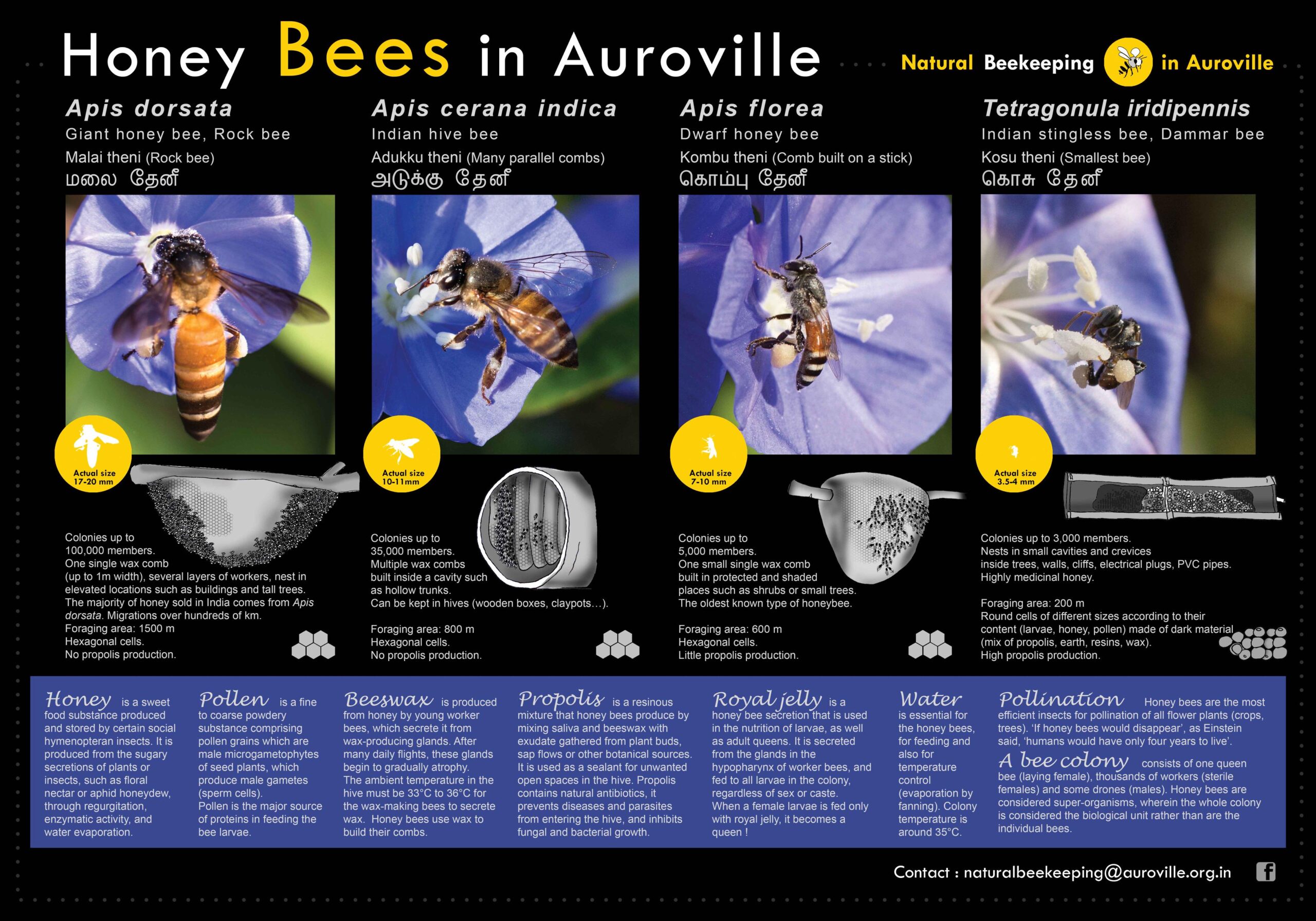
Beekeeping at AuroOrchard began in 2015 as part of our effort to restore ecological balance and strengthen pollination on the farm. Bees are vital partners in farming — their work enhances both the quantity and quality of fruit and seed production, while their presence reflects the overall health of the landscape.
In South India, four main honeybee species are commonly found. Two — the giant rock bee (Apis dorsata) and the dwarf honeybee (Apis florea) — build open-air combs. The Indian hive bee (Apis cerana indica) and the stingless bee (Tetragonula iridipennis) prefer enclosed cavities, which allows us to keep them in specially designed hives. With the support of small grants, we built hives suited to the tropical climate and the natural habits of these local species, focusing particularly on Apis cerana and Tetragonula.
From the start, our approach has been rooted in Natural Beekeeping — no treatments, no artificial feeding, and minimal intervention. We believe that honeybees, like all living beings on the farm, should be allowed to thrive according to their own rhythm. Until now, we have rarely harvested honey, leaving it for the bees to sustain themselves through the long dry months. Going forward, we plan to experiment with ethical honey harvesting, taking only small, carefully chosen portions of surplus honey while ensuring the wellbeing and stability of each colony.
Today, around thirty colonies inhabit AuroOrchard, and we plan to expand especially with stingless bees, whose pollination greatly benefits fruit trees and flowers. Through this ongoing research, we hope to deepen our understanding of the bees and their lives.
Our work with vermicomposting at the farm is inspired by the soil ecologist Dr. Sultan Ismail, whose lifelong research has revealed the vital role of earthworms as engineers of soil fertility. Following this vision, we began exploring what we now call worm polyculture — a composting system that values both the indigenous worm varieties as well as the commercially available species.
In our system, a mix of earthworms coexist in layers: the native Lampito mauritii working deep in the soil to aerate and structure it, and surface-dwellers like Eisenia foetida breaking down organic matter rapidly at the top. Together, they form a complete soil community, mirroring the complexity of nature’s own composting process.
The result is a rich, dark, living compost — teeming with microbial activity, balanced in moisture, and full of slow-release nutrients.
This ongoing research continues to expand toward integrated systems. Using this research, we would like to develop vermiwash for natural foliar feeding, cow-dung–based composting, and even vermi-protein experiments for poultry feed. In these quiet bins, where life constantly eats and renews itself, we are reminded that the smallest beings may hold the greatest power of transformation.
Integral Agriculture grows from the conviction that the work of the soil is also the work of consciousness. It is based on the understanding that farming is not only an ecological activity but also a social and psycho-spiritual practice. Drawing inspiration from the philosophy of Sri Aurobindo and The Mother, the research explores how cultivation can become a means of transformation — of the land, the farmer, and the community.
The inquiry looks at agriculture as a living synthesis of matter and spirit. Integral Agriculture asks questions like: What kind of consciousness does our food carry? How does working with the soil affect the human psyche? Can agriculture help us evolve toward greater unity with life? These are not rhetorical questions but living experiments, taking form each day through observation, reflection, and action on the farm.
Practically, this work translates into designing farming systems that integrate the physical (ecological), vital (social), and mental-spiritual-psychic dimensions of life — combining regenerative methods such as syntropic design, soil ecology, and participatory governance with an inner attitude of care and contemplation. In this sense, Integral Agriculture becomes both a scientific framework and a spiritual practice, a philosophy of relationship that seeks harmony between human aspiration and the intelligence of nature.
Through ongoing study, teaching, and collaboration, AuroOrchard serves as a field laboratory for this emerging paradigm — an agriculture that nourishes not only the body but also consciousness itself, moving from an economy of extraction to a culture of evolution and offering.
Integrated Perennial Horticulture through Syntropy
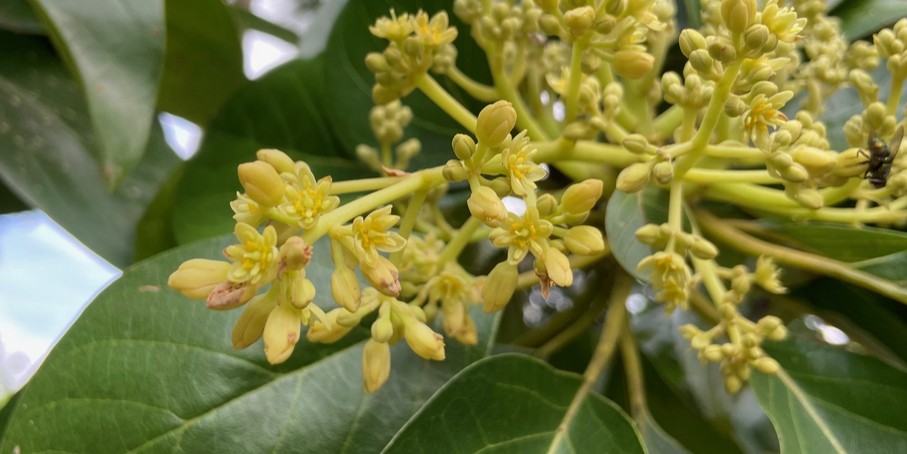
Since 2022, our work in the 80-year-old mango orchard has sought to understand how perennial systems can evolve toward greater diversity, resilience, and care. What began as a study in integrated orchard management gradually became an experiment in perennial horticulture through syntropic design.. We divided the 10-acre orchard into smaller management zones, introduced green manures, and shifted from ploughing to brush-cutting and shallow discing, reducing soil disturbance while cycling biomass. Soil analyses revealed the contrast between sandy topsoils and clay-rich subsoils — the former prone to leaching and fungal loss, the latter holding the orchard’s latent fertility.. To restore balance, we integrated cover crops, compost, and microbial inputs while initiating micro-irrigation and water-harvesting swales to stabilise moisture. In parallel, new species were introduced among the old mangoes — avocado, soursop, jackfruit, bael, and coffee under partial shade — marking the orchard’s gradual transformation into a poly-orchard. The two main objectives now are:
(1) diversifying old orchards by introducing new species consortia into existing perennial systems,
(2) starting new orchards designed from inception with syntropic arrangements.
The early syntropic trials demonstrated how companion species like papaya can act as nurse plants, increasing survival rates by over 80% and shading delicate seedlings from the tropical sun. Monsoon-timed planting reduced irrigation demand by nearly half. Multi-strata arrangements enhanced biodiversity, attracting pollinators, birds, and soil fauna. These findings resonate with Ernst Götsch’s Break-Through in Agriculture (1995), which emphasizes succession, consortia, and biomass cycling as pathways for regeneration. A comparison with India’s ultra-high density plantation (UHDP) model highlights that syntropy achieves resilience and biodiversity without dependence on external inputs, while addressing ecological concerns of the Ultra High Density Planting models. This is an evolving research on the farm contrasting fruit-oriented syntropic systems with vegetable production and situating them within debates on biodiversity, climate adaptation, and the teleological vision of agriculture.
The Production Research program at AuroOrchard began in 2021 with a simple question: how much do we actually grow, and what does it take to grow it? Over time, this evolved into a comprehensive system for recording, analysing, and understanding productivity in relation to water, soil, and labour. Using an in-house Excel-based data system, each crop is now tracked by bed and season, giving a detailed picture of how cultivation techniques, weather, and inputs affect outcomes.
Our mapping of production zones — with stone markers and geo-referenced plots — allows us to link yield data directly with field conditions. Preliminary findings between 2022 and 2024 show clear seasonal rhythms: beans, gourds, and cucumbers perform best in April–May, while brinjal and okra remain stable across seasons. The data also revealed unexpected losses — from pest pressure, transplant shock, and irregular harvest timing — which are now being addressed through better planning and staggered sowing.
Besides being a great tool for crop planning, the potential of this research is in understanding the real cost of growing food: the water, labour, and energy that go unseen in every harvest. The long-term vision is to develop a farm productivity index that can serve all Auroville farms — supporting transparent, collaborative crop planning and advancing the collective goal of food self-reliance and ecological accountability.
Across the world, studies show that the nutritional quality of food has been declining for decades. Modern high-yield agriculture has led to soils depleted of organic matter and trace minerals, breeding crops that are larger and more uniform but poorer in essential nutrients. Synthetic fertilizers, hybrid seeds, and long-distance storage systems have further widened the gap between yield and nourishment. Food has become abundant yet often hollow — rich in calories, low in vitality. Through field trials and laboratory analyses, we are learning how farming practices, soil life, and post-harvest handling affect the nutrient density of food. In 2022, a comparative test of AuroOrchard eggs showed that our free-range brown eggs contained higher protein (15.49 g/100 g) and iron (2.5 mg/100 g) than commercial samples from Pondicherry, reflecting the birds’ natural diet and outdoor lifestyle. In 2025, our turmeric was certified with 4.97 % curcumin, well above the national average, and free from any adulteration or synthetic residues. Both studies confirm that soil health and animal welfare are directly reflected in food quality. Our long-term aim is to build a farm nutrition index that links soil composition, crop management, and final food quality helping us reclaim food nutrition in the conversation of ecological farming.
In our tropical red soils, nutrients are easily washed away by monsoon rains and organic matter breaks down rapidly under heat. Over the past few years, we have been exploring how biochar — charcoal made from crop residues and farm waste — can help rebuild this foundation of fertility.
Our first experiment in 2021 compared two beds of okra: one amended with terra preta, a mix of biochar, compost, and microbial inoculants, and another with regular compost. The terra preta bed yielded around 20% higher and showed stronger plant health, with deeper green leaves and almost no disease. This early success encouraged us to go further.
In 2024, in collaboration with Pierre Dernier, a student from Gembloux Agro-Bio Tech, Liège University, we tested biochar charged with compost tea and cow urine at different concentrations on sweet corn. Results showed that urine-charged biochar performed better for most nutrients, but increasing the dose beyond a certain point gave no extra benefit. Soil analyses also revealed that while deeper layers retained nutrients better, the top 20 cm remained poorer, likely due to oxidation and leaching. This explains why our soils often stay “hungry” despite heavy composting — and why liquid microbial inputs like amrit jal can be more immediately effective. We also noted signs of nitrogen starvation, where decomposing mulch consumes soil nitrogen to feed bacteria, competing with plants. This highlights the need for regular rotation of mulch with green manures and cover crops to maintain balance.
Although still limited by resources to produce biochar consistently, we remain committed to expanding this work — integrating biochar into composting systems.
Technology, and particularly Artificial Intelligence (AI) and the Internet of Things (IoT), are rapidly transforming agriculture worldwide. Some envision a future where machines will replace most human labour in farming, raising concerns about agriculture becoming fully mechanised and dehumanised. At AuroOrchard, we would like to propose a different approach: adopting technologies at a human scale, where they support farmers rather than displace them, and where automation becomes a tool for both ecological stewardship and conscious evolution.
The Conscious Technology Lab aims to integrate IoT and data-driven practices into orchard and vegetable cultivation, beginning with automated irrigation and monitoring. The project seeks to reduce water wastage, improve yields, and document how conscious use of technology can complement the human role in farming. Alongside the technical pilot, the Lab will serve as a platform for farmer engagement, and community reflection on the relationship between ecology, technology, and consciousness.