Discovering the Golden Eggfruit…
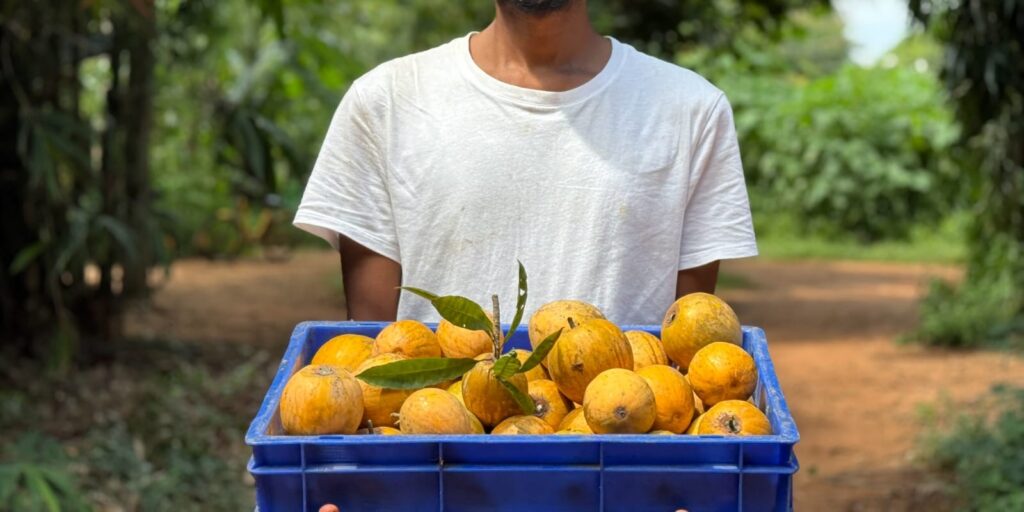
Over the last few weeks at Auro Orchard, I’ve been spending most of my days around the fruit trees, observing, tasting, and doing small bits of research on the fruits growing here. Since I mostly eat fruits throughout the day, this kind of work feels very natural to me it’s both nourishment and exploration at the same time. During these walks, I came across our eggfruit trees, and noticing the bright yellow fruits hanging from the branches felt almost like spotting little suns tucked among the leaves. Harvesting them was a fun experience on its own, and a couple of ripe ones had even fallen perfectly to the ground, soft and ready to eat. The moment I opened one, the texture really stood out: dense, creamy, and yolk-like, almost like scooping out a rich egg yolk but in a sweet, custardy form. The flavor is unlike any other fruit I’ve tried, intensely sweet and extremely satisfying, the kind of fruit you can have only half or one at a time because it fills you up so quickly. Home » Blog » Discovering the Golden Eggfruit: A Sweet Journey at AuroOrchard Discovering the Golden Eggfruit: A Sweet Journey at AuroOrchard November 2025 · Charan Over the last few weeks at Auro Orchard, I’ve been spending most of my days around the fruit trees, observing, tasting, and doing small bits of research on the fruits growing here. Since I mostly eat fruits throughout the day, this kind of work feels very natural to me it’s both nourishment and exploration at the same time. During these walks, I came across our eggfruit trees, and noticing the bright yellow fruits hanging from the branches felt almost like spotting little suns tucked among the leaves. Harvesting them was a fun experience on its own, and a couple of ripe ones had even fallen perfectly to the ground, soft and ready to eat. The moment I opened one, the texture really stood out: dense, creamy, and yolk-like, almost like scooping out a rich egg yolk but in a sweet, custardy form. The flavor is unlike any other fruit I’ve tried, intensely sweet and extremely satisfying, the kind of fruit you can have only half or one at a time because it fills you up so quickly. Eggfruit, also known as canistel, originally comes from Mexico and Central America and later spread to countries in the Caribbean and other tropical regions. Even though it has been around for centuries, it’s still not widely known in India. The tree itself is slow to mature and typically takes around eight years before it begins to produce fruit, which makes the harvest feel even more meaningful. Here at the orchard, as we continue enjoying these unique fruits, we’re also exploring different ways to process them, especially turning them into ice creams and simple frozen desserts to see how their natural creaminess transforms when chilled. It’s been a lovely discovery and definitely one of the more fascinating fruits I’ve spent time with recently. Have you tasted this fruit before? We would love to hear your experience. Over the last few weeks at Auro Orchard, I’ve been spending most of my days around the fruit trees, observing, tasting, and doing small bits of research on the fruits growing here. Since I mostly eat fruits throughout the day, this kind of work feels very natural to me it’s both nourishment and exploration at the same time. During these walks, I came across our eggfruit trees, and noticing the bright yellow fruits hanging from the branches felt almost like spotting little suns tucked among the leaves. Harvesting them was a fun experience on its own, and a couple of ripe ones had even fallen perfectly to the ground, soft and ready to eat. The moment I opened one, the texture really stood out: dense, creamy, and yolk-like, almost like scooping out a rich egg yolk but in a sweet, custardy form. The flavor is unlike any other fruit I’ve tried, intensely sweet and extremely satisfying, the kind of fruit you can have only half or one at a time because it fills you up so quickly. Eggfruit, also known as canistel, originally comes from Mexico and Central America and later spread to countries in the Caribbean and other tropical regions. Even though it has been around for centuries, it’s still not widely known in India. The tree itself is slow to mature and typically takes around eight years before it begins to produce fruit, which makes the harvest feel even more meaningful. Here at the orchard, as we continue enjoying these unique fruits, we’re also exploring different ways to process them, especially turning them into ice creams and simple frozen desserts to see how their natural creaminess transforms when chilled. It’s been a lovely discovery and definitely one of the more fascinating fruits I’ve spent time with recently. Have you tasted this fruit before? We would love to hear your experience. Previous ArticleNext Article Featured Articles Abundance Product of the Month 22 Oct 2025 Monthly Updatesㅤㅤㅤㅤㅤㅤㅤㅤ 22 Oct 2025 The Unstructured Calling: Finding My Rhythmㅤㅤ 30 Nov 2025 Hands-On Approach 29 Nov 2025
Experiments with Syntropic Agriculture

In the last few years, we have observed that the consumption of Auroville vegetables is going down within Auroville. The five most consumed vegetables in Auroville- Potato, Tomato, Onion, Cauliflower and Carrot don’t grow here locally. The demand for locally grown vegetables is low in our international city and even then, we are competing with produce available in Pondicherry and around at very low prices. Considering all this, we have consciously decided to grow more fruits as there is a lot that we can grow and that is still is being bought from outside- Papaya, Banana, Pineapple, Chikoo, Guava, Citrus, Coconut, Jackfruit, Custard apple, Ramphal, Avocado, and so forth. Home » Blog » Experiments with Syntropic Agriculture Experiments with Syntropic Agriculture July 2025 · Anshul Aggarwal In the last few years, we have observed that the consumption of Auroville vegetables is going down within Auroville. The five most consumed vegetables in Auroville- Potato, Tomato, Onion, Cauliflower and Carrot don’t grow here locally. The demand for locally grown vegetables is low in our international city and even then, we are competing with produce available in Pondicherry and around at very low prices. Considering all this, we have consciously decided to grow more fruits as there is a lot that we can grow and that is still is being bought from outside- Papaya, Banana, Pineapple, Chikoo, Guava, Citrus, Coconut, Jackfruit, Custard apple, Ramphal, Avocado, and so forth. We are now either densifying the existing orchards or reorganizing some orchards towards more efficient and productive plantations. Main design objectives: Increase fruit production in the next 2-5 years. Employ syntropic methods to increase density and use biomass to feed the soil. Try new plants like Coffee and Cacao- create microclimate to support these species. Entropy, Negantropy and Syntropy The idea of entropy originated in the late 19th century in thermodynamic studies. Entropy is the measure of disorderness of a system, a measure of its chaos (Clausius, 1865). The conventional understanding suggests whenever a system goes through any transformation, the entropy of the system increases, giving us the famous axiom that the universe is increasingly moving towards chaos. While this may be true for theoretical models and isolated systems, we, in fact, observe a completely opposite phenomenon in living systems that are transforming all the time. Later scientists observed that what we see as chaos in living systems over time, is in fact, higher forms of natural order, spontaneous configurations that make the system more and more stable. A seed releases its energy to germinate, to grow as a plant, as a tree towards higher complexities of life and order. Human beings learn over time to develop a more and more complex consciousness. This leads us to the idea of a decreasing entropy of systems, a negative entropy, or negentropy (Schrödinger, 1944). While negentropy gives us a new perspective of what is happening in nature, it still doesn’t tell us why it is happening-why is disorder moving to more order. Syntropy fills this gap. It adds a teleological aspect to the transformation of systems. Syntropy suggests that we become what we become not only because of what we were, but also because of what we could be. A tree unfolds from a seed not only because of the nature of the seed, but the potential of becoming a tree that is inherent in it. This understanding highlights a goal, a pull from the future towards higher orders, as much as a push from the past foundations. We can also relate this idea to Yoga, a movement towards a complete union, a path of progress, development and unfolding of a harmony in greater complexities. What is Syntropic Farming? The concept of Syntropic farming method was developed by Swiss farmer and researcher Ernst Götsch, who settled in Brazil in the 1980s. Originally trained as a geneticist and plant breeder, Götsch became disillusioned with conventional agriculture and began experimenting with natural regeneration processes in tropical ecosystems. His approach, outlined in his influential paper “Breakthrough in Agriculture”, proposes that human cultivation can regenerate rather than deplete ecosystems. At its core, syntropic farming is based on ecological succession and stratification, mimicking the structure and dynamics of natural forests. Instead of combating nature, it works in harmony with it by planting a consortium of species—pioneer, secondary, and climax—across different light strata and life cycles. This method emphasizes high biodiversity, minimal external inputs, and a continuous process of pruning and biomass management to accelerate soil fertility and system evolution. How is it different from Permaculture’s Food Forest? It is important to make this distinction as a syntropic forest is significantly different from a food forest. Firstly, the goal of a syntropic forest is ecological restoration and not necessarily to provide food. It works on the principle of ecological succession and stratas which translates to light requirements and life cycles. In a food forest, however, the goal is to fit as many edible species into one consortium based on vertical spacing/layering as possible. There is emphasis on ‘support species’ in Syntropic farming to support soil fertility and main crop. In a food forest, edible crops are privileged over other crops. Also, syntropic systems are way more dynamic than a food forest. A syntropic system changes form with the completion of the life cycle of each plant. On the other hand, the idea in a food forest is to put together a system that will stay in the same consortium for as long as possible. In a syntropic system, Papaya may be grown as an initial species to use light and will be cut down after a couple of years to allow the main fruit crop under it to grow further. The goal in the food forest, on the other side, will be to preserve the Papaya and perhaps increase the spacing within the main fruit crop to allow for Papaya to continue growing. We will talk about the benefits of the syntropic approach over food forest in the following sections. Site Selection
Experiments in the Mango orchard
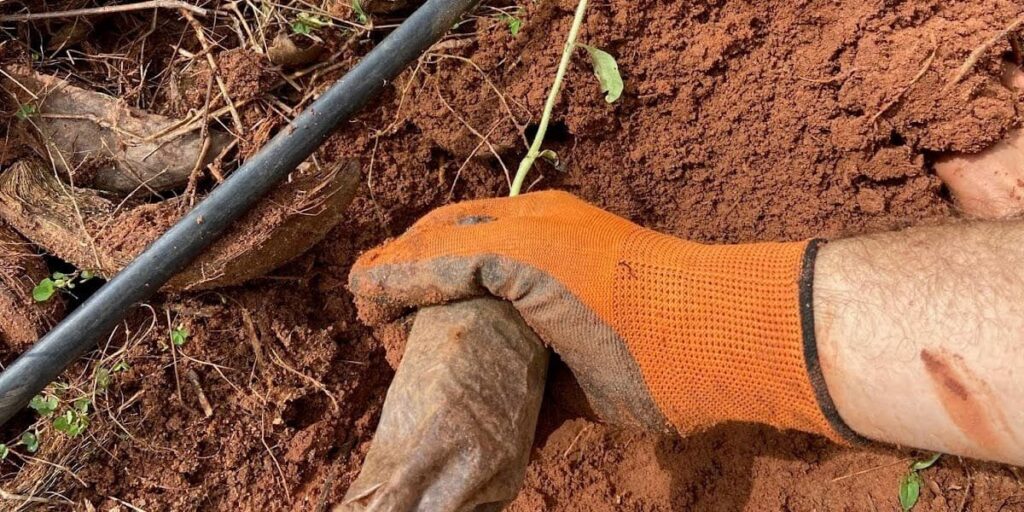
During the last month, our birds contracted a virus and fell terribly sick. The egg production came down drastically with almost no eggs. The little eggs that we got from the sick birds were discarded. With intensive care and help from the entire team, the birds are now doing well. The fourth batch of birds (one-day old chicks) will arrive in two weeks! This will replace the oldest flock which will complete two years at the end of the year. Home » Blog » Experiments in the Mango Orchard Experiments in the Mango Orchard Jan 31, 2025 · Pictures by Ami Grossman For over two years, we have been trying different crops in the Mango orchard to address the gaps of diversity and optimum land utilisation in this more than 80 year old orchard of over 400 mango trees. In 2023, we pruned the mangoes in one section heavily to rejuvenate them. As the space in between was now open to the Sun, we started planting turmeric, pumpkin and brinjal. Ash and Neem leaves are added around the young Pumpkin plants to protect them from Red-gourd-beetle. Sunflowers are being planted in the hedges for diversity and for more food for the bees. Turmeric planted in between the mango trees in May 2024 is now ready for harvest. Pumpkin seeds saved from the farm being sown Channels being irrigated in preparation for Pumpkin planting Next Article Featured Articles Monthly Updatesㅤㅤㅤㅤㅤㅤㅤㅤ 19 Sep 2025 Abundance Product of the Month 18 Sep 2025 Recipe Alert!ㅤㅤㅤㅤㅤㅤㅤㅤ 22 Sep 2025 Food and Agriculture in Auroville, India 18 Sep 2025