Flow meters that were already installed and became defunct after the land exchange have been revived. In the mango orchard and lemon orchard, they measure the amount of water used for irrigation and help us understand ⠀⠀⠀⠀⠀⠀⠀⠀⠀⠀⠀⠀⠀⠀⠀⠀⠀⠀⠀⠀⠀⠀⠀⠀⠀
Conscious Technology Project Update
August 2026 · Azhaganandan Veerappan, Anshul Aggarwal
Technology, particularly Artificial Intelligence and the Internet of Things, is rapidly transforming agriculture across the world. Some visions of the future imagine farms where machines replace most forms of human labour. While automation can offer significant benefits, it also raises important questions: What happens when agriculture becomes increasingly mechanised? What is the place of the farmer? Can technology deepen our relationship with the land, or does it risk distancing us further from it? We are exploring an approach of technology at a human scale. Through the AuroOrchard Conscious Technology Lab, we are experimenting with ways in which technology can support farmers without displacing them, reduce repetitive labour without removing human attention, and contribute to both ecological stewardship and conscious evolution.
The first phase of the project, supported by a grant from the Dutch foundation Stichting De Zaaier, began with one of the farm’s most essential and demanding areas of work: water management. Irrigation requires regular monitoring of pumps, tanks, pipelines and different cultivation areas. It is also an area where small inefficiencies can result in significant water loss. Between February and May 2026, the Lab began establishing an interconnected system for automating irrigation and collecting data about how water moves through the farm.
One of the first steps was automating the main irrigation sump. Previously, the three-phase pump had to be started and stopped manually. A float sensor and controller now detect the water level: when the sump is empty, the motor starts automatically, and when it is full, the motor stops. The cabling has been placed underground in protected casing and connected to a new control panel. A similar system has been installed for the overhead water tank, preventing overflow and reducing the need for constant manual intervention.
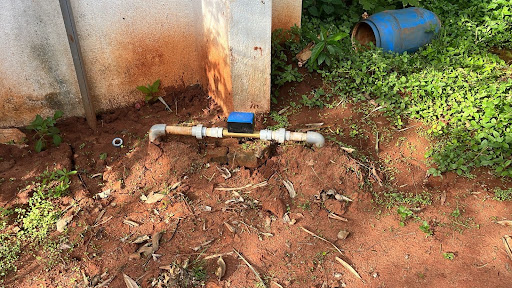
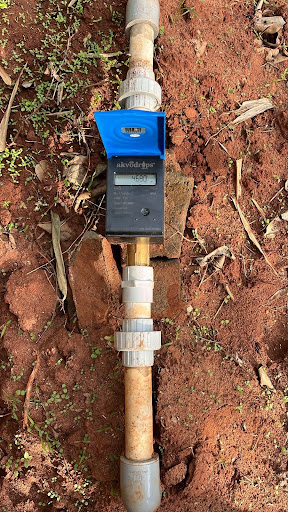
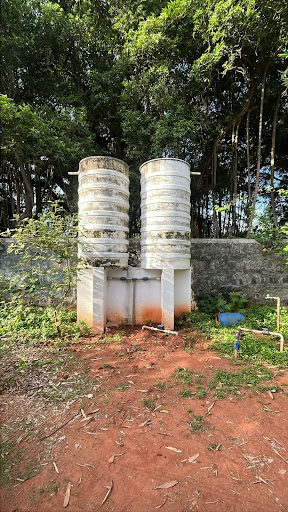
Water meter and automation for drinking water tanks
These are simple changes and very simple technologies that have been available for a long time,, but they already reduce repetitive work, improve reliability, prevent dry running of motors and minimise water wastage. More importantly, they allow the farm team to direct its time and attention towards work that requires observation, judgment and care. The Lab has also installed and configured a LoRaWAN gateway. LoRa is a low-power, long-range communication system that allows sensors distributed across the farm to transmit information to one central platform. The gateway now receives data from the connected flow meters and sensors, creating the basic infrastructure for farm-wide monitoring.
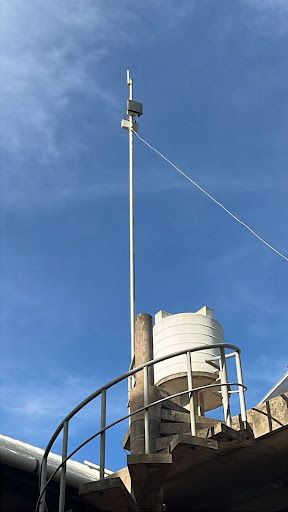
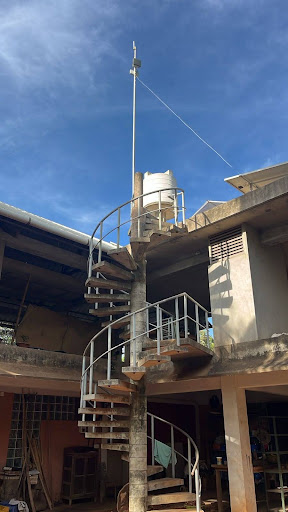
LoRaWAN gateway installed on the volunteer accommodation structure
Flow meters that were already installed and became defunct after the land exchange have been revived. In the mango orchard and lemon orchard, they measure the amount of water used for irrigation and help us understand consumption patterns over time. Another meter monitors irrigation in the banana beds at Hope, where the data can help prevent over-irrigation. A DN20 flow meter has also been installed on the overhead tank to track drinking-water use and daily distribution patterns.
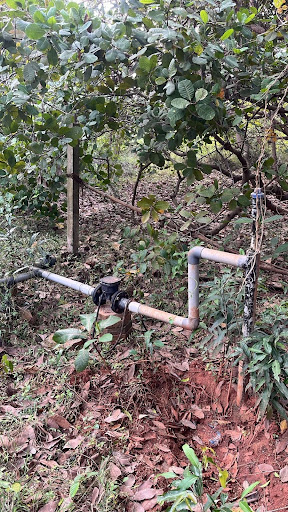
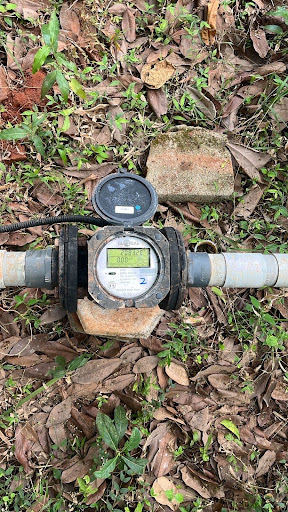
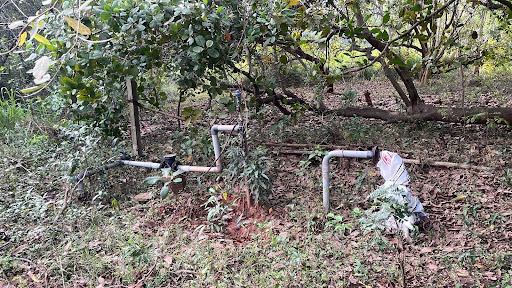
Flow meters re-installed after land exchange- Hope, Lemon Orchard and Mango Orchard
Alongside water-flow monitoring, a soil sensor has been installed to measure moisture, temperature and electrical conductivity. These measurements can help us move beyond irrigation based only on fixed schedules. Over time, we hope to better understand what the soil and plants actually require under changing weather and seasonal conditions. The sensor and flow-meter data are being brought together through a cloud-based dashboard, currently under development, which offers a real-time view of conditions across the farm. All this data is being put up on this dashboard which is still under construction: https://auroorchard-dashboard.netlify.app/
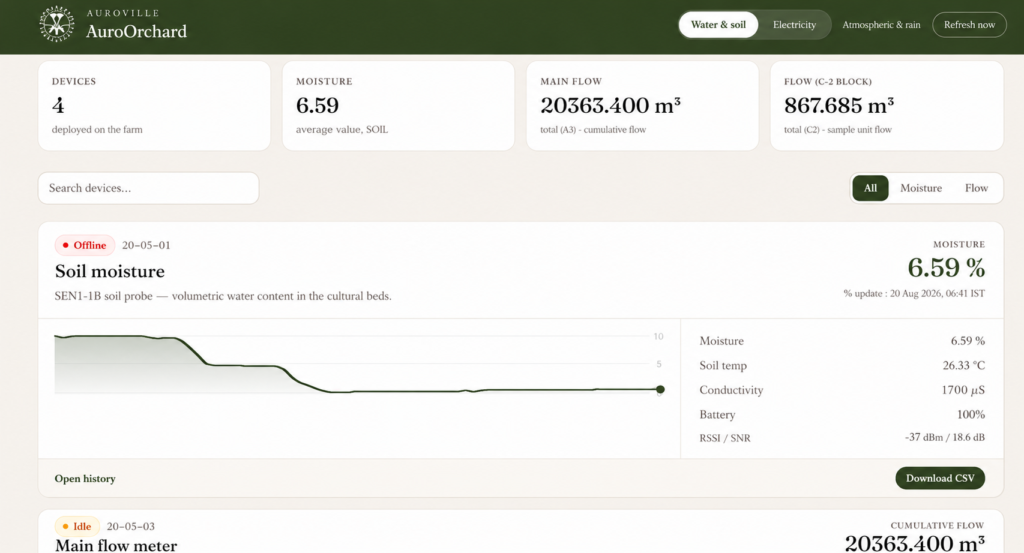
A screenshot of the dashboard
The next phase will focus on making this system more responsive. We plan to refine the soil-moisture sensor design, improve how the data is displayed, and develop valve and motor logic that can switch irrigation on or off in response to field conditions. We will also work on greenhouse irrigation calculations and conduct practical experiments to understand where automation is genuinely useful and where the farmer’s direct presence remains essential. As the project develops, we hope to host workshops and training sessions where farmers, technologists and community members can learn from the systems, question them and reflect together on the relationship between ecology, technology and consciousness.