Nutrition comparison of AuroOrchard eggs with…
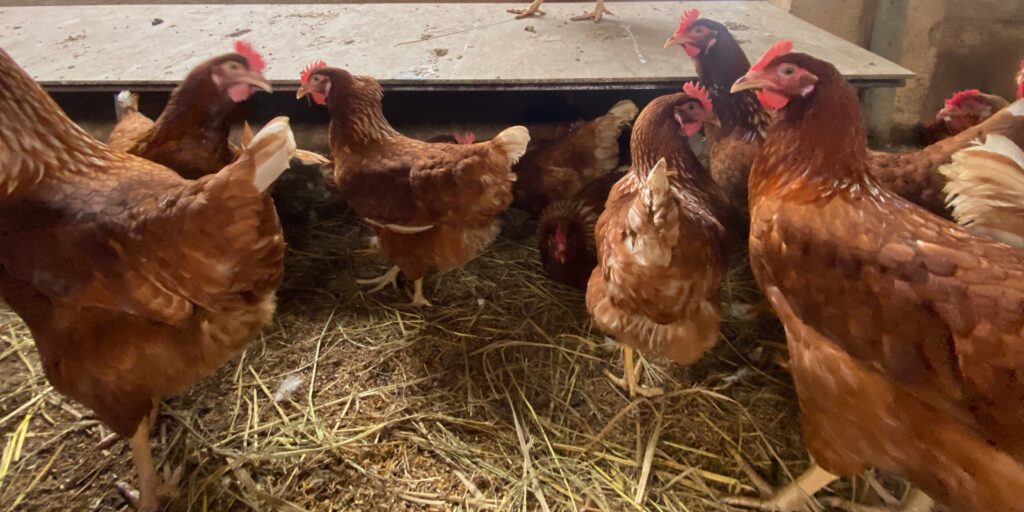
There are many assumptions around organic food, ethical food, farm eggs and free-range eggs. It is generally believed that these labels must also⠀⠀⠀⠀⠀⠀⠀⠀⠀⠀⠀⠀⠀⠀⠀⠀⠀⠀⠀⠀⠀⠀⠀⠀⠀ Home » Blog » Nutrition comparison of AuroOrchard eggs with other eggs in the marketㅤㅤㅤ Nutrition comparison of AuroOrchard eggs with other eggs in the marketㅤㅤㅤ July 2026 · Anshul Aggarwal There are many assumptions around organic food, ethical food, farm eggs and free-range eggs. It is generally believed that these labels must also indicate better nutritional quality. The converse is also common- if the nutrition is the same across different kinds of produce, why pay more for organic food or free-range eggs? We have been actively participating in these conversations for the last few years. We feel that one useful way to understand this is through nutritional testing and comparison. While a one-off test cannot serve as an absolute reference, individual tests can begin to show us a pattern and add more information to the discussion. Food composition varies according to the season, feed, age of the birds and other conditions. Any meaningful comparison would require regular and repeated testing. We also hope that sharing these results will create greater understanding and support for this work, and perhaps help us continue testing periodically, since comprehensive nutritional testing is expensive. After the work undertaken for our animal-welfare certification, and the many improvements made in our poultry system, we wanted to see how AuroOrchard eggs compared with the eggs that Aurovilians otherwise have access to. We sent three samples to Chennai Mettex Lab for comparative nutritional testing: white eggs purchased from Pour Tous Distribution Center; commercial brown eggs marketed as free-range, sold in packs of six and commonly available in stores in and around Auroville; AuroOrchard certified free-range eggs. The full test report can be found here.The following is a comparative summary of the results. All values are given per 100 g of edible egg, excluding the shell. Nutrient per 100 g Pondy White Pondy Brown AuroOrchard Energy 150.89 kcal 152.59 kcal 154 kcal Protein 13.04 g 13.13 g 13.74 g Total fat 10.61 g 10.71 g 10.62 g Saturated fat 3.96 g 3.96 g 3.87 g Carbohydrates 0.81 g 0.92 g 0.81 g Cholesterol 316 mg 273.3 mg 265.8 mg Sodium 120 mg 131 mg 115 mg Omega-3 fatty acids 158 mg 179 mg 196 mg Omega-6 fatty acids 1,183 mg 1,297 mg 1,151 mg Omega-6:omega-3 ratio 7.49:1 7.25:1 5.87:1 The differences in calories, carbohydrates and total fat are very small. All three eggs have broadly similar amounts of these nutrients. The clearer differences are in protein, omega-3, cholesterol and sodium. Among the samples tested, the AuroOrchard egg recorded: the highest protein; the highest omega-3; the lowest cholesterol; the lowest sodium; the lowest saturated fat; the lowest omega-6; the lowest omega-6-to-omega-3 ratio. The AuroOrchard sample contained around 5% more protein than the two Pondy eggs. Its omega-3 content was approximately 10% higher than the Pondy brown egg and 24% higher than the Pondy white egg. Its cholesterol was approximately 3% lower than the Pondy brown egg and 16% lower than the Pondy white egg. What does one egg contribute to our daily nutrition? The laboratory results are reported per 100 g, while an egg normally contains around 50 g of edible material. Egg sizes vary, so the following figures use 50 g as a simple illustration. For daily comparisons, we have used FSSAI’s reference values for an average adult diet: 2,000 kcal, 67 g total fat, 22 g saturated fat and 2,000 mg sodium. WHO describes approximately 50–75 g of protein as generally sufficient for an adult of healthy body weight consuming around 2,000 kcal. These are broad population references; an individual’s requirements depend on body size, activity, age and physiological condition. Approximate contribution from one 50 g egg Nutrient per 100 g Daily recommendation (FSSAI & WHO) Pondy White Pondy Brown AuroOrchard Energy 2,000 kcal/day 3.8% 3.8% 3.9% Protein 50–75 g/day 8.7–13.0% 8.8–13.1% 9.2–13.7% Total fat Up to 67 g/day 7.9% 8.0% 7.9% Saturated fat Up to 22 g/day 9.0% 9.0% 8.8% Sodium Less than 2,000 mg/day 3.0% 3.3% 2.9% The mid to late June showers bring some relief from the heat and life to the parched soil. During this time, we can start growing crops the same as Pin-Pani but also some other crops like cluster beans, flat beans etc.- its still a bit early for these crops but we can still do it. Of course, within this period falls the Aadi masam (mid-July) with heavy winds, when Papayas break and we have an abundance of green papayas in Auroville. Post-Aadi masam is really good for planting a diversity of crops. This is an interesting season because it is post-summer rain but it is not as cool as the post-monsoon season. So, it is in some ways similar to Pre-Summer and that is reflected in the kind of crops we can plant. We can start to grow some arugula in the shade, some greens, and prepare for planting yams and sweet potatoes. What can we conclude? Among the three samples tested, AuroOrchard eggs showed the strongest overall nutritional profile. It combined the highest protein and omega-3 results with the lowest cholesterol and sodium values. It also has a healthier omega-6 to omega-3 ratio. The test does give us some evidence towards how our attention to the birds, their outdoor access, fresh greens and the quality of their food is accompanied by a strong nutritional result in nutritional enhancement. We hope to repeat this testing periodically, across different seasons and flocks, so that we can understand how consistent these results are and how our farming practices influence the food we produce. Previous ArticleNext Article Featured Articles Words of appreciation…ㅤㅤㅤㅤㅤ 27 Aug 2026 Monthly Updatesㅤㅤㅤㅤㅤㅤㅤㅤ 26 Aug 2026 Words of appreciation…ㅤㅤㅤㅤㅤ 27 Aug 2026 Words of appreciation…ㅤㅤㅤㅤㅤ 26 Aug 2026
Natural Beekeeping and Apiary Project
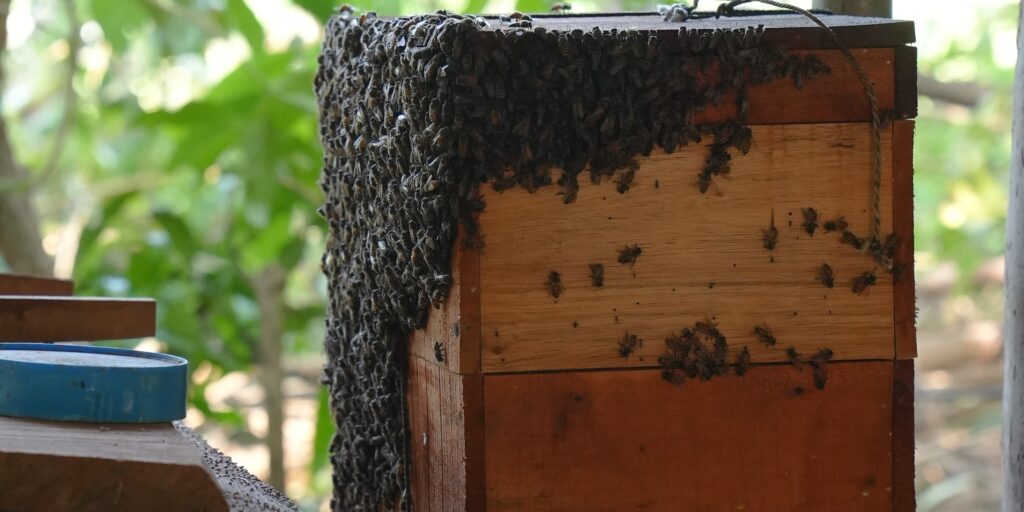
In January 2026, Erik spent six days at MadhuSree Honeybee Farm in Kerala. The farm has over 45 years of experience and manages more than 2,000⠀⠀⠀⠀⠀⠀⠀⠀⠀⠀⠀⠀⠀⠀⠀⠀⠀⠀⠀⠀⠀⠀⠀⠀⠀ ⠀⠀⠀⠀⠀⠀⠀⠀⠀⠀⠀⠀⠀⠀⠀⠀⠀⠀⠀⠀⠀⠀⠀⠀⠀ Home » Blog » Natural Beekeeping and Apiary Project Natural Beekeeping and Apiary Project July 2026 · Erik Jansegers & Anshul Aggarwal Between August 2025 and April 2026, AuroOrchard’s natural beekeeping project made significant progress towards developing a larger, resilient apiary and creating opportunities for learning about bees and small-scale honey harvesting. The project began in August 2025 with two main aims: to gradually expand the farm’s apiary to 100 hives, with the possibility of eventually reaching 200, and to offer workshops for farmers, students and people interested in natural beekeeping. Learning from experienced beekeepers In January 2026, Erik spent six days at MadhuSree Honeybee Farm in Kerala. The farm has over 45 years of experience and manages more than 2,000 colonies of the Indian hive bee, Apis cerana, and the stingless bee, Tetragonula iridipennis. The visit offered valuable practical learning in hive design, colony management, honey production, multiplication of colonies and the organisation of a professional beekeeping operation. It also helped inform the next stage of hive development at AuroOrchard. New hives and growing colonies Almost 30 new hives have been made using three designs developed and adapted by Erik: One Kenyan top-bar hive Five Warré hives Twenty-two stingless bee boxes designed for honey production These designs build on research and experimentation at AuroOrchard since 2015, together with Erik’s earlier beekeeping experience in France. The dimensions, ventilation, entrances and internal organisation of the hives are designed around the needs of the bees and the conditions of our region. The stingless bee boxes include a separate honey chamber, allowing honey to be collected with minimal disturbance to the brood area. The number of Apis cerana colonies at the farm has increased from three in 2025 to seven. The number of stingless bee colonies has grown from around fifteen to more than forty. The colonies are healthy and developing well. We are currently placing particular emphasis on stingless bees, which have shown themselves to be highly resilient in our local conditions. Expanding the apiary In February, the existing roofed apiary structure was extended and an old shed was repaired. Together, these spaces can eventually shelter between 100 and 200 stingless bee colonies. Honey harvesting is expected to begin in January 2027, during the main flowering season from December to March. The coming months will continue to focus on strengthening the colonies, observing the new hive designs and improving them through experience. Sharing the learning On 18 April 2026, AuroOrchard hosted a new three-and-a-half-hour workshop titled “The Secret Life of Honeybees: An Introduction to Natural Beekeeping.” Twenty-five people participated in the workshop, which introduced the lives of honeybees, the differences between bee species, hive design and the principles of working with bees in a respectful and attentive way. The response was very positive and encouraging. Natural beekeeping has been an area of exploration at AuroOrchard for more than ten years. This project is helping us deepen that work, create a strong home for bees at the farm and share what we are learning with a wider community. Previous ArticleNext Article Featured Articles Remembering the Beginnings…ㅤㅤㅤㅤㅤ 27 Aug 2026 Monthly Updatesㅤㅤㅤㅤㅤㅤㅤㅤ 26 Aug 2026 Remembering the Beginnings…ㅤㅤㅤㅤㅤ 27 Aug 2026 Words of appreciation…ㅤㅤㅤㅤㅤ 26 Aug 2026
The Story of How AuroOrchard Started…
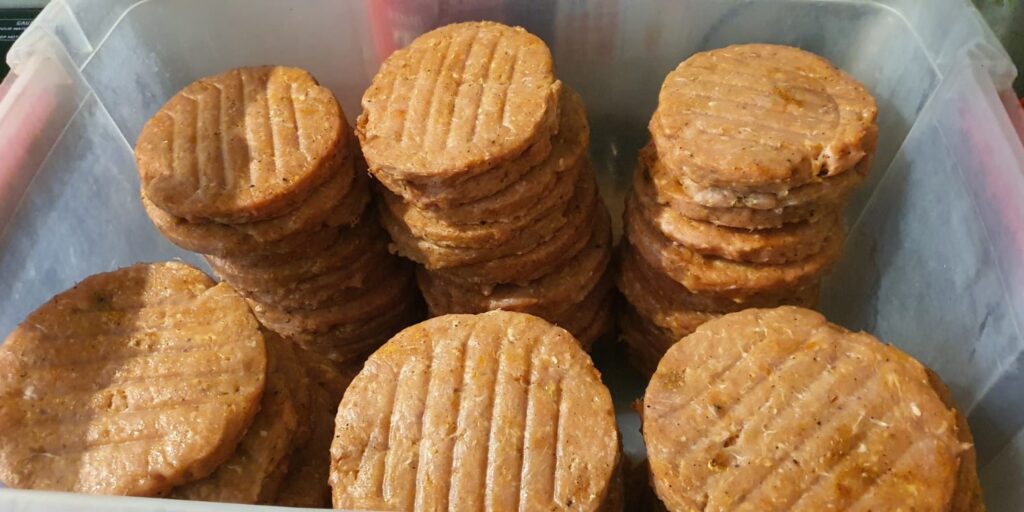
In December last year, I wrote about the dilemmas of agriculture with animals. Home » Blog » The Story of How AuroOrchard Started Offering Meat The Story of How AuroOrchard Started Offering Meat July 2026 ·Madhuri Kadam & Anshul Aggarwal In December last year, I wrote about the dilemmas of agriculture with animals. In this post, we would like to share a little more about how these dilemmas play out in the context of the farm, and what we have been doing with our chickens. Inevitably, during any conversation about the activities of the farm, the question of chickens comes up. Do we need them on the farm? Aren’t Aurovilians supposed to avoid eating meat? Is this appropriate within a conscious community? Is it ethical to keep animals for food production? How is Auroville different if we also participate in animal farming, however well-managed it may be? Our sincere answer involves the following points: A large number of Aurovilians consume milk, eggs and meat for different reasons. At present, they have few sources of animal protein whose production conditions, feed, antibiotic use, animal welfare and traceability can be properly verified. As farmers, we feel responsible for engaging honestly with what the community is already eating and for trying to improve how that food is produced. If farms within Auroville withdraw completely from animal-food production, it does not necessarily mean that consumption will stop. Much of it will simply continue through outside systems over which we have very little knowledge or influence. Our poultry also currently generates around half of the farm’s income and contributes significantly towards supporting vegetable and fruit production. If we stopped poultry within our present system, we would need to considerably expand horticultural production, increase prices, develop another dependable source of income, or reduce the activities of the farm. Auroville is meant to be a field for exploring solutions that may have relevance for the wider world. Animals remain integral to the land, livelihoods, nutrition and farming systems of millions of households in India and elsewhere. If our agricultural solutions completely exclude animals, we may resolve one ethical contradiction while leaving many other agricultural realities unexplored. Expecting farmers to keep domesticated animals indefinitely without receiving food or livelihood from them is also economically unrealistic in many contexts. Our exploration is therefore not simply about whether animals should be present on farms, but about how these relationships can be transformed: how animals are cared for, what conditions they live in, how the food received from them is valued, and how responsibility is taken for their entire lives. Surely, there are counterpoints to each of these arguments. Auroville has a substantial vegan community, as well as many vegetarians by birth or by choice. For many people, this issue is deeply sensitive. For some, the ethical objection is fundamental: animals should not be used or killed for food under any circumstances. We take these objections seriously, even when we arrive at a different practical position. Our position has emerged from the particular realities of food production and consumption within Auroville. We do not claim that better animal welfare resolves the ethical contradiction of using and killing animals. We do feel, however, that as long as animal foods continue to be consumed, there is value in producing them locally, transparently and with greater care. Poultry has been part of AuroOrchard for around 45 years. During this time, it has moved from cages to deep litter and eventually to free-range systems, with the standards improving continuously. Free-range is not the panacea of poultry farming. It is the most responsible system that we currently know how to operate at the required scale within our present conditions. Can it be improved? Of course. We are trying every year to first come up to the best international standards within free-range, and hopefully then surpass those standards. Standards are minimum requirements, not the highest goals. This brings us to the question of what the goal should be. We feel that farmers cannot answer this on their own. As a community, we need to ask- What do we want our food to be? How do we want it to be grown? What standards are we prepared to support, even when they require more labour, infrastructure and money? In the last few years, we have made good progress in understanding the global free-range poultry ecosystem and connecting with people who can help us improve our work. We buy one-day-old chicks from a large commercial hatchery. This itself raises many questions and remains an unresolved part of our system. We have limited influence over the breeding system, the parent flocks and the wider hatchery process before the chicks arrive at the farm. Once the chicks arrive, however, we care deeply for them. They have enough time and space to move, scratch, forage, dust-bathe and express many of their natural behaviours. They are protected from predators and provided with appropriate shelter, feed and care. The difficult question arises when their egg production declines significantly, usually when they are around two years old. At this stage, we need to make space for a younger flock if the poultry activity is to continue. Until last year, we would announce that the older birds were available, and people from the neighbouring villages would come and take several birds at a time. Some would keep them for a while and receive the few eggs they continued to lay. Eventually, however, almost all the birds would be killed for food. It felt wrong to care for the birds for two years and then, once their role on the farm was over, hand them to someone else and distance ourselves from what happened next. We were outsourcing the killing while avoiding the consequences of our own farming decisions. We felt that if we chose to keep birds for eggs, we also had to take responsibility for what happened when we decided to cull the flock. We also felt that if people in
Interview with Christian Tarpin, 2019
Following is an English translation of the French interview with Christian conducted by Emilie Ponceaud Goreau and Anthony Goreau Ponceaud and published in Open Edition of Journals, a French platform for the humanities and social sciences. Christian worked on the farm from 2012-2019, and was the key driver in Home » Blog » Interview with Christian Tarpin, 2019 Interview with Christian Tarpin, 2019 May 2026 · Anshul Aggarwal Following is an English translation of the French interview with Christian conducted by Emilie Ponceaud-Goreau and Anthony Goreau-Ponceaud and published in Open Edition of Journals, a French platform for the humanities and social sciences. Christian worked on the farm from 2012-2019, and was the key driver in transitioning the farm to fully organic. In this interview, he describes how he began his work at AuroOrchard and reflects on his ideas about agriculture, consumption, and creating a new relationship with the soil. Reference: Emilie Ponceaud-Goreau and Anthony Goreau-Ponceaud, “Entretien avec Christian Tarpin. Ferme AuroOrchard, 12 décembre 2019,” Les Cahiers d’Outre-Mer [online], 281 | January–June, published online January 1, 2022. URL : http://journals.openedition.org/com/11323 DOI : https://doi.org/10.4000/com.11323 Photograph 1: Christian Tarpin, originally trained as a civil engineer and urban planner specializing in mobility systems, is now a farmer at AuroOrchard, the historic farm of the Auroville community, founded by Gérard and Bithi in 1969. Photograph 2: The “Groundnut Field” and the First Cowshed of AuroOrchard What were your impressions upon arriving here? I discovered the farm on February 15, 2012, shortly after Cyclone Thane had passed through (December 31, 2011). It was devastated, yet I fell in love with it. Forty years of conventional agriculture had damaged it; the cultivation practices, maintaining the soil bare and clean, ready to receive new crops, had destroyed its fertility. This is true in general, but even more so in this climate. On top of that, the cyclone had passed through and caused major damage. I still remember Gérard1 standing in front of the four hectares where there are 300 large mango trees, extending his hand and saying: “and there, the mango orchard”… and I could see nothing, the trees were so entangled, broken… The road entering it was not even visible anymore! But I also saw that Gérard had done incredible work. To what extent does the farm at AuroOrchard fit into the evolution of the local landscape? Hmm… To understand that, we will have to take quite a few detours… In fact, the climax ecosystem of this region is the Tropical Dry Evergreen Forest (TDEF)2. This country experiences intense sun and intense rains; only trees are strong enough to withstand and protect the soil from these aggressions. The region is also described as arid because evaporation exceeds precipitation. In reality, it is bistable: either one strips and damages the land and moves toward desert, or one protects and cares for it and moves toward forest. Agroforestry is therefore unavoidable… agriculture must navigate, oscillate between these two “temptations”: desert or forest. The history of this place is linked to that of Pondicherry. The city was built mainly out of wood, which explains the deforestation. It was also burned and rebuilt several times because of the quarrels between the English and the French. In the eighteenth century, the inhabitants also cleared a ten-kilometre “buffer zone” around the city to protect themselves from leopards and elephants. Auroville was established in this place, intentionally desertified by humans. The landscape evolved toward desertification, especially because cattle are left free to roam here; it is a local tradition. At the beginning of Auroville in the 1970s, the plateau was desert-like, though it nevertheless became green during the rainy season… The inhabitants had developed a rainfed agricultural system consisting of enclosing the fields at the end of spring in order to protect them from cows; they sowed as soon as the first rains of the small monsoon arrived in June, and harvested one or two crops. Afterwards, they opened the fields again, the animals ate the stalks, trampled the soil, deposited their excrement… This ecosystem was fragile; the older Aurovilians experienced sandstorms. Today only 2% of the original forest that once covered the eastern coastal strip of the Indian subcontinent remains. Most often, only the sacred groves around temples survive; when entering them, the presence of these old trees is striking, one can breathe there… It would take centuries to recreate this forest! The history of the landscape here has been deeply marked by human beings. It was once an extremely rich, wooded landscape, but today we continue moving toward the desert. When I arrived at AuroOrchard eight years ago, I had difficulty outlining the farm on Google Maps because the surroundings were still green. Today the green form of AuroOrchard emerges like an island of resistance, green amidst the red of exposed earth! We are still pushing the cursor toward desertification because this is an “economic development” zone, highly coveted along the highway… How did you come to take responsibility for the farm? I always had gardens; I was self-sufficient in vegetables, cultivating more than 1,000 square meters of land to feed my family. It was part of my life, but I had no training as a farmer, even less in tropical agriculture. At first, I considered myself an apprentice; I listened to Gérard, conducted small experiments, and continued the BRF3 approach that he had started in 2011. It was a very good direction, which I developed extensively. Bernard and Deepika4, the founders of Pebble Garden, the seed-conservation vegetable garden where I volunteered, encouraged me. I began here in February 2012, initially one day per week. I observed what was being done, learned their methods, and gradually became more and more involved. By October 2012 I was full-time, responsible for the vegetables… One day, because of an excess of potassium, a field bloomed with green, slimy, foul-smelling algae, like the green tides in Brittany, and I really became angry: “either we switch to organic farming or I leave.” Gérard received this very
What Did Auroorchard Produce & Where It…
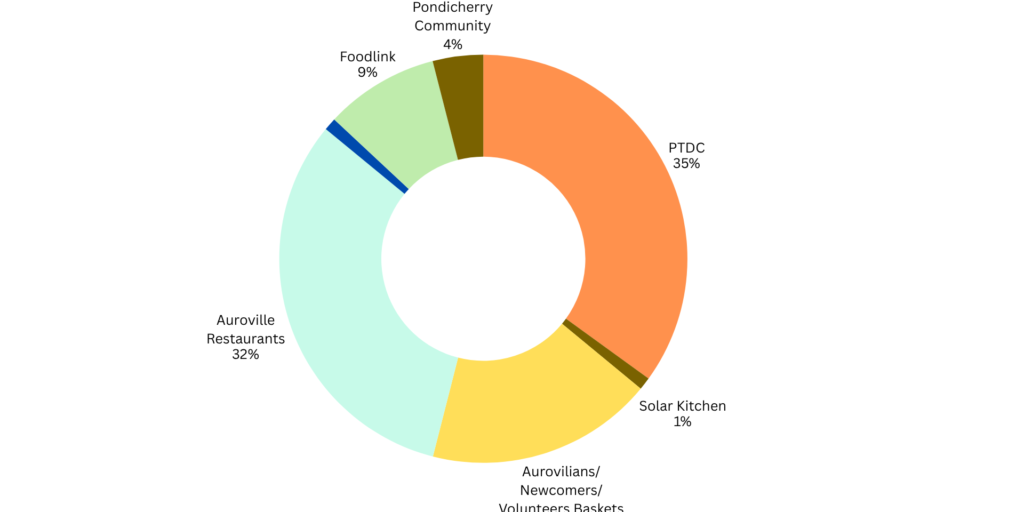
This is an overview of the distribution of food from AuroOrchard during April 2025 to March 2026 and its comparison to the previous years. Home » Blog » What Did Auroorchard Produce & Where It Went | 2025-26 What Did Auroorchard Produce & Where It Went | 2025-26 May 2026 · Anshul Aggarwal This is an overview of the distribution of food from AuroOrchard during April 2025 to March 2026 and its comparison to the previous years. This year, our production focus was on fruits and bringing the poultry to a certifiable standard. The work in poultry also shows the increase in production of eggs this year. Similarly, fruit production was higher comparatively. The work with the orchards has certainly diverted some space, energy and attention from the vegetables and we can see a small drop in production for some vegetables, greens and herbs. This is in line with our long term strategy of strengthening the fruit orchards more and more and maintaining the vegetables at a significant yet limited production level. The choice of keeping the vegetables limited is due to lack of demand for local vegetables within Auroville, the distribution challenges that it brings with it as well as the high amount of labour and energy required to consistently produce vegetables in large quantities. Overall, over the last eight years, farm production is rising significantly (see charts below). The following analysis outlines our major production and distribution trends. Overall production trend 2017-2026 Fruits, Nuts & Vegetables The drop in the nut production (cashews) reflects the loss of trees due to land exchange. Last year, we were able to collect some fruit from the lost trees. However, in 2025-2026, we only collected fruit from trees still left at AuroOrchard. The drop in vegetable production, as explained above, is a sign of shifting attention to fruits, and the increase in production of fruits is encouraging. Trend for Vegetables, Fruits and Nuts Six most produced vegetables (figures in Kg) Six most produced fruits (figures in Kg) Eggs In terms of our infrastructural capacity, this is the peak egg production that we can expect. With around 1500 laying birds around the year, we get around 800-1100 eggs per day. While this is still much lower than the daily egg needs of Auroville, expanding this system further has multiple challenges. Therefore we will maintain this scale for the years to come and bring more innovation, better practice within this system progressively. Though the figure of 2025(-2026) looks only a bit higher than 2017(-2018), the quality of the eggs and poultry practices has significantly improved since then. Food preservation/ Abundance This year our food preservation work gained some momentum. We were able to develop multiple recipes and distribute certain products consistently. Distribution The majority of the food produced went to PTDC followed by Auroville restaurants and units like Auroville Bakery, Taste of Korea, La Terrace, Coffee Ideas, Naturellement, Nowana, PTPS, The Right Path Café and The Sprout. Roughly one-fifth went directly in baskets to Aurovilians, Newcomers and volunteers. 96% of the food produced is distributed within Auroville. The remaining 4% is distributed mainly in Pondicherry with the Sri Aurobindo Ashram community through baskets. Solar kitchen remained the lowest consumer (only 1%) and Foodlink’s share has dropped significantly over the last year. Financial sustainability Our main source of income continues to be the eggs. The proportion of income from fruits and vegetables is more or less the same compared to the previous year(s). We had some small income from the preserves distributed through ‘Abundance’ as well as a very small income from sapling sales. The current situation remains concerning as it is not sustainable to depend heavily on only one income source-and that too on the poultry. We are hoping to gradually expand the income shares of fruits and abundance products. You can access the data from 2024-25 here. Previous Article Featured Articles What Did Auroorchard Produce & Where It… 28 May 2026 Monthly Updatesㅤㅤㅤㅤㅤㅤㅤㅤ 29 Apr 2026 What Did Auroorchard Produce & Where It… 28 May 2026 Salt: How a Tiny Crystal Took Over Our Meals 28 Apr 2026
The Six Seasons of Aurovilleㅤㅤㅤㅤ
Does Auroville only have one long summer season? That is how it feels. But even the subtle differences make a lot of difference in farming. When I came to Auroville in 2019, I had only farmed in the mountains. I was used to four distinct Home » Blog » The Six Seasons of Auroville The Six Seasons of Auroville April 2026 · Anshul Aggarwal Does Auroville only have one long summer season? That is how it feels. But even the subtle differences make a lot of difference in farming. When I came to Auroville in 2019, I had only farmed in the mountains. I was used to four distinct seasons- of course with their own subtleties, but still the distinction between summer, autumn, winter, spring was quite pronounced. It took me about two years to understand that Auroville actually has six seasons! We have been planning our crops based on this understanding since 2022. Only much later, and recently, I found out that ancient Tamizh literature like Tolkaapiyam, also identifies six seasons for Tamil Nadu. This system of six seasons is called Paruvangal. Each season lasts exactly two Tamizh months, beginning with the Tamizh New Year in mid-April. Interestingly, my observations align perfectly with this age-old system. I will first describe how I observe seasons. The typical cycle of seasons is based on the position of the Earth in relationship to the Sun. The four main events in this yearly cycle with the Sun are- the two equinoxes, where the Earth is in perfect alignment with the Sun and the two solstices, where the Earth is tilted closest or farthest from the Sun. Since we are very close to the equator (12 degrees North) in Auroville, we don’t see the pronounced effects of these movements, and yet there are subtle changes. We can use the visual of breathing in and out- the most fundamental cycle that we experience. As the Earth moves in her cycle, it too breathes in and out. The beginning of the in-breath starts with the Autumn Equinox (September 21st)*. This is the period of going inwards, the year is winding down, we begin to reflect on the activity so far, some have the need to retreat into contemplation and silence, the land starts to cool down after summer and the rhythm of life becomes more relaxed. The peak of this in-breath comes at the Winter solstice (December 21st), the longest night of the year. In-breath, the period of inner activity continues until Spring Equinox (March 21st). We then move to the out-breath, where life starts to wake up from its slumber, flowers bloom, the land and air start to get warmer, microbes and insects multiply, and there is an impulse for external activity. The peak of this cycle is reached at the Summer solstice (June 21st) and this period itself continues until the Autumn Equinox (September 21st), after which it repeats itself. While these periods and patterns don’t apply as per dates and months in the same way to all locations on the Earth, the principles apply to all places and people. Even if not coordinated with seasons, we can easily observe these cycles in our own life. This is the template on which Auroville’s six seasons are based. The breathing cycle of the Earth * These descriptions apply to all of us in the Northern hemisphere of the planet. These patterns will be the exact opposite for people living in the Southern hemisphere. In the case of Auroville, or perhaps larger Tamil Nadu, the two extreme points are Summer and Monsoon, and, in my scheme, they become the reference for all the other seasons. And due to our location close to the equator as well as our proximity to the oceans, our seasons are not only influenced by solar cycles but also by oceanic and wind phenomena. The correlation of these seasons with the calendar months and the Tamizh Paruvangal is as follows: English calendar Solar event Breath cycle Paruvangal Tamizh calendar Pre-Summer Mid-Feb to Mid-April Spring Equinox Out-breath Pin-pani (Late dew) Masi & Panguni Summer Mid-April to Mid-June – Out-breath Ila-venil (Tender heat) Chittirai & Vaikasi Post-Summer Mid-June to Mid-Aug Summer Solstice Peak of out-breath Mudhu-venil (Mature heat) Ani & Adi Pre-Monsoon Mid-Aug to Mid-Oct Autumn Equinox In-breath Kar (Dark clouds) Avani & Purattasi Monsoon Mid-Oct to Mid-Dec – In-breath Kulir (Cold) Aippasi & Kartikai Post-monsoon Mid-Dec to Mid-Feb Winter Solstice Peak of in-breath Mun-pani (Early dew) Margali & Tai I will now describe what these seasons mean to us and how we organise our work based on them. Pre-Summer Paruvangal: Pin-pani (Late dew) | Tamizh calendar: Masi & Panguni | English calendar: Mid-Feb to Mid-April I will put this as the first as this is right after the Pongal festival in mid-January. The first season of a new cycle, and I will call this Pre-Summer. The days are still a bit short and the mornings and evenings are still cool. During this season, we continue planting summer crops like pumpkins, cucumbers, and gourds from the late previous season. We could continue planting some winter crops like spinach, lettuce etc. but the quality of those in this season is not that great due to hot days. The flavour is different and the texture is harder. During Pre-Summer, life is blooming, we can see a diversity of flowers on crops and trees. This is also the best time to save seeds. This season is closely associated with the Post-monsoon season, the last in the cycle (Mun-pani). Summer Paruvangal: Ila-venil (Tender heat) | Tamizh calendar: Chittirai & Vaikasi | English calendar: Mid-April to Mid-June Then, the sun starts to rise in the sky and the days as well as the nights are warmer. This is what I would call the real Summer. The production during this time starts to be limited to a few crops. It’s not so much due to heat but due to limitation of water and pressure from pests. Like many places
Reflections from Volunteersㅤㅤㅤㅤㅤ
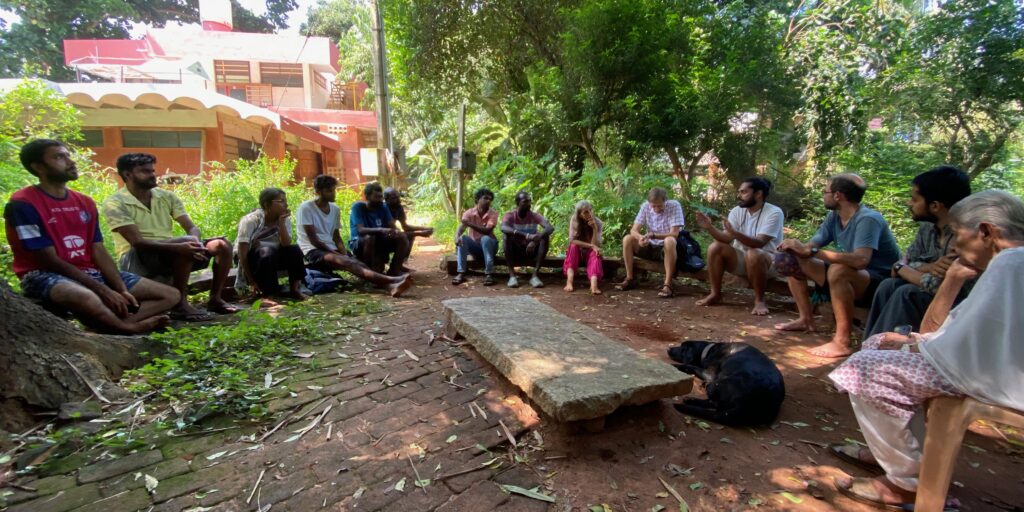
Our effort has been to open the space on the farm for learning agriculture as well as coming into a deeper contact with the land and oneself. We firmly believe the farm to be a site for Integral Education, with ample opportunities for development of the physical, vital, mental, spiritual, as well as the psychic. These are the reflections from some of our past volunteers showing the potential and possibilities of this work. Home » Blog » Ayurvedic Recommendations for Winter Reflections from Volunteers March 2026 · Anshul Aggarwal Our effort has been to open the space on the farm for learning agriculture as well as coming into a deeper contact with the land and oneself. We firmly believe the farm to be a site for Integral Education, with ample opportunities for development of the physical, vital, mental, spiritual, as well as the psychic. These are the reflections from some of our past volunteers showing the potential and possibilities of this work. My time at Auroorchard was a deeply valuable experience. I find it incredibly important that we spend time on the land – growing, preserving and innovating with food and Auroorchard provides that opportunity! I found the Auroorchard to be a living lab, where people can execute projects and research that can serve the multitude of projects on the farm, from regenerative farming to cultural paradigm shifts to education. Thanks to Anshul, Auroorchard takes a holistic approach to food farming, which is essential in both local and global food transitions that we desperately need. I hope the farm can grow, evolve and thrive for many years ahead. — Nikita Bharat, Netherlands AuroOrchard has left my heart full, thanks to the open-hearted people who work there and the mesmerizing beauty of the farm itself. It has been a true pleasure documenting the life of AuroOrchard and diving into the techniques of the natural way of farming. I feel deeply grateful for having been a part of the farm, even for a short period of time. — Taisiia Latypova, Russia I stayed at the farm for a week, and the experience truly stayed with me. I had zero background in farming, yet everyone there welcomed me with warmth and patiently taught me the basics. Every day brought a new learning — not just about farming practices, but about people, their journeys, and the stories they shared while we worked together. Even in that one week, I felt a deep connection to the people and the sense of community on the farm. It was a meaningful and memorable experience. — Sai Kiran, Andhra Pradesh, India I worked at AuroOrchard for a month, really it’s a wonderful experience to me and I gained a lot of knowledge from the farm.And now I am implementing the learnings at my place. And the people who are there are great and provided a lot to me. And everyone who is interested in farming should visit this place. — Ramesh G, Tamil Nadu, India It was amazing volunteering at AuroOrchard. Volunteering brought new learnings about farming, a nourishing breakfast and company of like minded fellows from different walks of life. Anshul used to solve my doubts and was great at doing thought experiments. Guided farm walk also helped a lot. I thoroughly enjoyed being at the farm. I saw so many birds I had not even known and made some great friends too. Thanks again for the opportunity ! — Abhijeet Kulkarni, Maharashtra, India It’s a simple truth that AuroOrchard made me feel far more deeply than I ever had before. My weeks at AuroOrchard showed me how every role, no matter how small or humble, becomes meaningful when directed toward a shared purpose: growing food for the community in the most natural and conscious way possible. During my stay, I listened to locals, Aurovilians, volunteers, travellers and tourists. Everyone carried a fragment of the larger story: a story shaped by the vision of The Mother and Sri Aurobindo, rooted in inner evolution, collective harmony, and the aspiration to manifest a more conscious world. Auroville itself is built on this experiment of human unity, and AuroOrchard reflects that ideal in the soil, the sweat, and the spirit of everyday work. The people I met now long-standing acquaintances and friends were bound not by background but by shared values. Together we watched sunrises on days that began in quiet reflection and sunsets that carried the satisfaction of honest labour. Even the pre-monsoon showers felt like a blessing, softening the earth we were working to nurture. We weeded, mulched, composted, pruned Malabar spinach. Simple tasks, yet profoundly grounding. Anshul’s guidance, the helpfulness of every volunteer and worker contributed in their own way. And that’s the beauty of the place: there is space for all, for every profession, every stage of life, every wandering soul seeking meaning or direction. Volunteering here isn’t just service; it is a form of education. You learn what it truly takes to bring food to a table. You learn to value every grain, every leaf, and the labour behind it. You learn the quiet art of not wasting. You learn the power of a community that gives because giving is part of living. Not everyone can give time, not everyone can give resources—but each of us can give something. And each offering, however small, helps sustain spaces like AuroOrchard spaces that heal the earth, and in many ways, heal us too. If you ever wish to reconnect with the essentials nature, community, purpose let Auroville hold you for a while. And let AuroOrchard put your hands back into the soil. It has a way of changing you, gently, irrevocably. — Rashmika Rajaram, Karnataka, India AuroOrchard means everything to us because it’s where we met. Living together for a love of health, AuroOrchard couldn’t have been a more profound farm to put our feet, hands, heart & mind in all things Nature. With Anshul at the helm and incredibly kindred volunteer souls, this place is
Certified Humane International program …
We have been working on this certification for the last 6 months, and our poultry has gone through significant improvements with support from a wonderful pool of resource people who deeply care about ethics of animal care in agriculture. This ce Home » Blog » Certified Humane International program for the Poultry Certified Humane International program for the Poultry March 2026 · Anshul Aggarwal AuroOrchard has just completed the certification process of the Certified Humane International (CHI) program. We have been working on this certification for the last 6 months, and our poultry has gone through significant improvements with support from a wonderful pool of resource people who deeply care about ethics of animal care in agriculture. This certification is quite stringent with a great deal of paperwork, in-person inspection and annual audits. The CHI standards are quite extensive and detailed and have given us a strong foundation and reference to build on. You can read more about CHI standards here. This process has also helped us know more about the conversation on ethical poultry farming in the world, and how different farmers around the world are practicing this in their own ways based on their context and resources. While the certificate in itself is not a big achievement, it affirms our commitment to an unending pursuit of growing the highest quality food for Auroville. Our sincere gratitude to our wonderful community for their support and encouragement in doing this work. You can find some answers to common questions on AuroOrchard eggs here. Previous Article Featured Articles Monthly Updatesㅤㅤㅤㅤㅤㅤㅤㅤ 25 Mar 2026 Year-end updatesㅤㅤㅤㅤㅤㅤㅤㅤ 20 Dec 2025 Certified Humane International program … 27 Mar 2026 Time to Summernate: Ayurveda Healthy Tips by 26 Mar 2026
Food Sovereignty and Seeds of AuroOrchard
Since the Second World War, the agriculture paradigm has shifted dramatically to keep pace with the evolving industrial and economic paradigms. The culture of mono-cropping has grown on some ill-found assumptions and hard realities of the changing social structures in farming communities. As much as monoculture is believed to be the only way to produce high-yields, and a dominant solution to feeding the world, it is also easier for farmers who have no option than to resort to mechanization due to lack of hands working on the fields. The farmers who lack the resources to buy machines or employ family members on the farm suffer the most. However, despite the illusory success of turning large acres of land into monocrop systems, the inequity in food distribution couldn’t have been higher than ever. As per studies done in recent times, collectively we grow food already for about 10 billion people (calorie equivalence) but over a third of this food is wasted while harvesting, storing, shipping and so forth (Holt-Giménez et al., 2012). Home » Blog » Food Sovereignty and Seeds of AuroOrchard Food Sovereignty and Seeds of AuroOrchard March 2026 · Anshul Aggarwal Since the Second World War, the agriculture paradigm has shifted dramatically to keep pace with the evolving industrial and economic paradigms. The culture of mono-cropping has grown on some ill-found assumptions and hard realities of the changing social structures in farming communities. As much as monoculture is believed to be the only way to produce high-yields, and a dominant solution to feeding the world, it is also easier for farmers who have no option than to resort to mechanization due to lack of hands working on the fields. The farmers who lack the resources to buy machines or employ family members on the farm suffer the most. However, despite the illusory success of turning large acres of land into monocrop systems, the inequity in food distribution couldn’t have been higher than ever. As per studies done in recent times, collectively we grow food already for about 10 billion people (calorie equivalence) but over a third of this food is wasted while harvesting, storing, shipping and so forth (Holt-Giménez et al., 2012). Small farms feed the world Interestingly, over 70% of the food that we end up eating, still comes from small-farms (25 acres or less) managed by communities and families for subsistence, and not from large mechanized monocrop systems as we are made to believe. Also small farms have been found to be 4-5 times more productive than large farms because of their intensive diverse cropping integrated with animal rearing(Lerman & Sutton, 2008; Small farmers feed the world, Grain, 2014). We do have enough food to feed the planet and almost three quarters of it comes from small farms. So where does large scale industrial agriculture fit in this story and how can it help if production is not really the primary challenge? The industrialization of agriculture has led to large scale disempowerment of small farmers, degraded rural lands and culture and polluted our soil, water and air and the poor stay hungry no matter how much more food is produced on this planet. Our overwhelming stress on strategies and policies to feed the world are focused only on producing more food. But we forget that this also means more food of a certain quality. As the world wakes up to appreciate the subtle nuances of relationships of humans with nature, other humans and themselves, the subtle qualities of food and their relationship with human health must also be considered. Cheap food does not mean good food and as a global collective, feeding the world population is rather an insufficient objective. That all on this planet should have access to clean and wholesome food is an idea worth living and fighting for, and large scale industrial agriculture has very little to offer in this regard. The solution of lack of access could lie in decentralization and localization of production and distribution. But the road ahead is difficult, especially for small farmers. Changing climatic patterns and a demand from consumers of non-seasonal, non-local produce due to changes in diet preferences, loss of knowledge of using traditional and local foods along with loss of traditional seed varieties due to lack of skill and subsidies on hybrid seeds has led to a loss in agricultural biodiversity and a degradation of local food systems. As a result farmers have had to grow food based on the lopsided market demands and economic incentives. This trend is, of course, changing slowly and research and experimentation in rediscovering a balance of natural farming in the current ecological and social paradigms is emerging both on the fields and within the new food distribution enterprises. Human role in agro-bio-diversity One of the aspects of re-discovering this balance and re-establishing the lost relationship with the land is letting go of our conceptions of order and monocultures towards revitalising the biodiversity in our ecosystems. Since human impact has surpassed that of all others, we have been shaping the evolutionary process of biodiversification, consciously and unconsciously. Our very existence has a definite impact and our role in the ecosystem implores us to walk, work, eat and modify our environment for survival. Yet, in the last few centuries or even since agriculture began thousands of years ago, our impact on our environment has been steadily increasing as we slowly seem to be losing track of what is important and are moving from modification to exploitation. Communities based on land and in forests have evolved with their ecosystems since millennia. They themselves have been a part of the biodiversity of the land. Not only have humans evolved within the ecosystems, they have also contributed in protecting and furthering the evolution of these systems. The Amazon forests, which are now being referred to as the oldest food forests, are the perfect example of how human culture can support and enhance biodiversity and create a synthesis of wild and humanized ecosystems (Panko, 2023;
Frequently Asked Questions about Eggs
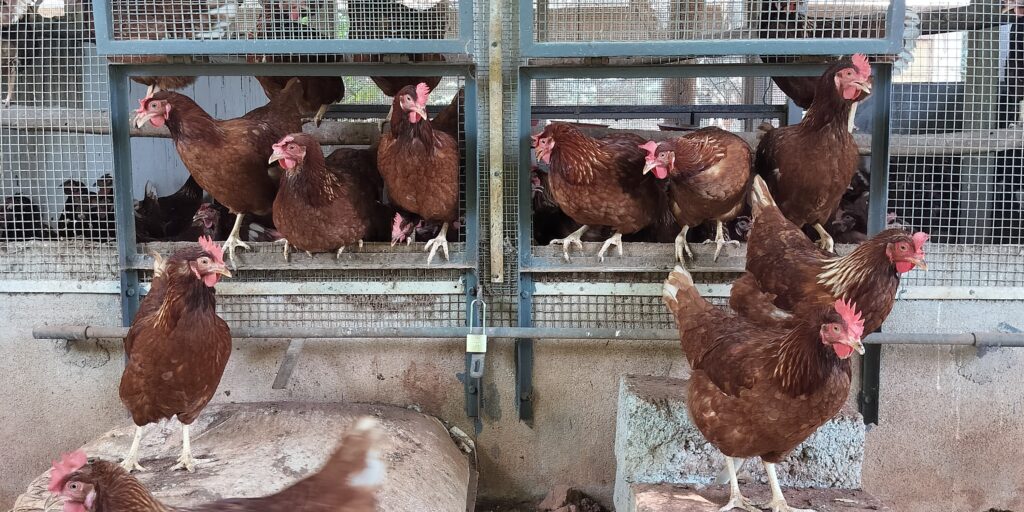
Previously, I wrote about the dilemmas of working with animals in agriculture, emphasising that the question is not so much whether to work with animals, but how to do so responsibly. Our poultry raises many of these questions, and none of them have simple or fixed answers. We are discovering what is possible today, while also reflecting on what the ideal might be for animals in agriculture in Auroville. Home » Blog » Frequently Asked Questions about Eggs from AuroOrchard Frequently Asked Questions about Eggs from AuroOrchard February 2026 · Anshul Aggarwal Previously, I wrote about the dilemmas of working with animals in agriculture, emphasising that the question is not so much whether to work with animals, but how to do so responsibly. Our poultry raises many of these questions, and none of them have simple or fixed answers. We are discovering what is possible today, while also reflecting on what the ideal might be for animals in agriculture in Auroville. This post responds to questions we have received over time from community members and visitors about our poultry and eggs. If you have further questions, please write to us at auroorchard@auroville.org.in, and we will include them here. What do terms like caged, cage-free, and free-range mean? These terms describe how birds live: Caged systems keep birds in small cages with very limited movement. Cage-free systems remove individual cages but usually keep birds indoors in large sheds. Free-range systems, like ours, allow birds regular outdoor access where they can walk, forage, scratch, and dust-bathe in sunlight and fresh air. Each system reflects different priorities— efficiency, space, labour, and care. How is free-range different from organic? Free-range describes how birds live (access to outdoor space, ability to forage and express natural behaviours). Organic describes what goes into the system, especially feed and inputs. In most organic standards, birds must also have outdoor access, but “free-range” eggs are not necessarily organic unless the feed and inputs meet organic requirements. What kind of poultry system does AuroOrchard follow? AuroOrchard follows a free-range, pasture-based approach integrated with the orchard. Birds live outdoors for much of the day and are rotated through designated areas. Poultry is part of the farm ecology, contributing to nutrient cycling, composting, and soil health, and is not treated as a standalone “production unit”. What is the origin of the concept of ‘free-range’? Traditional agricultural communities naturally followed the free-range poultry system where chickens ran around the yards around the house. This changed drastically across the world as agricultural production became more organised, mechanised, and industrialised. The modern concept of “free-range” arose in the mid-20th century after the Second World War, particularly in the United States and Europe, as poultry farming became industrialised and egg and meat production shifted toward: Battery cages Indoor confinement High stocking densities Controlled lighting and feed Maximum output per bird These systems prioritised efficiency over natural behaviour. “Free-range” developed as a counter-term, meant to distinguish birds that were not permanently confined indoors or in cages, for regulatory and marketing distinction. As a regulatory and market label, “free-range” generally means: The hens are not kept in cages or indoor confinement. They have access to space to roam, graze, and engage freely with their environment having a greater contact with sunlight, fresh air, and soil. Free-range systems promote: Behavioural freedom and enrichment (Hartcher & Jones, 2017) Because these birds live as birds should, many community members report a richer flavour than the ones produced in factory conditions (Comparison of AuroOrchard eggs with Pondy eggs). What free-range standards does AuroOrchard follow? We follow Certified Humane standards, which are among the most comprehensive and widely-recognised animal welfare standards for laying hens globally, and we undergo annual audits. AuroOrchard (per 100 birds) Certified Humane Standard (per 100 birds) Indoor Space 15 sq. m. 14 sq. m. Outdoor Space 200 sq, m. 19 sq. m. Outdoor time 6 hours (10 am to 4 pm) 6 hours Indoor Perching Space 17 m 15 m Nesting area 2 sq. m. 0.8 sq. m. Feeder space 4 m 4 m Drinker space 2 m 2 m Other specific details about lighting, daily care, biosecurity, record maintenance for better follow up, egg collection and sorting standards etc. can be found here. What do the birds eat? The birds have access to a feeder where they can eat anytime during the day. The feeder is refilled twice a day in the morning and the afternoon. This feed is bought from commercial feed suppliers. We have tried to get the exact composition of the feed but none of the feed suppliers give this information. Instead, they have given us a general nutritional profile: Crude Protein: 16–18% Crude Fat: 2.5–5%Crude Fibre: 4–7% Metabolizable Energy: 2,600–2,800 kcal/kgCalcium: 3.5–4.5%Available Phosphorus: 0.35–0.50 The supplier has also assured us that the feed is free from any avian- or mammalian-derived protein, and any growth promoters and sub-therapeutic antibiotics. In addition, the birds are also fed daily with a diversity of green leaves (Moringa, Papaya, Wild Tamarind etc.). The birds also eat wild grasses, worms and everything else that they forage in the free range. Why doesn’t AuroOrchard produce its own poultry feed? While this would be ideal, AuroOrchard doesn’t grow grains and does not have the right soil conditions and is set up to do so. If we buy grains from other farms, the feed cost will be very high and will immediately affect the price of the egg. We have been exploring (without much success though) if we can get someone to make the feed for us so that we can ensure what exactly goes into the feed. Are AuroOrchard eggs organic? No. We do not claim that the eggs are organic. Since the feed is bought from outside and we have no way to say with 100% certainty that this feed is organic, we cannot say that the eggs are organic. Most likely, the grains used by commercial feed suppliers are grown in the so-called conventional manner. Are antibiotics or hormones used?